


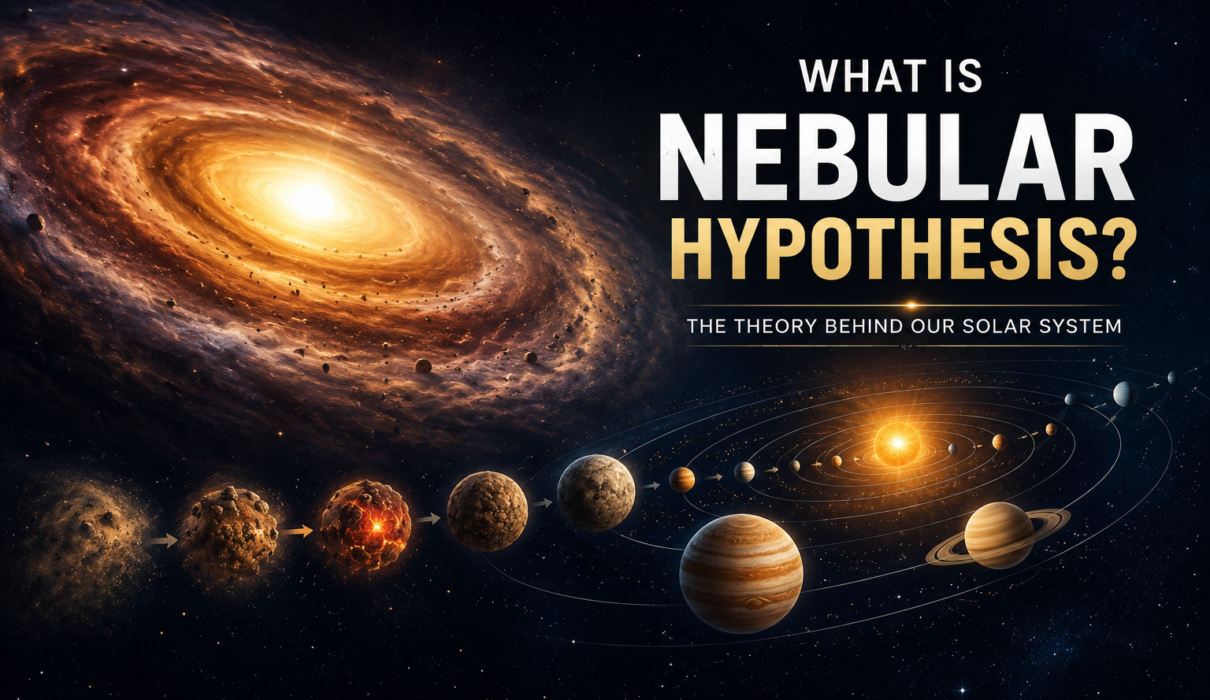
Look up at the night sky and you’re staring at the answer to one of humanity’s oldest questions. Where did we come from? So what is the nebular hypothesis, and why do scientists still lean on an idea that’s over 250 years old? In short, it’s the leading explanation for how our Sun, Earth, and every other planet formed from a swirling cloud of gas and dust. It’s not just a dusty textbook theory either. It’s the same basic process astronomers are watching happen right now, in real time, around baby stars scattered across our galaxy.
Stick with me here, because this isn’t as complicated as it sounds. By the end of this article, you’ll understand exactly what the nebular hypothesis says, who came up with it, why it almost got tossed out, and how modern telescopes basically proved it right.
Key Takeaways
- The nebular hypothesis says the solar system formed from a collapsing, rotating cloud of gas and dust called a solar nebula, roughly 4.6 billion years ago (ALMA Observatory).
- Philosopher Immanuel Kant proposed the idea in 1755, and mathematician Pierre-Simon Laplace refined it in 1796 (Wikipedia).
- The modern version, called the solar nebular disk model, is backed by real images of protoplanetary disks captured by the ALMA telescope array.
- The original theory struggled to explain angular momentum, but later science filled in the gaps.
Table of Contents
What Is the Nebular Hypothesis? A Simple Definition
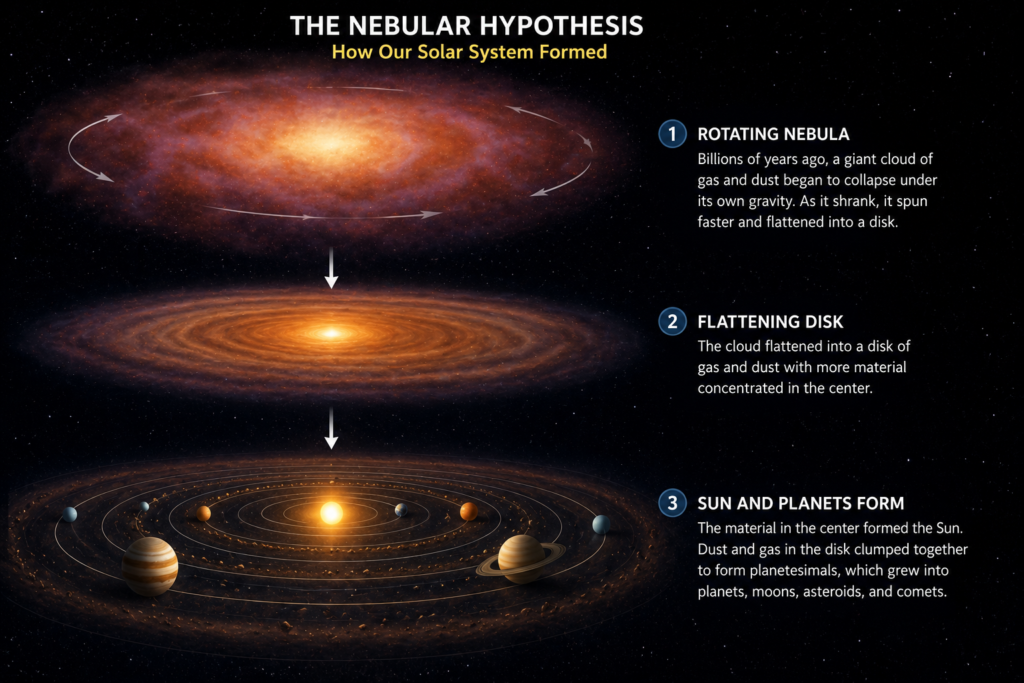
At its core, the nebular hypothesis is the idea that the Sun and planets didn’t just appear out of nowhere. They condensed out of a massive, slowly spinning cloud of gas and dust in space, called a nebula. Gravity pulled this material inward. As it collapsed, it spun faster and flattened out, kind of like pizza dough spinning in the air, until it formed a disk with a dense, hot clump glowing at the center.
That center became the Sun. The leftover material in the disk clumped together over millions of years into planets, moons, asteroids, and comets. Among scientists who study how planetary systems come together, this remains the go to explanation, and Wikipedia lists it as the dominant model in the entire field of cosmogony (Wikipedia).
Here’s the part that surprises a lot of people: this isn’t just a story about our own solar system. Astronomers now believe this same nebular process plays out around distant stars too, which is honestly one of the coolest things about the whole idea. It means the process that built Earth is happening again, somewhere else, right now. If you want the fuller, blow by blow account of that process, we’ve also broken it down separately in how the solar system formed.
Who Discovered the Nebular Hypothesis? Kant and Laplace’s Big Idea
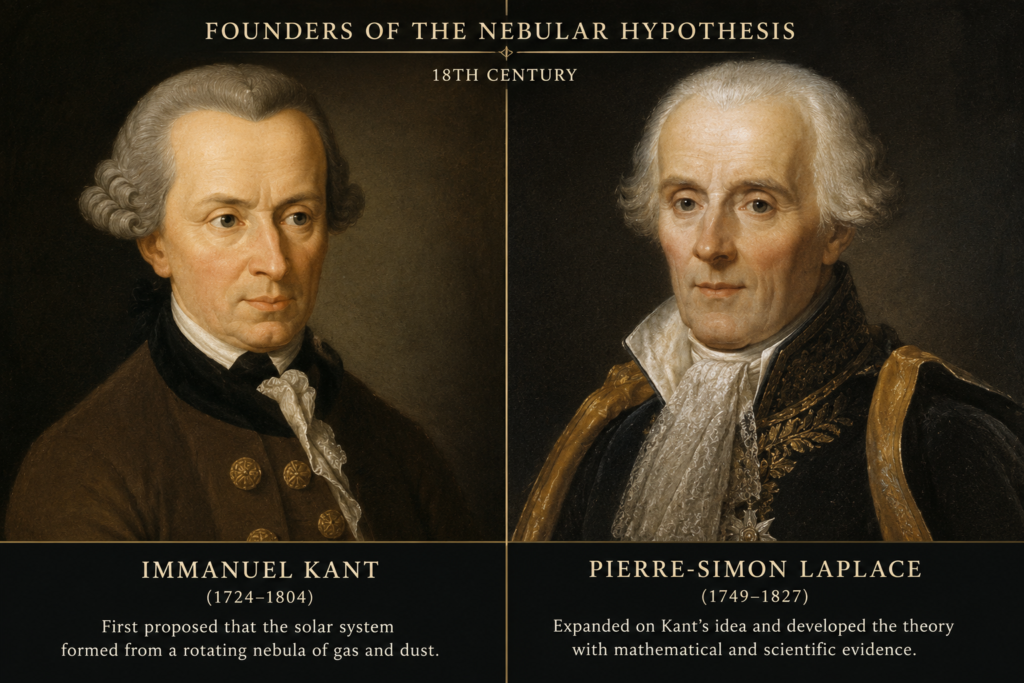
You can’t really talk about what the nebular hypothesis is without giving credit to the two men most associated with it, even though a third thinker got there first.
Emanuel Swedenborg Planted the Seed (1734)
Most articles skip this part, but it’s worth knowing. Long before Kant, the Swedish scientist Emanuel Swedenborg had already sketched out pieces of a similar idea back in 1734. Kant knew Swedenborg’s work and used it as a launching point for his own theory two decades later (Wikipedia). It’s a good reminder that big scientific ideas rarely come from just one person.
Immanuel Kant’s Version (1755)
The German philosopher Immanuel Kant gets most of the historical credit. In 1755, he published a work called Universal Natural History and Theory of the Heavens, where he laid out the core idea that would define the whole theory: a spinning cloud pulled inward by its own gravity, eventually giving birth to both the Sun and the planets around it (Solar System Wiki). Kant’s angle was interesting. He thought the universe started as cold, scattered particles that collided and generated heat through gravity, which is what got everything spinning in the first place.
Pierre-Simon Laplace’s Refinement (1796)
Forty-one years later, French mathematician Pierre-Simon Laplace came at the same problem independently and sharpened it considerably. In his 1796 book Exposition du Système du Monde, Laplace built on Kant’s rough sketch and added a mechanical detail Kant hadn’t nailed down: a hot nebula that cooled, shrank, and squashed itself into a flat disk as it spun (Solar System Wiki). He proposed that as the young Sun contracted, it left behind rings of gas that eventually clumped together into planets. Because their two versions overlap so much, historians usually just call the combined idea the Kant-Laplace nebular hypothesis.
How Does the Nebular Hypothesis Explain Our Solar System?
So, step by step, how does a cloud of space dust turn into Earth, Mars, and Jupiter? It honestly comes down to gravity, spin, and time.
First, a huge cloud of interstellar gas, mostly hydrogen and helium with trace heavier elements, starts to collapse under its own gravity. As it shrinks, it spins faster (physicists call this the conservation of angular momentum, and it’s the same reason an ice skater spins faster when they pull their arms in). That spin flattens the cloud into a rotating disk, with a dense, superheated core at the middle.
That glowing core eventually ignites into the Sun. Meanwhile, the leftover disk material, still swirling around it, starts sticking together in a process called accretion. Tiny dust grains collide and stick. Those clumps become pebbles, then boulders, then planetesimals, and eventually full planets.
Where a planet formed in that disk mattered a lot. Closer to the young Sun, it was too hot for anything but rock and metal to solidify, which is why Mercury, Venus, Earth, and Mars turned out small and rocky. That freshly formed, rocky young Earth then entered a violent stretch of its own history, one we cover in detail in what was the Hadean eon and what Earth was like in the Hadean era.
Farther out, past a boundary astronomers call the frost line, temperatures dropped low enough for ices like water, methane, and ammonia to freeze solid too (Wikipedia, Frost Line). That extra icy material let planets out there grow massive fast, pulling in huge amounts of gas and becoming the gas giants Jupiter and Saturn, plus the ice giants Uranus and Neptune.
It genuinely surprised me the first time I learned that the asteroid belt sits almost exactly where that frost line used to be. That’s not a coincidence, it’s basically a fossil record of where the temperature boundary once was.
What Problems Did the Nebular Hypothesis Run Into?
Now, this theory wasn’t smooth sailing from the start. For about a century it was the dominant explanation, and then scientists started noticing cracks.
The biggest one involved angular momentum. Here’s the puzzle: the Sun holds about 99.9 percent of all the mass in the solar system, yet it’s the planets, especially the four big outer ones, that carry over 99 percent of the system’s total spin, or angular momentum (Britannica). That number still trips people up, mass and spin should track together if everything came from one shrinking cloud, but they don’t, at least not in the simple original version of the theory. Basically, if the Sun formed the way Kant and Laplace described, it should be spinning much faster than it actually does.
On top of that, 19th century astronomers discovered:
Asteroids with wildly eccentric, tilted orbits that didn’t fit a neat, flat disk model, along with moons orbiting some planets backward, in the opposite direction of their planet’s spin. That same leftover debris field is also the reason young Earth got pummeled so hard early on, a period we dig into in what is the late heavy bombardment.
Both discoveries directly contradicted the tidy, orderly picture the nebular hypothesis originally painted, and by the early 20th century, the theory had fallen out of favor. Scientists briefly floated a rival idea called the tidal or collision theory, suggesting a passing star nearly collided with the Sun and dragged out the material that became the planets. That theory didn’t hold up either.
Is the Nebular Hypothesis Still True Today?
Yes, and this is where it gets genuinely exciting. Scientists went back to the drawing board through the mid 1900s, and researchers like Victor Safronov worked out how magnetic fields and turbulence in the disk could transfer angular momentum outward, solving the puzzle that had stumped Kant and Laplace. That fix gave rise to what’s now called the solar nebular disk model, or SNDM, which is essentially the nebular hypothesis 2.0.
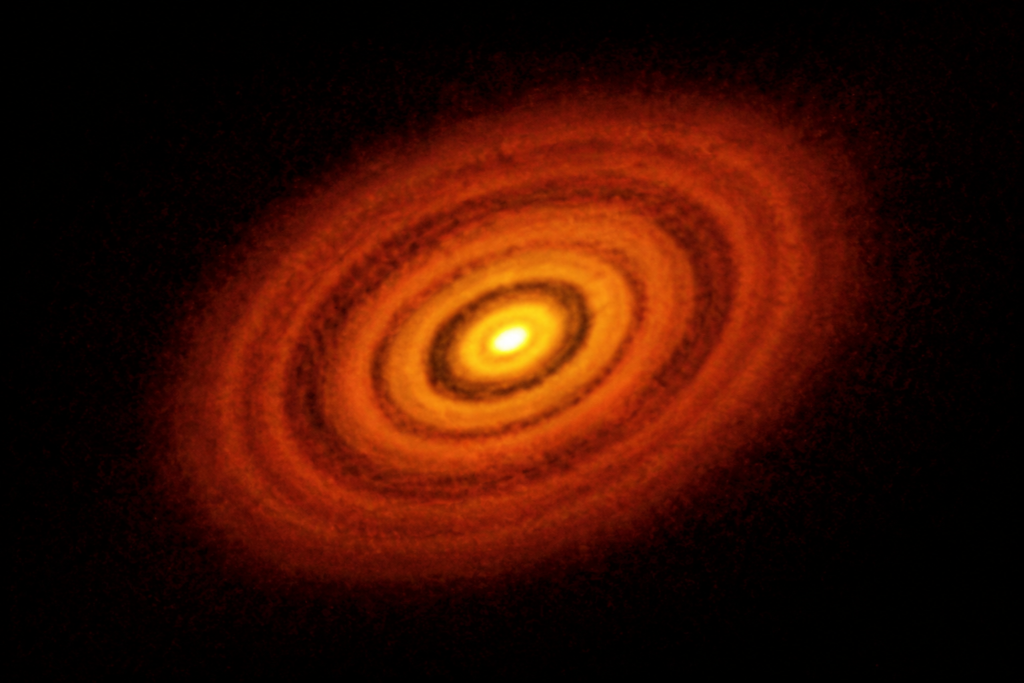
And we’re not just taking this on faith anymore. In 2014, the ALMA telescope array in Chile captured the first high resolution image of fine structure inside a protoplanetary disk, around a young star called HL Tau, and it looked almost exactly like textbook diagrams of the early solar system.
Since then, ALMA has imaged dozens more disks with visible rings and gaps carved out by forming planets. In one recent survey, astronomers pointed ALMA at 19 young protostars specifically hunting for early signs of planet formation. Every single one turned out to have a disk around it, which tells researchers that the basic ingredients needed for planets to start building were already sitting there, even at that early stage (ALMA Observatory).
Put simply, we’re watching baby solar systems form the exact way Kant guessed nearly 300 years ago, minus a telescope. That’s a wild thing to sit with for a second.
A physics course at UNLV sums it up well: with so many protoplanetary disks turning up wherever astronomers look at star forming regions, there’s little doubt left that the basic nebular hypothesis describes both our solar system and planet formation everywhere else in the universe (UNLV Physics).
Why the Nebular Hypothesis Still Matters
This isn’t just ancient history for astronomy nerds. The nebular hypothesis is the backbone for how scientists study exoplanets, the thousands of planets discovered orbiting other stars. When researchers spot a protoplanetary disk around a distant star, they’re essentially looking at a photograph of what our own solar system looked like 4.6 billion years ago. It also helps explain practical, everyday facts you might not connect to space science, like why Earth has water (a story we pick up in how Earth’s first oceans formed), why Jupiter is mostly gas, and why the asteroid belt exists where it does instead of being a planet itself.
Understanding what the nebular hypothesis is also gives you a sturdier way to think about scientific theories in general. Good science doesn’t collapse the moment a flaw shows up. Kant and Laplace got a huge amount right with 18th century tools and zero space telescopes, and later generations refined the parts that didn’t fit rather than throwing the whole idea away. That’s really the story of how science works.
Frequently Asked Questions
What is the nebular hypothesis in simple words? It’s the idea that the Sun and all the planets formed from a giant, spinning cloud of gas and dust in space, called a solar nebula, that collapsed under gravity roughly 4.6 billion years ago (kpiasacademy.com).
Who first proposed the nebular hypothesis? Immanuel Kant proposed it in 1755, and Pierre-Simon Laplace independently developed a similar version in 1796. Together they’re often credited as the Kant-Laplace nebular hypothesis (Britannica).
Is the nebular hypothesis a fact or a theory? It’s a scientific theory, meaning it’s a well tested explanation backed by strong evidence, including direct telescope images of similar disks forming around other young stars.
What problem almost disproved the nebular hypothesis? The distribution of angular momentum. The Sun holds nearly all the mass in the solar system but very little of its spin, which didn’t match early versions of the theory until later physics explained how that spin transferred outward into the planets.
Does the nebular hypothesis apply to other solar systems too? Yes. Astronomers now use the same nebular process, called the solar nebular disk model, to explain how planets form around stars across the galaxy, not just our own Sun.
Keep Reading: What Happened After the Solar System Formed
The nebular hypothesis explains how we got a Sun and a rocky third planet. What happened on that rocky planet next is its own wild story, one worth following if you liked this one:
- What was the Hadean eon?, the violent first chapter of Earth’s history right after it finished forming
- What was Earth like in the Hadean era?, a closer look at the molten, hostile surface of our young planet
- What is late heavy bombardment?, the asteroid and comet impact storm that reshaped the early inner solar system
- How did Earth’s first oceans form?, covering where all that water actually came from
- Did life exist in the Hadean eon?, an honest look at the earliest possible signs of life
- The Hadean atmosphere explained, for what early Earth’s air was actually like
And if you want to fast forward a few billion years to when humans finally showed up, we’ve also covered what human species existed before us, how early humans started fire, how early humans communicated, whether Homo sapiens and Neanderthals interbred, and how climate change affected human evolution.
