


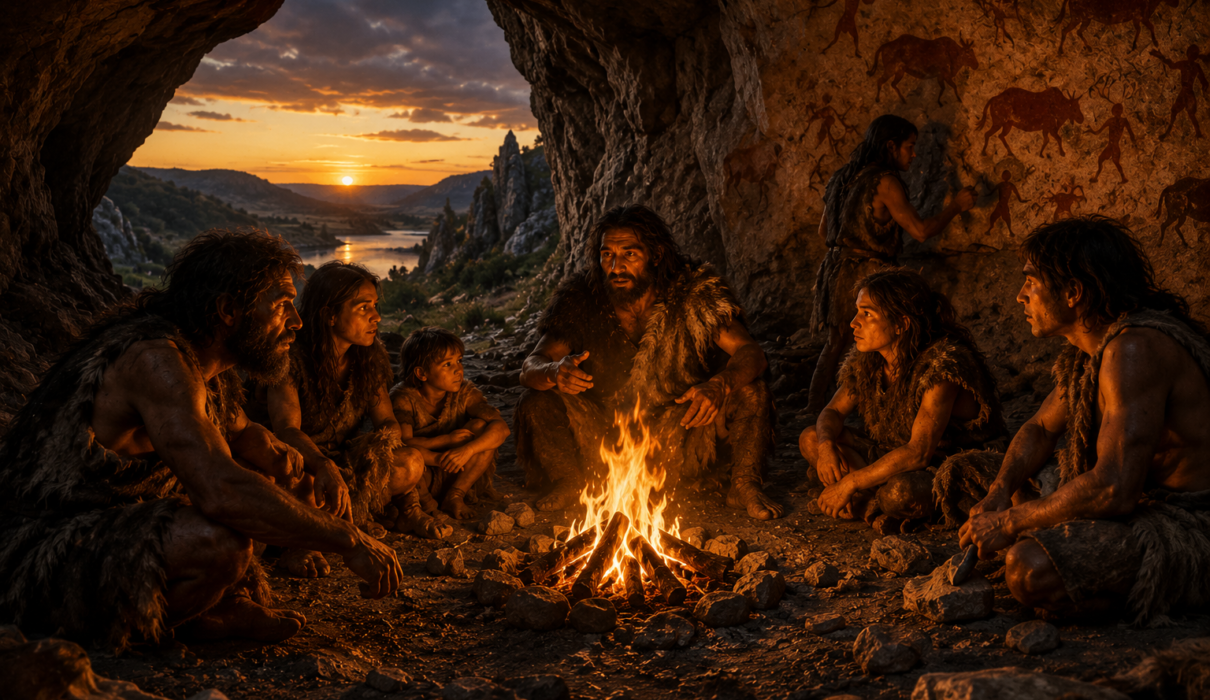
Lightning splits a tree. Grass catches. A band of hominins watches from a distance as the flames die down to embers then one of them creeps closer and refuses to let it go out. That’s how did early humans start fire, in its earliest form not by making flame, but by keeping it?
For most of that history, humans couldn’t strike fire from nothing. They could only tend what nature gave them. Two recent discoveries have rewritten that timeline:
- June 2026 Wonderwerk Cave, South Africa: controlled fire use pushed back to 1.79 million years ago (PLOS One, 2026)
- December 2025 Barnham, England: deliberate fire-making confirmed to 400,000 years ago, 350,000 years earlier than previously known (Nature, 2025)
Here’s what the evidence actually shows no campfire myths, just the research.
Key Takeaways
- Controlled fire use dates back ~1.79 million years at Wonderwerk Cave, based on bone luminescence and infrared analysis (PLOS One, 2026).
- Deliberate fire-making is confirmed to 400,000 years ago at Barnham, England, using iron pyrite and flint (Nature, 2025).
- Early humans used two technologies: friction (hand drills, bow drills, fire ploughs) and percussion (striking pyrite or flint for sparks).
- Cooking via fire likely fueled brain growth the human brain burns ~20% of daily body energy (NBC News, 2025).
Table of Contents
How Did Early Humans Start Fire Before They Could Make It?
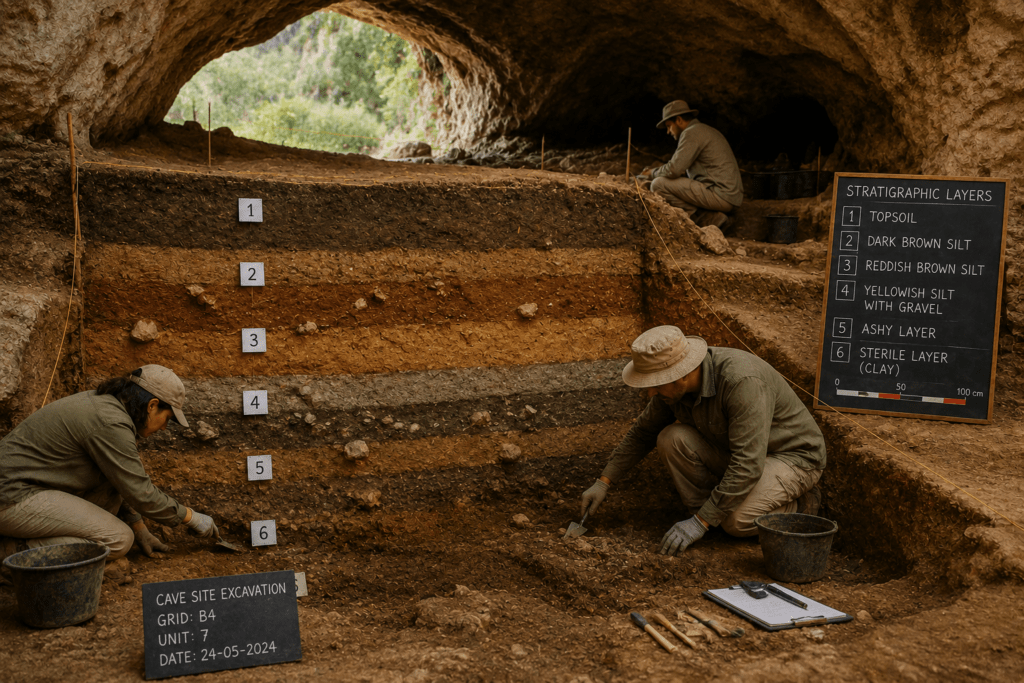
A 2026 study of burnt bones at Wonderwerk Cave found Homo erectus was capturing and tending wildfire-sourced flame as early as 1.79 million years ago (PLOS One, 2026).
- Researchers analyzed 161 fossilized small-mammal bones, many bundled in ancient owl pellets
- Found in two layers more than 30 meters inside the cave too deep for a stray wildfire to reach
- Burnt bones clustered in specific spots, not scattered randomly, pointing to repeated burning events
Early humans had the planning to transport and feed a flame but it would take over a million more years before anyone could strike one from nothing. That gap is the part most explanations skip.
What Methods Did Early Humans Use to Make Fire From Scratch?
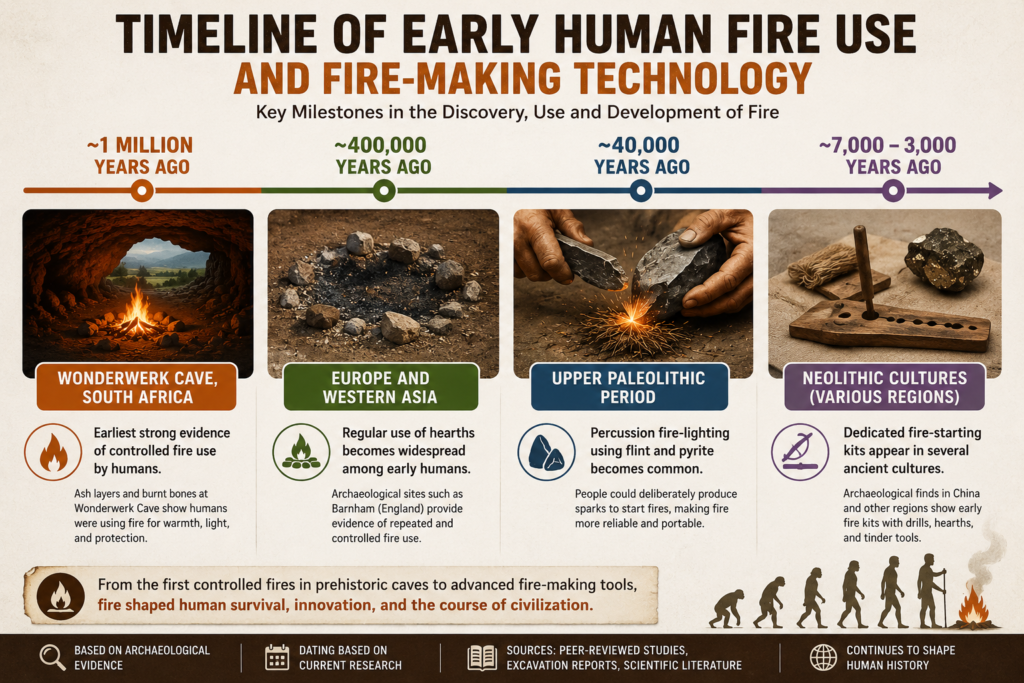
Early humans relied on two physical principles: friction and percussion (University of Reading, 2023).
Friction methods (rubbing wood to create a smoldering coal):
- Hand drill — a wooden spindle spun between the palms into a notched fireboard until dust ignites
- Bow drill — adds a bow and cord for faster, easier spinning, plus a handheld block for pressure
- Fire plough — a stick rubbed back and forth along a groove in softer wood
Percussion methods (striking materials for sparks):
- Iron pyrite against flint — dates back at least 40,000 years, used widely across Europe and Asia (Everything Everywhere, 2025)
- Quartz against flint — also viable, though pyrite’s spark-throwing made it more valuable
Friction tools were wood they rot and leave almost no trace. Percussion tools were stone they survive for millennia. So the fossil record is skewed toward percussion evidence, even though friction was likely used just as often.
Why Did the Barnham Discovery Change the Timeline?
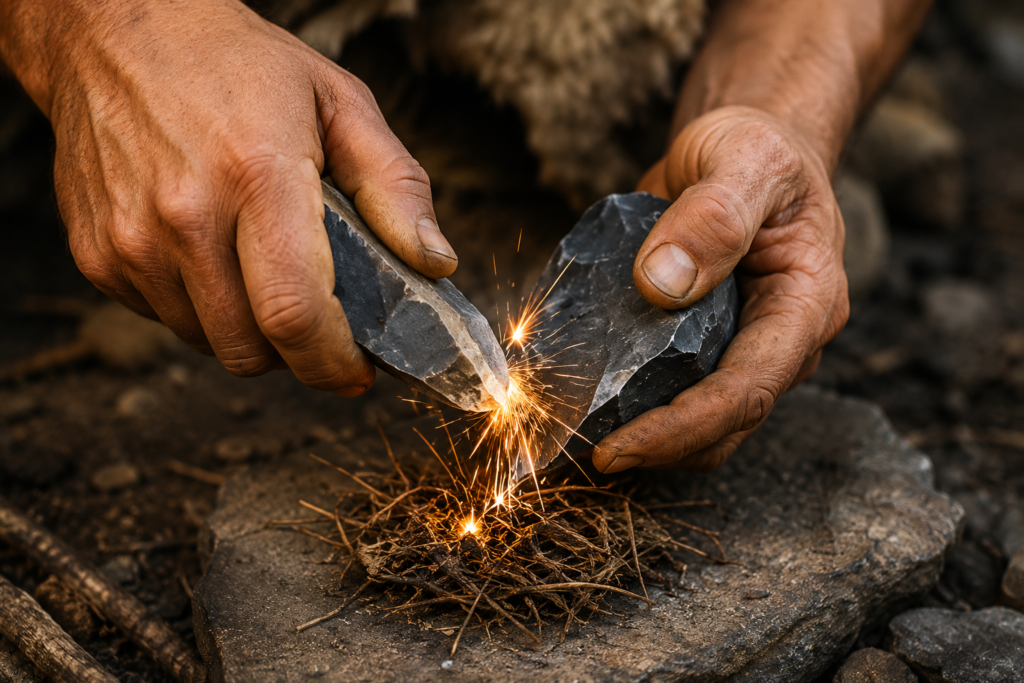
Barnham, in Suffolk, England, produced something almost never preserved: physical proof of deliberate spark-making, dated to ~400,000 years ago. Before this, the oldest confirmed fire-making evidence was only 50,000 years old (NPR, 2025).
- Artifacts found together: scorched earth, heat-fractured flint hand axes, and two fragments of iron pyrite
- Pyrite isn’t naturally found in that area — someone carried it there on purpose (UCL, 2025)
- It took four years of geochemical analysis to rule out wildfire as the cause
- Clay showed repeated heating above 700°C, consistent with a reused hearth, not a one-off blaze (University of Liverpool, 2025)
Lead archaeologist Nick Ashton called it the most exciting discovery of his 40-year career (PBS NewsHour, 2025).
Could Other Early Human Species Have Made Fire Too?
Possibly, but the physical evidence hasn’t surfaced yet. Researchers including Chris Stringer of the Natural History Museum say other groups, potentially early Homo sapiens, may have developed fire-making independently around the same time (NPR, 2025).
Why proof is so rare:
- Ash disperses within years
- Charcoal decays within decades in most soils
- Sediment washes away with rain and groundwater over millennia
Even a 20-year-old campfire ring is hard to identify outdoors today. Multiply that decay by ten thousand, and it’s clear why confirmed sites older than 50,000 years were essentially non existent before Barnham.
Researcher Dennis Sandgathe cautions against overgeneralizing from one site: it proves fire-making capability existed by 400,000 years ago not how widespread it was (NPR, 2025).
How Did Fire Change the Human Body and Brain?
Fire reshaped human biology by making food easier to digest and freeing energy for brain growth. The brain alone uses ~20% of daily body energy (NBC News, 2025).
What cooking does that raw food can’t:
- Breaks down toxins in roots and tubers
- Kills disease-causing pathogens in meat
- Makes plant and animal tissue easier to digest, releasing more usable energy
Harvard anthropologist Richard Wrangham’s “cooking hypothesis” argues this calorie boost let brains grow while guts shrank (Harvard Gazette, 2009). Earlier Wonderwerk Cave findings (burnt bone, ash residue, ~1 million years old) were called “the most compelling evidence to date” for this idea even before the 2026 update pushed the date back further (PNAS, 2012).
How Did Fire Change Human Society and Survival?
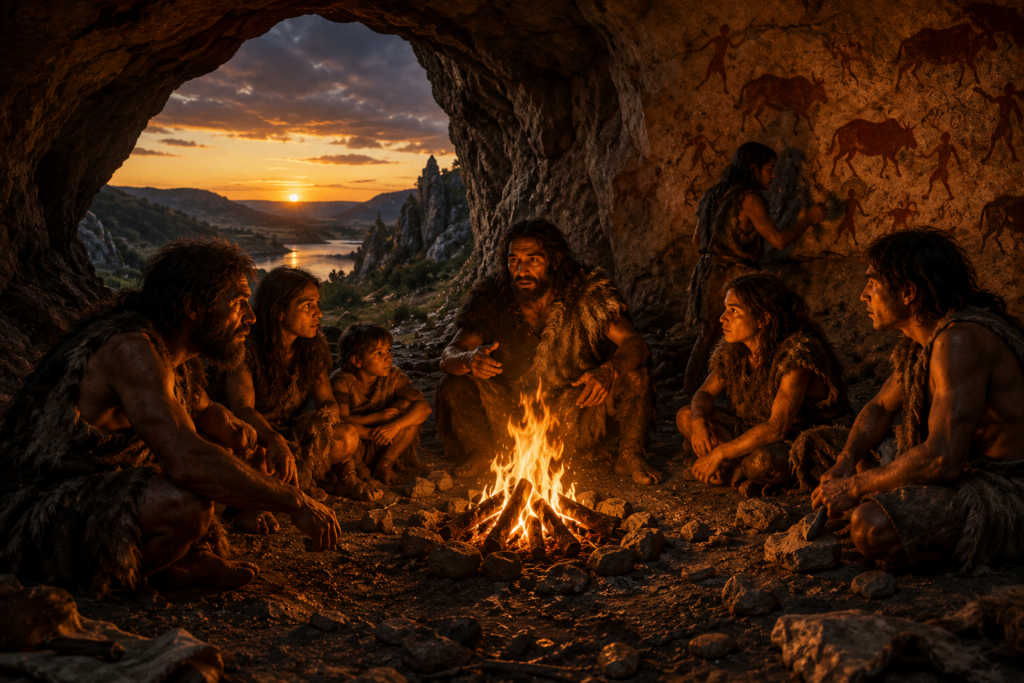
Fire offered more than warmth. It gave early humans a reason to gather after dark (PBS NewsHour, 2025).
What fire made possible:
- Protection — light and heat kept predators at bay after sunset
- Warmth — survival in colder, harsher climates
- Social gathering — evening hearths created space for storytelling and planning, linked to the rise of language and group structure
- Freedom of movement — once fire could be made on demand, groups could choose campsites by resources, not by an existing flame (University of Liverpool, 2025)
Chris Stringer notes the Barnham occupants lived as brain size was approaching modern levels fire’s nutritional and social benefits likely reinforced each other (NBC News, 2025).
What Happened to Fire-Making Technology After the Stone Age?
Friction and percussion methods coexisted for tens of thousands of years before metal tools took over.
- A 7,000-year-old fire-starting kit found in China included a 60-cm drill stick and matching fireboard (ZME Science, 2025)
- By ~200,000 years ago, Homo sapiens used both methods, depending on local materials
- Iron pyrite gave way to flint-and-steel as metallurgy advanced through the Iron Age (Everything Everywhere, 2025)
- None of it fully disappeared the Hadza of Tanzania still use bow drills, hand drills, and fire ploughs today, not as reenactment but as working technology (University of Reading, 2023)
Frequently Asked Questions
How did early humans first start fire?
Early humans first controlled fire by tending naturally occurring flames, likely from lightning-sparked wildfires, as far back as 1.79 million years ago (PLOS One, 2026). They didn’t learn to manufacture fire from friction and sparks until much later.
When did humans learn to make fire instead of just using it?
The oldest confirmed fire-making evidence dates to ~400,000 years ago at Barnham, England — iron pyrite, heat-fractured flint, and scorched clay at one hearth (Nature, 2025). Before this 2025 discovery, confirmed fire-making went back only 50,000 years.
What two main methods did early humans use to make fire?
Friction (hand drills, bow drills, fire ploughs) and percussion (striking iron pyrite or quartz against flint) (Everything Everywhere, 2025). Percussion fire-making is confirmed to at least 40,000 years ago.
Did fire really help human brains grow larger?
Most researchers think so cooking makes food easier to digest, and the brain alone uses ~20% of daily body energy (NBC News, 2025). Burnt bone and ash from Wonderwerk Cave support this “cooking hypothesis,” first proposed by Richard Wrangham.
Why is fire-making evidence so rare in archaeology?
Friction tools were wood, which decays within years or decades (UCL, 2025). Stone percussion tools survive far longer — which is why most surviving evidence skews toward struck flint and pyrite.
Conclusion
So, how did early humans start fire? In stages, across nearly two million years:
- First by tending flames stolen from nature
- Then, by at least 400,000 years ago, by making fire through striking sparks and grinding wood
Along the way, fire reshaped digestion, fueled brain growth, and pulled people into shared circles of light circles that may have planted the seeds of human language and society.
Two major discoveries landed within six months of each other (December 2025 and June 2026), each pushing the timeline back further. “Settled” prehistory rarely stays settled for long.
