


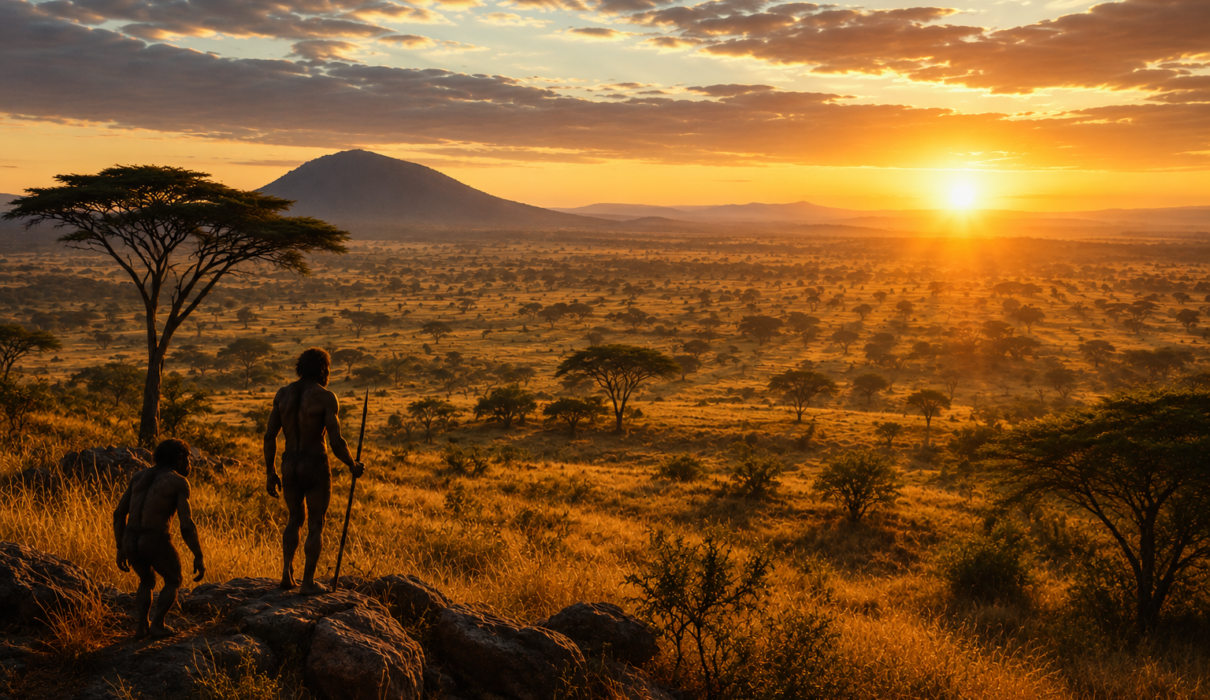
Here’s something that will blow your mind: every single thing that makes you human — your big brain, your upright walk, your ability to use tools exists because of climate change.
Not today’s climate change. Ancient climate change. But the story is eerily similar to what we face now.
About 6 million years ago, our ape-like ancestors lived in lush African forests. Then the climate started shifting. Forests shrank. Grasslands spread. Temperatures swung wildly. Droughts hit. Ice ages came and went.
And every time the climate changed, our ancestors had a simple choice: adapt or die.
The ones who adapted? They became us. The ones who didn’t? They’re extinct.
So when scientists ask “how has climate change affected human evolution?” the honest answer is: in almost every way imaginable. And understanding this history could be the most important lesson we ever learn about surviving the climate crisis happening right now.
Let’s go back in time and bring the science with us.
Table of Contents
Key Takeaways
- Climate change is the 1 driver of human evolution over the past 6 million years, according to the Smithsonian Institution’s Human Origins Program.
- Our ancestors evolved in Africa around 300,000 years ago, during a period of extreme climate instability (Smithsonian Human Origins Program, 2024).
- Brain size increased most sharply during periods of wild climate swings not stability.
- Major human migrations out of Africa were triggered by climate shifts, including green corridors created by warm, wet periods (PLOS ONE, 2013).
- Today’s rapid climate change is already affecting human health, fertility, and disease patterns a potential new chapter in human adaptation.
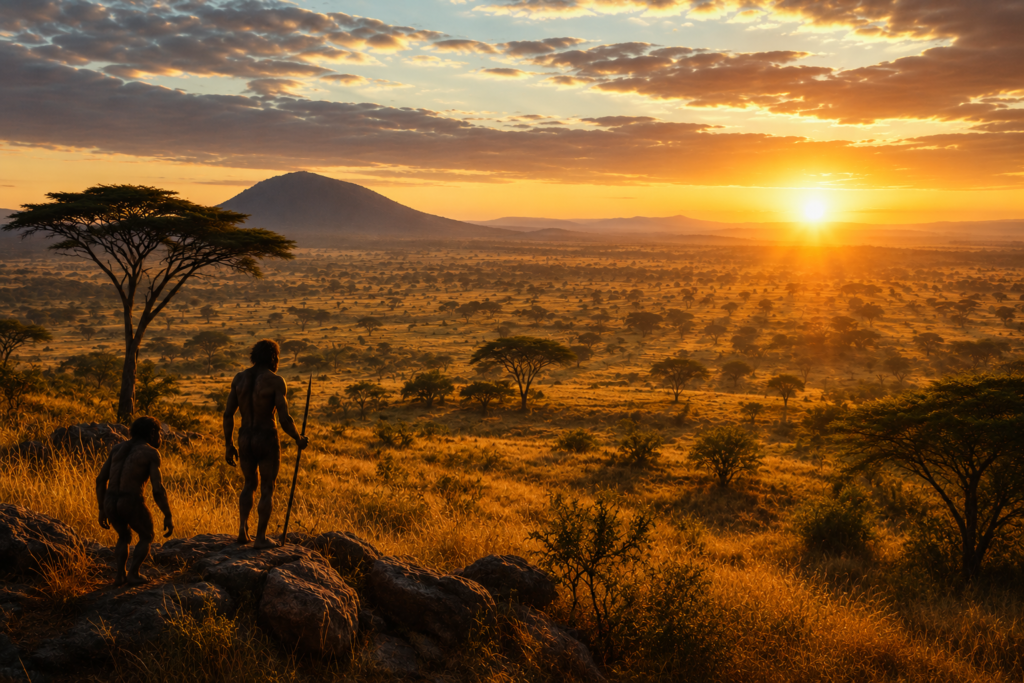
The Secret Theory That Changed Everything We Know About Human Evolution
For decades, scientists believed humans evolved because of one single thing: the African savannah spread, and our ape ancestors had to adapt to open grassland. Simple story. Neat and tidy.
Then Dr. Rick Potts of the Smithsonian Institution’s Human Origins Program proposed something far more interesting.
He called it Variability Selection and it changed paleoanthropology forever.
“Natural selection was not always a matter of ‘survival of the fittest’ but also survival of those most adaptable to changing surroundings.”(Smithsonian Institution Human Origins Program, humanorigins.si.edu 2024)
The idea is straightforward. When climate stays the same for a long time, animals evolve to be really, really good at one type of environment. But when climate keeps changing swinging between wet and dry, hot and cold the animals that survive are the ones who can handle anything.
That’s us. That’s Homo sapiens.
According to the Smithsonian, the origin of every major human species including our own lines up almost perfectly with periods of intense climate variability in the fossil record. Read the full Smithsonian research here.
As University of Liverpool professor Matt Grove explained to Scientific American: “If those events line up with what the climate record tells us were the periods of instability, that would seem to support Rick’s theory. And, in general, they do.”
How Shrinking Forests Made Us Walk Upright
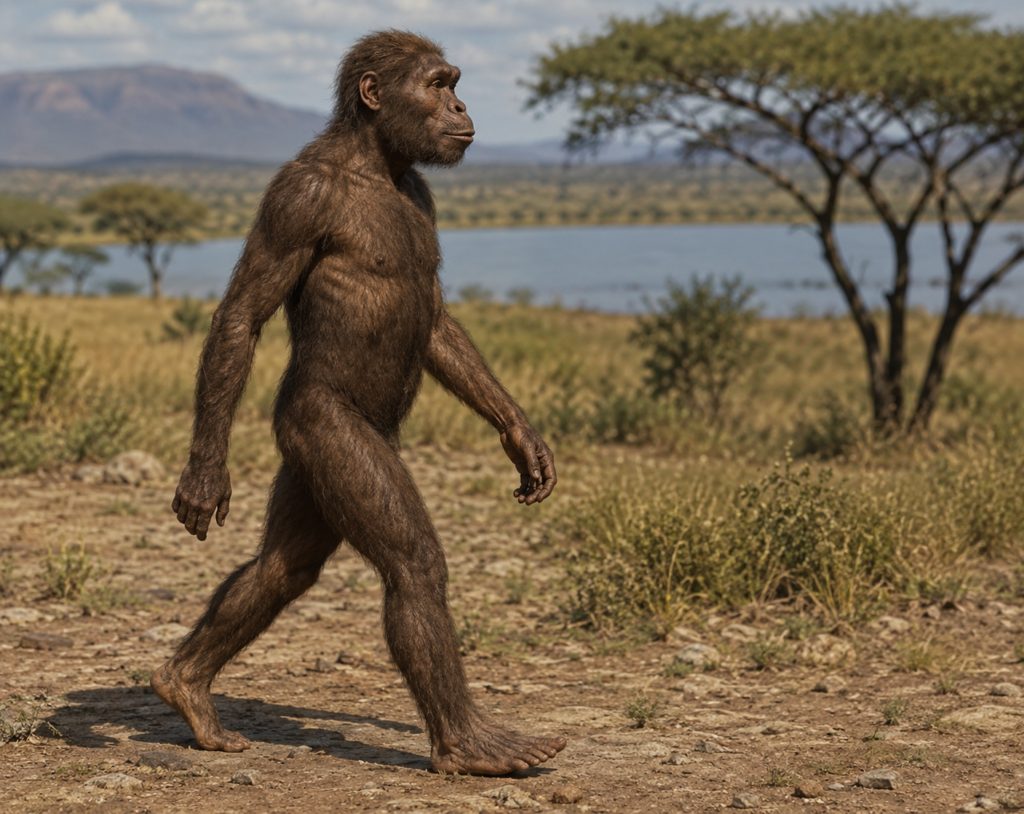
Walking on two legs bipedalism is the trait that scientists say most clearly links to climate change and human evolution. And the story starts with trees disappearing.
Around 6–8 million years ago, a long-term climate shift began cooling and drying out Africa. Tropical forests shrank. Open grasslands savannahs spread across East Africa. Our ape-like ancestors had lived in the trees. Now, suddenly, there were far fewer trees.
Scientists call this the Savannah Hypothesis. The idea is that as forests retreated, early hominins who could walk upright across open ground had a huge survival advantage. They could:
- See predators coming over tall grass
- Travel farther distances to find food and water
- Carry food or tools in their freed-up hands
- Regulate body heat better in the hot, open savannah
A 2023 study in Plant Biology (published in NCBI) found that vegetation changes driven by climate specifically the expansion of open landscapes strongly influenced the evolution of upright walking in our African ancestors.
Now, the savannah hypothesis isn’t perfect. Some early bipeds actually lived in partially forested areas. So scientists now think it’s more of a “mosaic environment” patches of forest AND grassland, driven by unstable climate, that created pressure for flexible movement.
Either way: no climate change, no upright walking. No upright walking, no hands free for tools. No tools , no civilization.
Want to understand how the earliest humans used those freed-up hands? Read our deep dive: How Did Early Humans Start Fire?
Why Our Brains Grew So Fast And Climate Made It Happen
Here’s a question scientists have wrestled with for 150 years: why did human brains get so big, so fast?
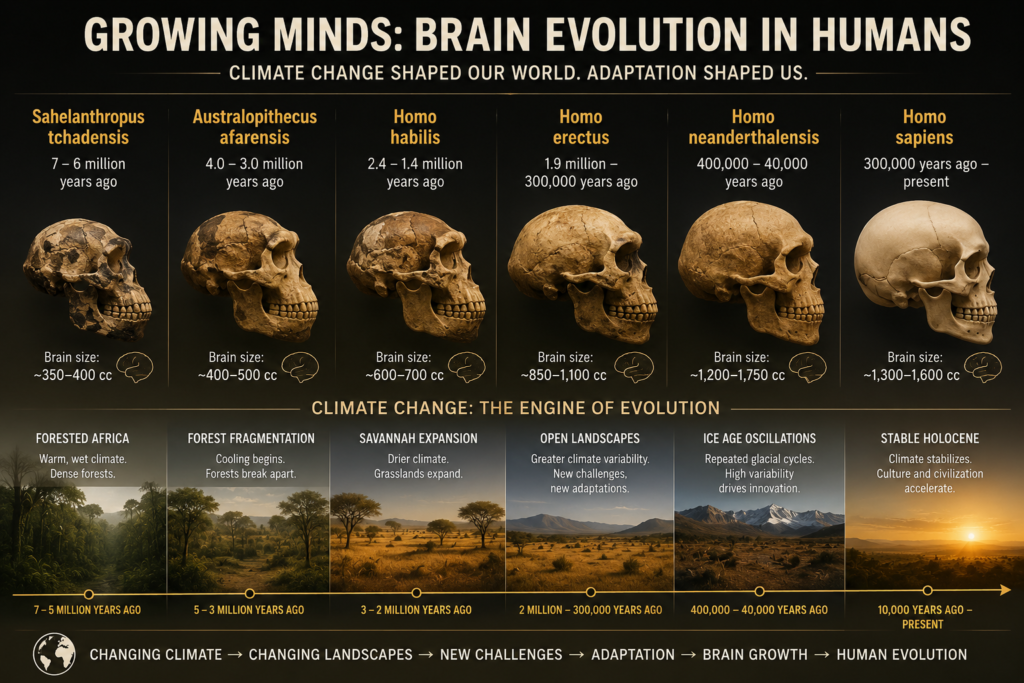
A 2013 PLOS ONE study found a striking answer: the most dramatic episodes of brain expansion in early humans happened during periods of intense climate variability not during stable times. Specifically, a major brain expansion event at approximately 1.8 million years ago coincided directly with rapidly fluctuating lake levels and extreme climate swings in the East African Rift System.
Think about it this way. If your environment is predictable and stable, you don’t need a big brain. A simple brain can handle: eat, sleep, avoid predators. Done.
But when your environment goes crazy droughts, floods, new predators, shrinking food sources you need to think on your feet. You need to plan ahead, solve new problems, cooperate with your group, and invent new strategies. Those are exactly the skills that need a bigger brain.
Key finding: Brain size in Homo expanded most sharply at ~1.8 million years ago exactly when East African climate pulses created extreme environmental variability, including the appearance and disappearance of massive lakes.
Dr. Rick Potts of the Smithsonian puts it this way: “The evolution of the brain is the most obvious example of how we evolve to adapt.” He notes that brain growth wasn’t a steady march it happened in pulses, each pulse coinciding with a period of high climate instability.
The Cooling and Drying That Built Our Minds
Between 3 and 2 million years ago, Africa got colder and drier. Savannah replaced much of the forest that our ancestors had used for shelter. But crucially, the climate didn’t just get dry it became unstable. Warm, wet periods alternated with cooler, dry periods.
Scientists now believe these environmental stresses drove the rapid and steady increase in brain size that accompanied human evolution from early Homo habilis through Homo erectus and, eventually, to Homo sapiens about 300,000 years ago.
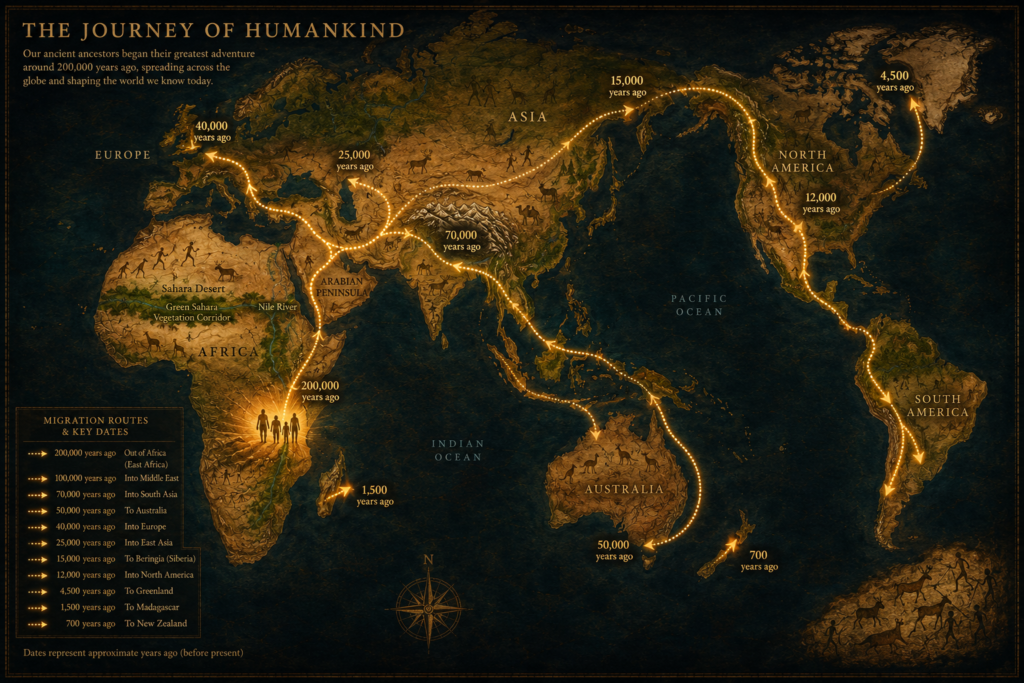
How Climate Change Drove Humans Across the Entire Planet
Our species, Homo sapiens, evolved in Africa around 300,000 years ago during a period of severe climate instability. But how did we end up everywhere? That answer too is written in the climate record.
Scientists now know that the main waves of migration out of Africa began somewhere between 60,000–90,000 years ago and they were timed perfectly with climate windows.
Green Corridors: When the Sahara Turned into a Garden
This might be the most surprising fact in this entire article: the Sahara Desert the largest hot desert on Earth used to be green.
Every 20,000 years or so, the wobble of Earth’s axis creates warm summers in the Northern Hemisphere. This caused regular wet periods when the Sahara filled with lakes, rivers, and grasslands. Elephants, hippos, and early humans moved through freely.
A landmark study published in SAPIENS found that these climate shifts triggered by Earth’s orbital wobble created “green corridors” between Africa and Eurasia. These corridors set the stage for wave after wave of human migration out of Africa.
Source: SAPIENS — Climate Swings Drove Early Humans Out of Africa (and Back Again)
A 2024 Breakthrough: The First Ice Age and the Exodus
In 2024, researchers from the University of Milan and Columbia University published a major finding in the Proceedings of the National Academy of Sciences. They found that the first major glaciation of the Pleistocene approximately 0.9 million years ago directly triggered a massive hominin migration out of Africa.
As the ice age hit, African habitats became unsuitable for hominin occupation. Drought forced our ancestors to move or face extinction. This explains a well-documented “population bottleneck” where hominin numbers dropped sharply just before the big migration.
Source: Phys.org / PNAS 2024 — Migration of hominins out of Africa driven by major glaciation
The Bering Land Bridge and the Americas
The climate-migration connection didn’t stop in Africa. Lower sea levels during glacial periods exposed the Bering Land Bridge connecting Siberia to North America. Humans followed the animals (mammoths, bison) across this temporary land connection, ultimately peopling the entire Americas.
No ice age. No land bridge. No indigenous civilizations in the Americas.
Curious about the ancient human species who came before us and helped map these routes? Explore: What Human Species Existed Before Us?
Climate Stress and the Sudden Birth of Human Technology
Here’s something remarkable: every major leap in human technology has happened during or just after a period of serious climate stress. This is not a coincidence.
The Smithsonian Institution notes that the emergence of stone tool technology coincides directly with a major period of climate change and environmental instability in Africa around 2.6 million years ago.
When resources got scarce when your familiar forest was replaced by dry savannah, when the animals you hunted moved away, when the water sources dried up you had two choices:
- Give up and go extinct (like many species did)
- Invent something new to survive
Our ancestors invented. They made hand axes, fire, spears, and eventually boats. Each invention was a response to a climate-driven challenge.
The Variability Selection Model Predicts Technological Explosions
According to the variability selection hypothesis, periods of high climate instability don’t just grow bigger brains they also trigger explosions in tool diversity and social complexity. During the most climatically unstable periods in the African fossil record, scientists find the greatest diversity of stone tool types.
Later, as global climate showed signs of drying (roughly 60,000–70,000 years ago), we also see greater human migration and with it, the spread of complex symbolic behaviour: art, music, and ritual burial.
What Today’s Climate Change Means for Human Biology Now
So far we’ve talked about the deep past. But here’s the part that should make you sit up straight: climate change is affecting human biology right now and scientists are paying close attention.
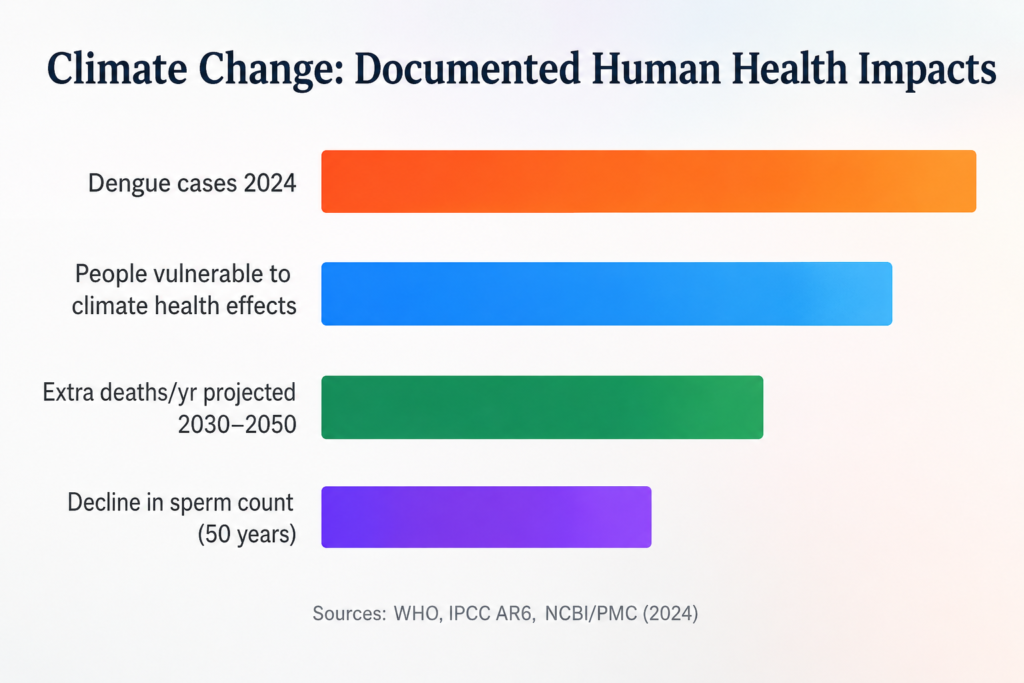
The IPCC’s Sixth Assessment Report (2023) identified that 3.3–3.6 billion people are currently vulnerable to the health effects of climate change. The WHO projects an estimated 250,000 additional deaths per year due to climate-sensitive diseases between 2030 and 2050.
Source: WHO via NCBI/PMC — Impact of Climate Change on Reproductive Health and Pregnancy Outcomes (2024)
Heat Stress Is Challenging Our Immune Systems
A 2024 peer-reviewed study published in Diseases (MDPI) found that rising temperatures are already impairing human immune function. Specifically, elevated temperatures cause immune cells to overproduce inflammatory signaling molecules, contribute to immunosuppression, and reduce the effectiveness of B lymphocytes — the cells that make antibodies.
In other words: the hotter our world gets, the harder it becomes for our bodies to fight disease.
Reproductive Health Under Pressure
A 2024 systematic review in NCBI found that increased exposure to air pollution and extreme temperatures both driven by climate change is consistently linked to reduced fertility, higher rates of miscarriage, preterm birth, and low birth weight.
Global trends over the past 50 years already show a decline in sperm counts and rising rates of pregnancy complications — with climate-driven pollution identified as a contributing factor.
Source: NCBI/PMC — Impact of Climate Change on Reproductive Health (2024)
New Diseases Are Spreading Into New Territories
Dengue fever cases reached a global record high of more than 10 million in 2024 and are expected to keep rising as warmer temperatures expand the range of disease-carrying mosquitoes. Malaria is similarly creeping into new regions. Zoonotic diseases (those jumping from animals to humans) are becoming more likely as climate change disrupts ecosystems.
Source: Association of Health Care Journalists — Climate and Health: Stories to Watch in 2025
Are We Evolving in Real Time? A Nuanced Answer
Can humans evolve fast enough to handle modern climate change? This is the key question and scientists are cautious.
Genetic evolution takes thousands to millions of years. Modern climate change is happening over decades. So our bodies cannot genetically adapt in time.
However, the Smithsonian reminds us of something crucial: humans have a secret weapon that no other species has at this cultural adaptation. Technology, medicine, agriculture, social systems. These are forms of adaptation that work far faster than genes.
A 2024 study from the University of Maine published in ScienceDaily raises a sobering counterpoint, though: the same evolutionary processes that made humans successful group competition, tribal thinking, short-term resource extraction may actively work against the global cooperation needed to solve climate change.
Source: ScienceDaily / University of Maine — Evolution might stop humans from solving climate change (2024)
Frequently Asked Questions About Climate Change and Human Evolution
How did climate change affect early human evolution?
Climate change shaped nearly every major human adaptation. The drying of Africa’s forests drove bipedalism (walking upright) around 6 million years ago. Intense climate swings triggered brain growth at approximately 1.8 million years ago. Climate-driven migration spread Homo sapiens across the planet between 60,000–90,000 years ago. (Smithsonian Institution Human Origins Program, 2024)
When did Homo sapiens first evolve, and what role did climate play?
Fossil evidence from Jebel Irhoud, Morocco (published in Nature, 2017) places the emergence of Homo sapiens at approximately 300,000 years ago during a period of extreme climate instability across Africa. Scientists believe this variability directly pressured the evolution of our larger brains and more flexible behavior. (Smithsonian Human Origins, humanorigins.si.edu)
Did climate change cause humans to leave Africa?
Yes. A 2024 study in the Proceedings of the National Academy of Sciences found that the first major Pleistocene glaciation (~0.9 million years ago) directly triggered hominin migration out of Africa. Later, climate-created “green corridors” across the Sahara and Arabia enabled multiple waves of Homo sapiens migration beginning ~65,000–90,000 years ago.
Is climate change affecting human biology today?
Yes, but through health — not genetic evolution. Rising temperatures impair immune function, increase disease spread, and reduce fertility. Dengue fever hit a record 10 million+ cases in 2024. The WHO projects 250,000 extra deaths per year from climate-sensitive diseases between 2030 and 2050. Genetic adaptation cannot keep pace with the speed of modern climate change.
What is the variability selection hypothesis?
Developed by Dr. Rick Potts of the Smithsonian Institution, variability selection proposes that key human traits — especially our large brains, adaptability, and intelligence — evolved not as responses to a single stable environment, but as responses to wildly fluctuating climates. The most adaptable individuals survived each climate swing, passing on their flexible traits. (humanorigins.si.edu, 2024)
The Bottom Line: Climate Made Us — Can We Return the Favor?
The answer to “how has climate change affected human evolution” is both humbling and electrifying: climate change is human evolution. It gave us our legs, our brains, our tools, and our curiosity. Every time our ancestors faced an unstable climate, the most adaptable ones survived and shaped what we became.
Key things to remember:
- Bipedalism emerged when climate-driven forest loss created open savannahs ~6 million years ago
- Brain size grew fastest during periods of extreme climate variability, especially ~1.8 million years ago
- Waves of human migration out of Africa were directly triggered by climate shifts
- Every major leap in human technology coincided with a period of climate stress
- Today’s rapid climate change is already stressing human health — immune systems, fertility, and disease exposure
Our ancestors survived 6 million years of climate chaos by adapting. The question now is whether we’ll use our extraordinary, climate-forged brains to address the climate challenge we’ve created before it shapes us in ways we can’t predict.

2 Comments