


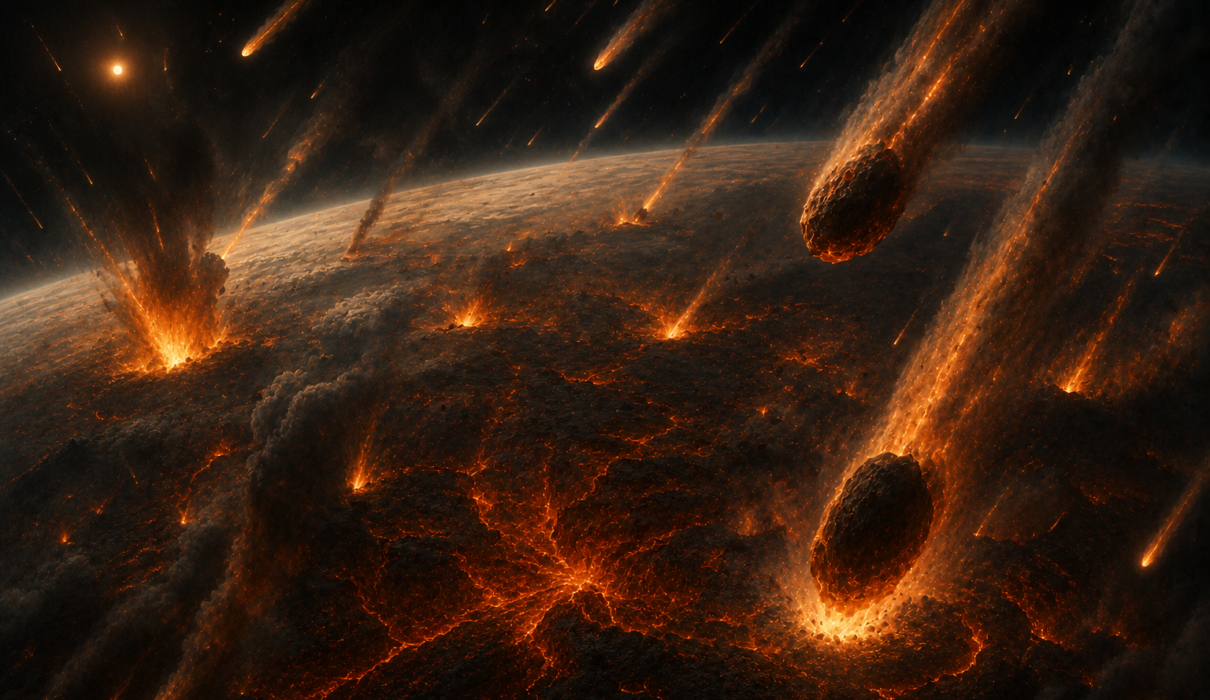
Picture a planet with no oceans, no green grass, and no blue sky just glowing rock, falling space debris, and a sky lit orange from volcanoes. That nightmare world was actually our home. The Hadean Eon was the very first chapter of Earth’s story, and it is so wild that scientists named it after the Greek god of the underworld, Hades.
If you have ever wondered how our calm, blue planet started out, you are about to find out it began as something closer to a horror movie. Stick around, because by the end of this post you will know exactly what the Hadean Eon was, why it happened, and how it secretly set the stage for every living thing on Earth today including you.
Key Takeaways
- The Hadean Eon lasted from about 4.6 to 4.0 billion years ago, marking Earth’s earliest history.
- Earth’s surface was largely molten rock during this time due to asteroid strikes, gravity, and radioactive heat.
- A Mars-sized object called Theia is believed to have smashed into early Earth and formed our Moon (Wikipedia: Giant-impact hypothesis).
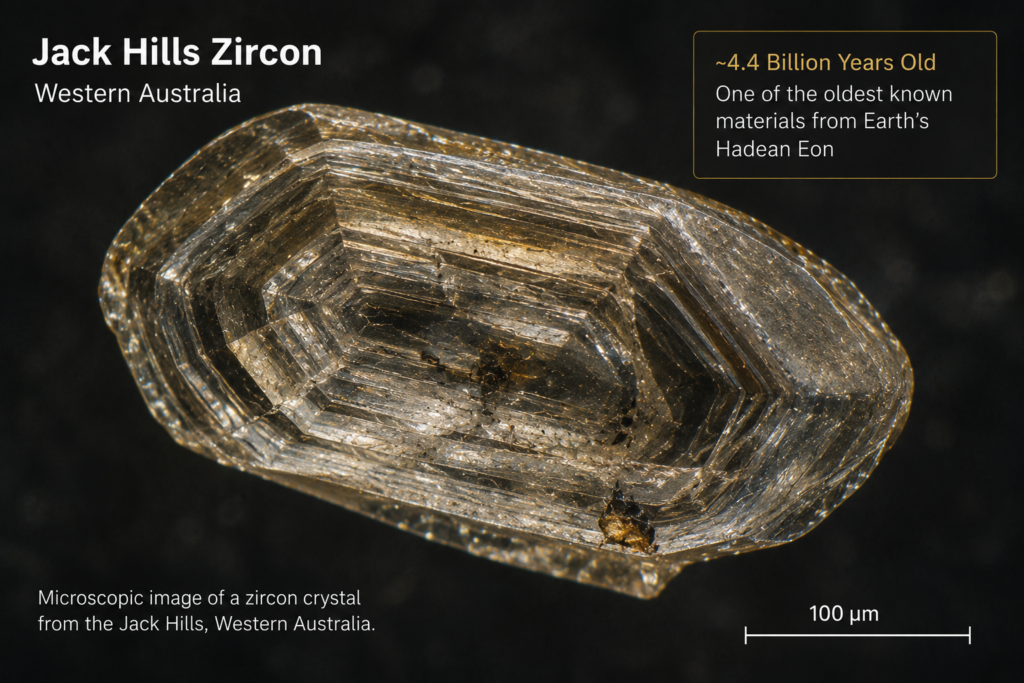
- The oldest known pieces of Earth, tiny zircon crystals from Australia, are about 4.4 billion years old (NASA).
Table of Contents
What Was the Hadean Eon, Exactly?
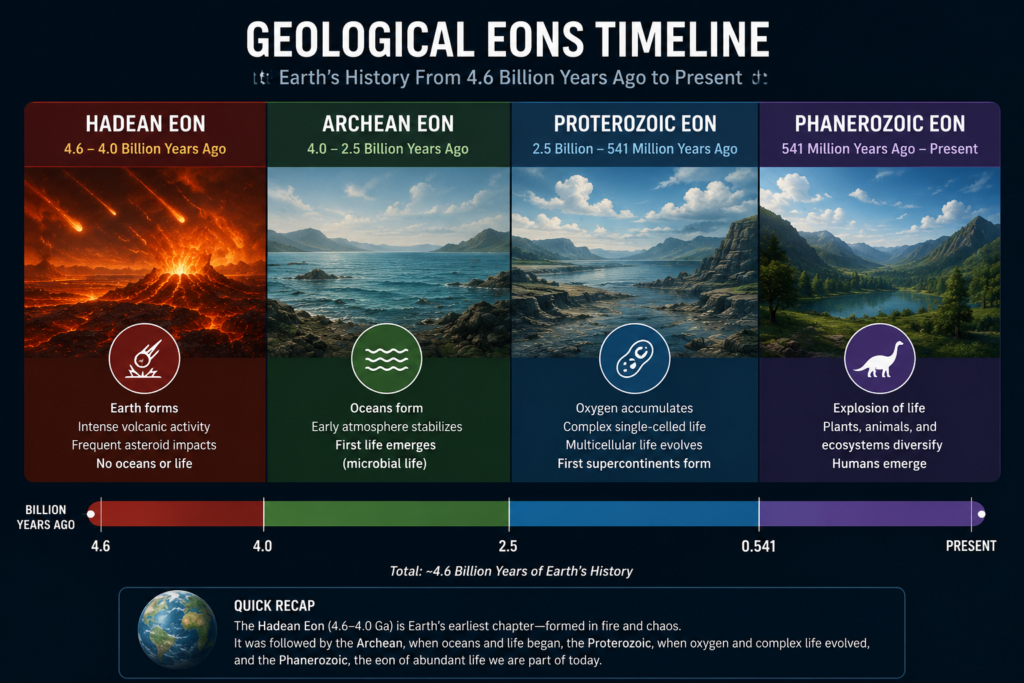
The Hadean Eon was Earth’s first geological time period, stretching from roughly 4.6 billion years ago, when the planet formed, to about 4.0 billion years ago (Britannica). It is not an official period like the ones with dinosaurs or ice ages. Instead, it is an informal label scientists use because almost no rock survives from that time.
During the Hadean Eon, Earth was busy forming its core, crust, oceans, and even its early atmosphere (Britannica). Dust and gas from a giant cloud around the young sun kept slamming together, piling up into the planet beneath our feet today.
Here’s the wild part: we are talking about an eon, which is the largest unit of geological time. One eon can swallow hundreds of millions of years like it’s nothing. That alone tells you how ancient and strange this chapter of Earth’s history really is.
When Did the Hadean Eon Happen?
Most geologists place the Hadean Eon between 4.6 and 4.0 billion years ago, right after Earth itself formed (Live Science). Some sources tighten that window slightly to 4.5–4.0 billion years ago, since exact boundaries are hard to pin down without solid rock evidence (LibreTexts).
To put that in perspective:
- Earth is about 4.54 billion years old.
- The Hadean Eon covers roughly the first 500–600 million years of that history (EarthDate).
- It ends when the Archean Eon begins, the period when Earth’s first solid, lasting rocks start showing up.
So when someone asks what was happening on Earth half a billion years after it formed, the answer is simple: we were still deep in the Hadean Eon, and the planet barely resembled the one we live on now.
Why Is It Called the Hadean Eon?
The name comes from Hades, the Greek god who ruled the underworld, and it is meant to describe just how hellish conditions were back then (LibreTexts Geosciences). Britannica notes the name reflects the “incredibly unstable conditions of Earth’s surface” at the time (Britannica).
Think about it like this: if you could time-travel to the early Hadean Eon, you would not find a single tree, lake, or breath of breathable air. You would find glowing lava fields, falling space rocks, and a sky thick with toxic gas. Naming it after the underworld really is fitting, isn’t it?
This single word Hadean packs an entire horror story into one name, and scientists still use it today whenever they discuss this earliest slice of our planet’s life.
What Did Earth Look Like During the Hadean Eon?
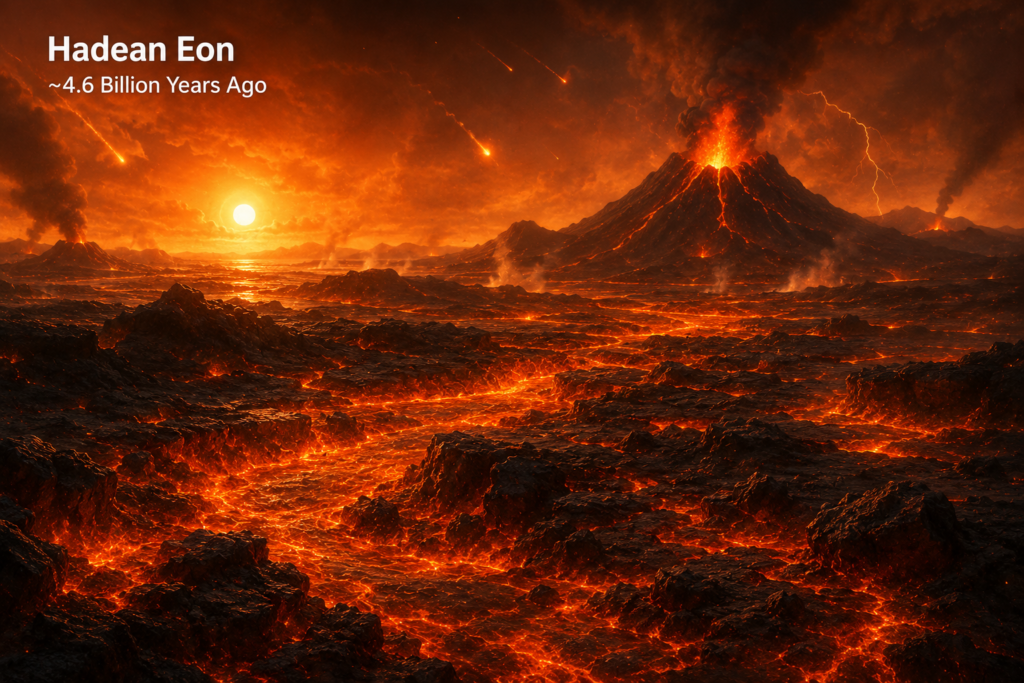
Earth during the Hadean Eon was nothing like the planet we know. Its surface stayed partly molten because of three major heat sources working together: gravitational compression, radioactive decay inside the rock, and constant asteroid impacts (LibreTexts Geosciences).
Some key features of this period include:
- Volcanic chaos – lava oozed across much of the surface instead of solid ground.
- Relentless bombardment – asteroids and comets struck Earth again and again.
- A forming core – heavy iron sank toward the center, building the core we still rely on for our magnetic field.
- A toxic atmosphere – early gases included hydrogen and helium, later joined by ammonia, methane, and water vapor from volcanoes (Britannica).
It’s almost funny to imagine, but a huge chunk of the heat trapped inside Earth right now, the heat that powers volcanoes and earthquakes today, is leftover warmth from the Hadean Eon (LibreTexts Geosciences). Our planet has never fully cooled down from its violent birth.
If volcanic, fiery beginnings fascinate you, you might also enjoy reading about how early humans first learned to start fire, a skill that, ironically, tamed the same element that once defined our planet’s birth.
The Theia Impact and the Birth of the Moon
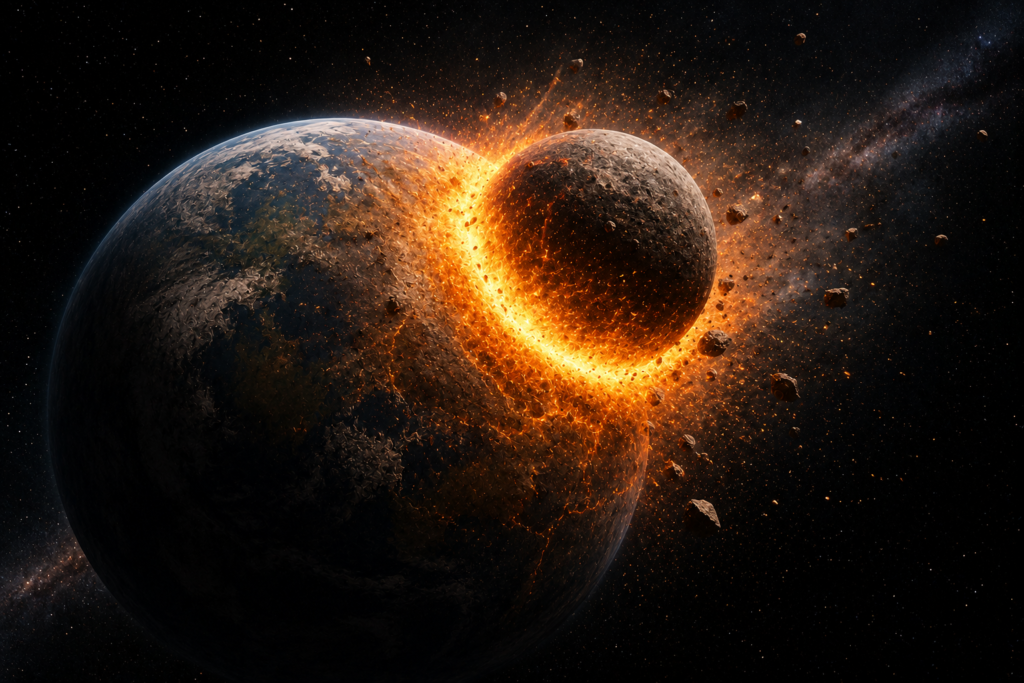
One of the single biggest events of the Hadean Eon was a collision between early Earth and a Mars-sized object that scientists call Theia. This giant impact is believed to have happened around 4.5 billion years ago, somewhere between 20 and 100 million years after the solar system formed (Wikipedia: Giant-impact hypothesis).
The crash was so violent that it melted Earth’s crust and blasted debris into orbit. Over time, that debris clumped together to form the Moon (Earth Site Education). It sounds like science fiction, but it is currently the leading scientific explanation for why we have a Moon at all.
This is not a minor detail, either. Without that Moon, Earth’s tilt and seasons would likely behave very differently, which could have changed the entire path of life on Earth. It’s wild to think a violent crash during the Hadean Eon gave us the same Moon we look up at tonight.
What Evidence Do We Have From the Hadean Eon?
Here’s the tricky part: almost no rocks from the Hadean Eon still exist. Erosion, melting, and plate tectonics destroyed nearly everything from that far back (UC Berkeley Museum of Paleontology).
But scientists did find one tough survivor: zircon crystals. Tiny zircon grains from the Jack Hills region of Western Australia have been dated to about 4.4 billion years old, making them the oldest known material formed on Earth (NASA). A 2014 study using atom-by-atom lead analysis confirmed one crystal’s age at 4.375 billion years, give or take only 6 million years (Live Science).
What makes zircons so special?
- They are nearly indestructible, surviving heat, pressure, and millions of years of weathering.
- Their chemistry hints that liquid water may have already existed during parts of the Hadean Eon (LibreTexts Geosciences).
- The oldest reliably dated whole rock, found in Canada, is about 4.03 billion years old, just slightly younger than the eon itself (Science/AAAS).
So even though the Hadean Eon left almost nothing behind, these microscopic time capsules let scientists peek into a world that otherwise vanished completely.
Was the Hadean Eon Always a Fiery Hellscape?
Honestly? Maybe not the whole time. For decades, scientists assumed the entire Hadean Eon was one long inferno. But zircon evidence is changing that picture.
Researchers studying the chemistry locked inside Jack Hills zircons believe Earth may have cooled enough for liquid water, and possibly oceans, not long after its crust hardened an idea nicknamed the “cool early Earth” hypothesis (Sci-News). That means parts of the late Hadean Eon might have looked surprisingly calm compared to the raging fireball we usually imagine.
Of course, calm is relative here. Later in the eon, Earth and the Moon both seem to have been pummeled again during an event known as the Late Heavy Bombardment, when comets and asteroids battered the surface and possibly destroyed early oceans (It’s a Natural Universe). So Earth’s first 600 million years were less of a steady horror story and more of a rollercoaster between chaos and calm.
Did Life Begin During the Hadean Eon?
This is the question that keeps scientists up at night. Some evidence suggests biological activity could have started before 4.0 billion years ago, right at the tail end of the Hadean Eon, though the most solid microfossil record only begins around 3.5 billion years ago (LibreTexts Geosciences).
A few researchers have even pointed to potentially biological carbon signatures trapped inside a 4.1-billion-year-old zircon from the Jack Hills site, though this remains debated among scientists (Wikipedia: Jack Hills).
Why does this matter so much? Because if life really did get a foothold before the Hadean Eon even ended, it means our planet became habitable far faster than anyone expected squeezing in the start of biology while volcanoes were practically still erupting next door.
It’s a humbling thought: long before dinosaurs, before fish, before anything with eyes, the Hadean Eon may have already been quietly cooking up the first ingredients of life.
How the Hadean Eon Connects to Human History
You might be thinking, “okay, but what does a 4-billion-year-old eon have to do with me?” Quite a lot, actually. Every event afterward the rise of oceans, the first cells, every twist of evolution traces back to conditions set during the Hadean Eon.
Curious how that long chain eventually led to us? You can explore what human species existed before us to see how life’s story unfolded long after Earth finally cooled down. Climate has always been a major driver of change too, and you can see that pattern repeat itself in 7 surprising ways climate change affected human evolution.
Even ancient human relationships echo this theme of dramatic transformation. If you enjoy stories of unexpected mixing and merging, like the planetary collision that built our Moon, you will probably love truths about whether Homo sapiens and Neanderthals interbred.
Quick Recap: Hadean Eon Facts at a Glance
- Time span: about 4.6 to 4.0 billion years ago.
- Named after Hades, the Greek god of the underworld.
- Surface conditions: largely molten, volcanic, and bombarded by space debris.
- Major event: the Theia impact, which likely created the Moon.
- Oldest evidence: zircon crystals around 4.4 billion years old from Jack Hills, Australia.
- Possible milestone: the first hints of life may have appeared near the end of this eon.
Frequently Asked Questions About the Hadean Eon
What was the Hadean Eon known for?
The Hadean Eon is best known for Earth’s molten surface, constant asteroid impacts, and the giant Theia collision that may have formed the Moon, all happening between about 4.6 and 4.0 billion years ago (Britannica).
How long did the Hadean Eon last?
The Hadean Eon lasted roughly 500 to 600 million years, starting with Earth’s formation around 4.6 billion years ago and ending close to 4.0 billion years ago (Live Science).
Is there any rock left from the Hadean Eon?
Almost none. The oldest reliably dated whole rock is about 4.03 billion years old and comes from Canada, while only individual zircon crystals, dated to about 4.4 billion years, survive from earlier in the eon (Science/AAAS).
Did the Hadean Eon have oceans?
Possibly, at least toward its later stages. Chemical clues inside ancient zircon crystals suggest liquid water may have existed before 4.3 billion years ago, supporting the “cool early Earth” idea (Sci-News).
Final Thoughts on the Hadean Eon
So, what was the Hadean Eon, really? It was Earth’s chaotic, molten, asteroid-battered childhood — a period so extreme that scientists borrowed the name of the underworld to describe it. Yet somehow, out of that fire and fury, came the Moon above your head, the oceans below your feet, and possibly the very first sparks of life.
Next time you look up at a calm night sky, remember: this planet wasn’t always peaceful. It clawed its way out of the Hadean Eon, one collision at a time, to become the only home we have ever known.
