


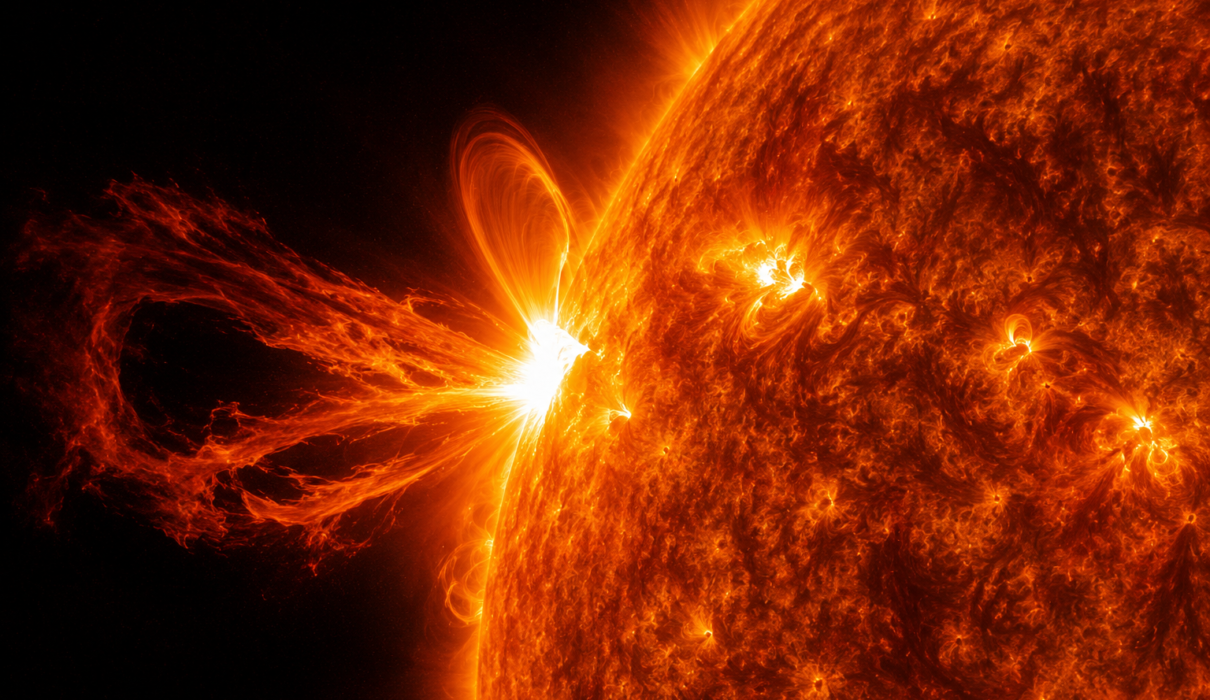
Here’s something wild to sit with for a second. Right now, as you read this, you’re standing on a rock that used to be part of a drifting cloud of gas. So is everyone you’ve ever met. That’s really where the story of the formation of the Sun begins, and it’s a lot stranger, and a lot more violent, than most people ever learn in school.
About 4.6 billion years ago, there was no Sun and no Earth, just a huge, cold cloud of hydrogen, helium, and dust drifting silently through space. Then something disturbed it, possibly a nearby star exploding. Gravity took over, the cloud began collapsing in on itself, and over the next 50 million years it turned into the star that now holds eight planets, dozens of moons, and you, in its orbit. Stick with me here, because by the end of this article you’ll understand exactly how a cold, dark cloud turned into the thing lighting up your sky every single morning.
Key Takeaways
- The formation of the Sun started roughly 4.6 billion years ago inside a collapsing cloud of gas and dust called the solar nebula (NASA Solar System Exploration).
- The Sun holds about 99.8% of all the mass in our entire solar system, which is honestly a bit hard to wrap your head around.
- Nuclear fusion switched on in the Sun’s core once temperatures hit around 15 million degrees Celsius, and that’s the moment it truly became a star.
- Scientists confirm this timeline using meteorite dating, telescope observations of young stars, and computer simulations, not guesswork.
Table of Contents
What Is the Sun?
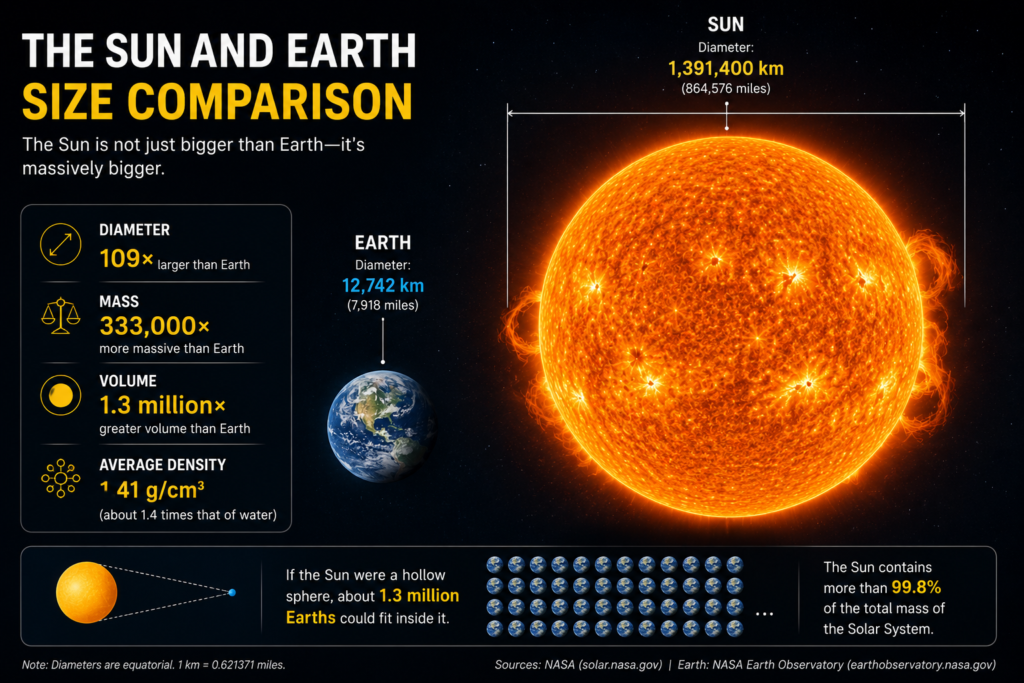
The Sun is the star at the center of our solar system, a massive, glowing ball of hydrogen and helium held together by its own gravity. It isn’t solid like Earth. It’s made of plasma, a super hot state of matter where atoms lose their electrons and float around as charged particles.
It’s also enormous. The Sun’s diameter is about 1.4 million kilometers, roughly 109 times wider than Earth, and you could fit more than a million Earths inside its volume (Space.com). Despite that size, astronomers actually classify it as a fairly average, middle-sized star. There are plenty bigger, and plenty smaller too.
What Is the Sun Made Of?
Once fusion kicked in during the formation of the Sun, it settled into roughly the same composition it still has today.
- Roughly 74% to 75% hydrogen by mass
- Roughly 24% to 26% helium by mass
- Less than 2% heavier elements like oxygen, carbon, and iron
The numbers vary slightly depending on the source you check, which makes sense given how hard it is to measure the interior of a star, but NASA and multiple astronomy references agree the Sun is overwhelmingly hydrogen and helium (Space.com). That single fact still makes me pause every time I say it out loud. Almost everything about the Sun, its heat, its light, the way it holds eight planets in orbit, comes down to just two elements smashing together over and over again.
When Did the Sun Form?
The Sun formed about 4.6 billion years ago, give or take a small margin scientists are still refining. That number isn’t a rough guess pulled from thin air. It comes from radiometric dating of the oldest known solid material in our solar system, tiny mineral grains found inside ancient meteorites (Britannica).
To put 4.6 billion years in perspective, if Earth’s entire history were squeezed into a single 24 hour day, the formation of the Sun would have happened right at midnight, and humans wouldn’t show up until the last few seconds before the next midnight. That comparison still gets me every time I think about it.
Where Did the Sun Come From?
The short answer is a giant molecular cloud. These enormous clouds of gas and dust, sometimes called stellar nurseries, drift through galaxies and are where basically every star, including our Sun, gets its start.
A few things worth knowing about the cloud that eventually became our Sun:
- It was made mostly of hydrogen and helium left over from the early universe.
- It also contained tiny amounts of heavier elements like carbon and iron, forged inside older stars that had already died.
- Astronomers think it stretched across dozens of light years and weighed roughly 300,000 times the mass of the Sun before it started collapsing.
Stellar nurseries like this one aren’t rare or mysterious. We can actually see them happening right now in places like the Orion Nebula, which gives astronomers a live preview of what our own solar system’s birthplace probably looked like.
How Did the Sun Form?
This is the core of the story, and it happened in stages rather than all at once. Breaking the formation of the Sun down into these steps makes the whole process much easier to follow.
Collapse of a Giant Molecular Cloud
Something disturbed the cloud’s balance. Many astronomers suspect a shock wave from a nearby exploding star gave a slow, sprawling cloud the nudge it needed to start collapsing under its own gravity (American Museum of Natural History). Once gravity got the upper hand, dense pockets inside the cloud began pulling in more material, growing heavier, and pulling in even more.
Formation of the Solar Nebula
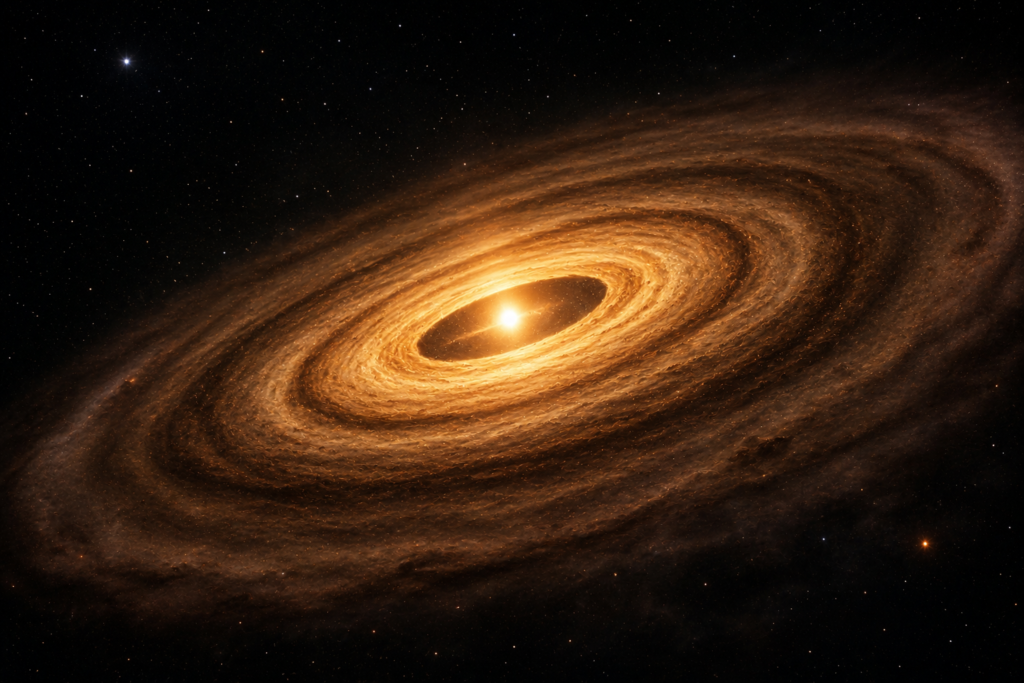
As the cloud shrank, it couldn’t just fall straight inward. It had a tiny bit of spin already, and that spin sped up dramatically as the cloud got smaller, the same way a skater spins faster by pulling her arms in. That speeding rotation flattened the collapsing cloud into a wide, spinning disk known as the solar nebula, with most of the material bunching up in the middle. This whole model, of a spinning disk collapsing into a star with planets forming around it, is what astronomers call the nebular hypothesis, and it’s still the leading explanation for how our solar system came together.
Birth of the Protosun
Once enough material piled up at the center of that disk, it became what astronomers call the protosun, essentially a baby star that’s still gathering mass but hasn’t ignited yet. It glowed a dull red purely from gravitational compression, long before any nuclear fusion started.
Growth Through Accretion
The protosun kept growing through a process called accretion, steadily pulling in more gas and dust from the surrounding disk. Within roughly 50 million years, pressure and temperature at its core climbed high enough to trigger the next stage (Universe Today). During this stretch, the young protosun likely went through a T Tauri phase, throwing off intense stellar winds that swept much of the leftover gas out of the inner solar system (Columbia University).
Nuclear Fusion Begins
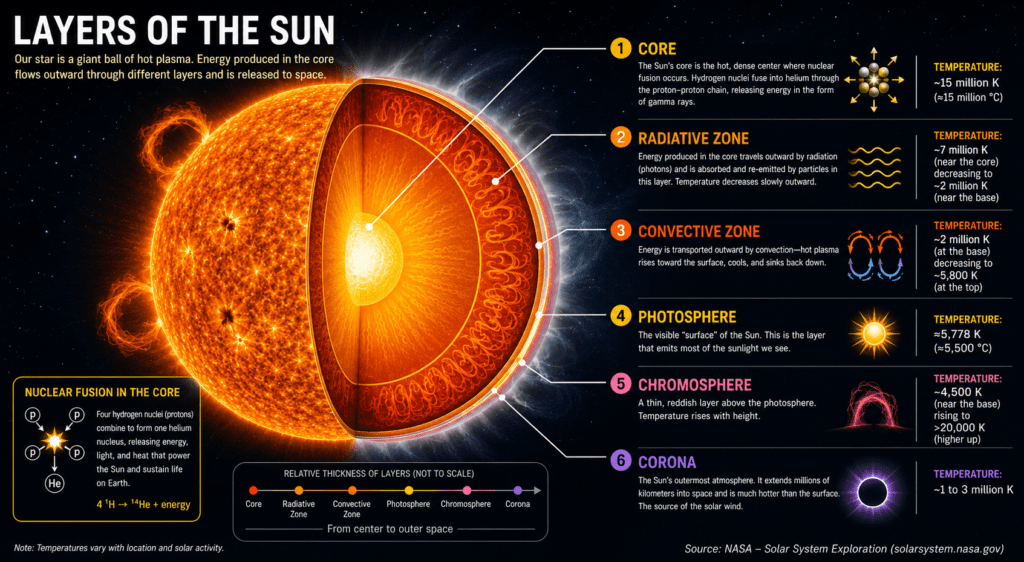
Here’s the moment everything changed. Once the core reached roughly 15 million degrees Celsius, hydrogen atoms started slamming together with enough force to fuse into helium. That fusion reaction releases a staggering amount of energy, and it’s still happening right now, every second, deep inside the Sun.
The Sun Becomes a Main Sequence Star
Fusion created outward pressure strong enough to balance gravity’s inward pull, and that balance is what finally stabilized the Sun into what astronomers call a main sequence star, meaning it steadily burns hydrogen into helium in a stable, long lasting way. This is technically the point where the formation of the Sun wrapped up and its adult life as a star began. NASA notes this balance is the reason the Sun doesn’t collapse under its own weight even today (NASA Science).
Isn’t it strange to think that a process happening 93 million miles away is the reason you can see this page right now?
What Happened to the Remaining Gas and Dust?
The Sun didn’t use up everything in the solar nebula. Leftover gas and dust kept swirling around it in a flattened ring called the protoplanetary disk, and that disk became the raw material for the rest of the solar system.
Closer to the young Sun, it was too hot for gases to stay put, so rocky material won out, which is why Mercury, Venus, Earth, and Mars ended up as dense, rocky worlds. Farther out, past what astronomers call the frost line, ice and gas survived the heat, allowing Jupiter, Saturn, Uranus, and Neptune to grow into gas and ice giants. Smaller leftovers never made it into full planets at all.
Some became asteroids, clustered mostly in the belt between Mars and Jupiter, while icier leftovers further out became comets, many of which still swing through the inner solar system on long, looping orbits today. If you want the full step by step of how that leftover disk turned into eight planets and everything else, we’ve broken it down separately in How Did the Solar System Form.
Evidence for the Sun’s Formation
None of this is just a nice story astronomers made up. Several independent lines of evidence back it up, and they all point in the same direction.
- Observations of young stars: Telescopes have caught other stars in the middle of forming, giving astronomers a live look at stages our own Sun likely passed through billions of years ago.
- Protoplanetary disks: Instruments like ALMA and the Hubble Space Telescope have directly imaged dusty disks surrounding young stars, including the famous rings around the star HL Tauri, which look remarkably like what our own solar nebula probably resembled.
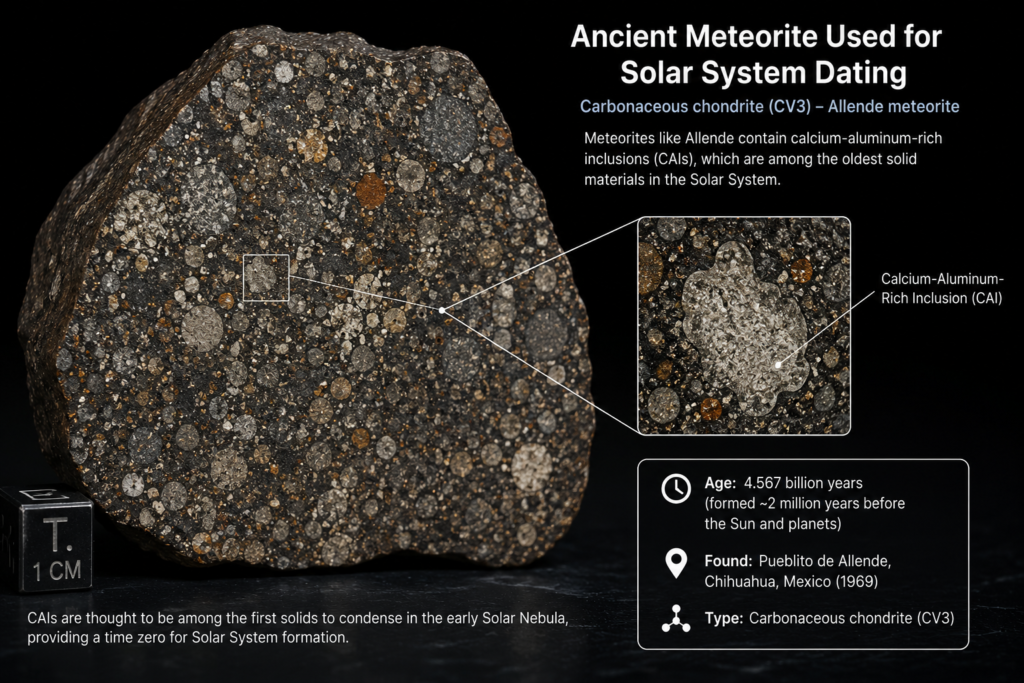
- Meteorite dating: Scientists have used radiometric dating on calcium-aluminum-rich inclusions inside ancient meteorites and consistently arrived at an age of about 4.567 billion years for the oldest solid material in the solar system (Britannica). That figure lines up closely with independent estimates of the Sun’s own age.
- Computer simulations: Researchers run detailed physics simulations of collapsing molecular clouds, and those models consistently reproduce a spinning disk with a dense central star, matching what we observe both in our solar system and around other young stars.
Put together, meteorites, telescopes, and simulations tell a remarkably consistent story about the formation of the Sun, which is honestly one of the more reassuring things about modern astronomy.
How Long Did It Take the Sun to Form?
There’s no single instant when the Sun “finished” forming, but astronomers can point to rough milestones. The initial collapse of the molecular cloud into a flattened disk likely took just tens of thousands of years. Reaching a stable, fusion-powered, main sequence star took considerably longer, somewhere around 50 million years from the first stages of collapse (Universe Today).
Fifty million years sounds enormous, and it is, but compared to the Sun’s current age of 4.6 billion years, it’s a fairly quick childhood. The Sun has now spent roughly 90 times longer as a stable star than it spent forming in the first place.
Why Is Understanding the Sun’s Formation Important?
This isn’t just trivia for astronomy nerds. Understanding how the Sun formed helps scientists explain why the planets sit where they do, why they all orbit in the same direction, and why Earth ended up in the narrow habitable zone that allows liquid water to exist.
It also matters far beyond our own solar system. The same physics that shaped the formation of the Sun is playing out right now around thousands of other young stars across the galaxy, which means studying our own star’s history gives astronomers a working blueprint for how other planetary systems, possibly ones with their own habitable planets, come together. It’s also the starting point for Earth’s own story, since the newly formed Sun set the stage for that brutal, alien first chapter of our planet’s history known as the Hadean eon.
Fun Facts That Bring the Formation of the Sun to Life
- The Sun makes up about 99.8% of the total mass of the entire solar system.
- It takes sunlight roughly 8 minutes and 20 seconds to reach Earth.
- The Sun’s core reaches about 15 million degrees Celsius, while its visible surface sits at a comparatively cool 5,500 degrees Celsius.
- Scientists estimate the Sun is a little less than halfway through its roughly 10 billion year lifespan.
- Every second, the Sun converts around 600 million tons of hydrogen into helium.
Frequently Asked Questions
How long did the formation of the Sun take?
The Sun’s core reached fusion temperatures roughly 50 million years after the solar nebula began collapsing, though it kept settling into its stable, main sequence state for a bit longer after that (Universe Today).
What triggered the collapse of the solar nebula?
Most researchers point to a shock wave from a nearby supernova as the likely trigger, though the exact cause is still debated among astronomers studying similar star-forming clouds today.
Is the Sun still forming or changing?
Not in the way it did billions of years ago. The Sun is now a stable, main sequence star, though it’s slowly getting brighter over time as its core composition shifts.
What will happen after the Sun’s current life stage ends?
In roughly 5 billion years, the Sun will run low on hydrogen fuel and expand into a red giant, likely engulfing Mercury and Venus before eventually shrinking into a white dwarf.
Final Thoughts
The formation of the Sun is one of those stories that makes the universe feel a lot smaller and a lot bigger at the same time. A cold, drifting cloud of gas turned into the fiery star that now keeps every planet, including the one you’re standing on, locked in orbit. It took roughly 50 million years to get from a collapsing cloud to a fusion-powered star, and it’s been quietly burning for 4.6 billion years since. Next time you feel sunlight on your skin, you’re feeling the tail end of a process that started with nothing more than gravity and a bit of cosmic dust.
