


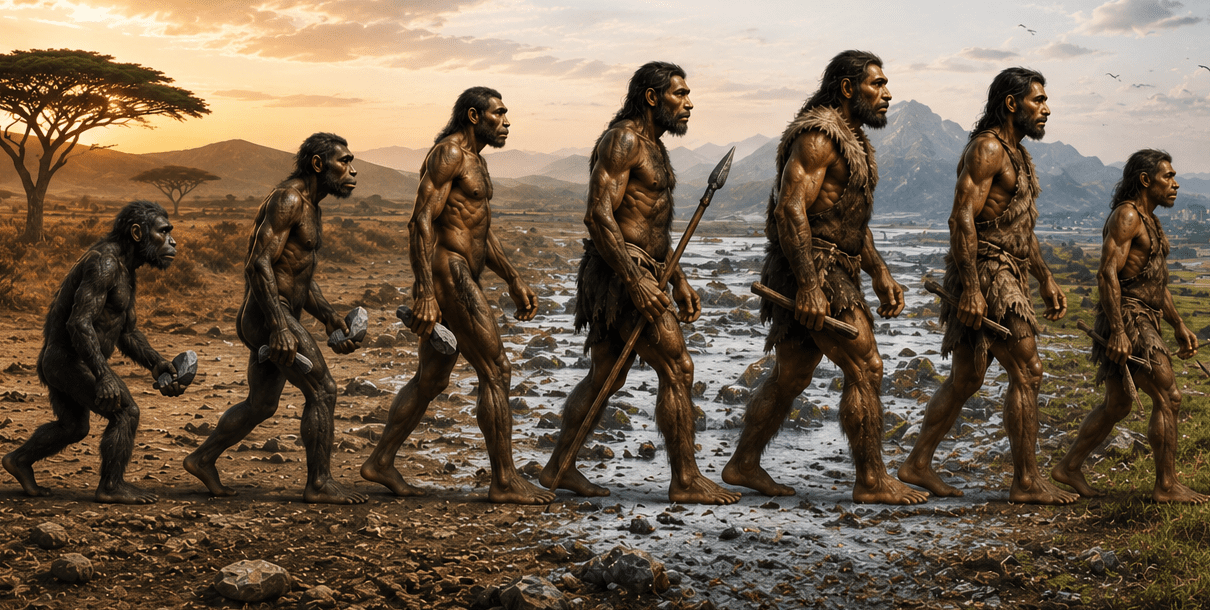
Did you know that around 300,000 years ago, at least 7 different human species were alive at the same time on this planet — and we weren’t even the smartest ones in the room yet?
That’s right. The story of humanity isn’t a straight line from ape to human. It’s a messy, overlapping, surprising family tree full of cousins who hunted, laughed, mourned their dead, and made art — long before modern humans became the only species left standing.
So who were these ancient relatives? What did they look like? Could they talk? And what happened to them?
Buckle up, because this journey through human evolution is wilder than anything you learned in school.
Key Takeaways
- Scientists currently recognise 15–20 distinct early human species (Smithsonian Human Origins Program, 2024)
- Non-African modern humans still carry 1–2% Neanderthal DNA in their genomes today (UC Berkeley / Nature, 2024)
- Homo erectus survived for roughly 1.5 million years — far longer than Homo sapiens has existed so far
- At least 7 human species shared the planet with early Homo sapiens simultaneously, as recently as 50,000 years ago
Table of Contents
How Many Human Species Have Actually Existed?
Most people assume human evolution is a neat progression: ape → cave person → us. But scientists currently recognise somewhere between 15 and 20 distinct early human species, and the number keeps growing with every new fossil discovery (Smithsonian Human Origins Program, 2024). Not all of them are direct ancestors. Many were evolutionary side branches full species that lived, thrived, and eventually disappeared.
Here’s the part that really blows people’s minds: these weren’t primitive cave creatures grunting at each other. Many buried their dead. Some made jewellery. At least one species the Denisovans interbred with our ancestors and left genetic traces that help Tibetans survive high altitudes today.
The human family tree isn’t a ladder. It’s more like a bush branching wildly, with multiple species growing in parallel, and most of them going extinct while Homo sapiens somehow kept going.
Let’s meet the most fascinating ones.
Homo habilis – The First “Handy” Human (2.4–1.4 Million Years Ago)

Evidence of toolmaking in Kenya dates back 3.3 million years, but Homo habilis the first species clearly in the Homo genus appeared roughly 2.4 million years ago (Britannica, Human Evolution, 2025). Their name literally means “handy man” in Latin, named for their habit of making and using simple stone tools a skill that was genuinely revolutionary at the time.
Homo habilis had a brain about 50% larger than their ape-like predecessors (Australopithecus), but they were still pretty small roughly the height of a modern 10-year-old. They walked upright but retained long arms suited for tree-climbing. Scientists debate whether they were hunters or scavengers, but either way, those tools gave them an edge.
Why does this matter? Homo habilis represents the moment our lineage made a fundamental shift: using objects from the environment to solve problems. That tiny cognitive leap shaping a rock into a cutting edge set the entire trajectory of human civilisation in motion.
Homo erectus – The Greatest Survivor (1.9 Million–110,000 Years Ago)

If there’s an MVP of the human family tree, it’s Homo erectus. This species survived for approximately 1.5 million years making it the longest-lived human relative we know of (A Day in History, 2022). To put that in perspective, Homo sapiens has only been around for about 300,000–400,000 years. We’re the newcomers.
Homo erectus was the first human species to leave Africa, spreading across Europe, the Middle East, and Asia. Fossils have been found from Georgia to Indonesia. They made sophisticated tools, likely controlled fire, and some scientists believe they developed early forms of language. Their brain was roughly 75% the size of ours not far off.
The Java Man, discovered in Indonesia in 1891, was one of the first Homo erectus fossils ever found. It showed an ancestor who walked fully upright a discovery that permanently changed our understanding of human origins.
Neanderthals – Our Closest, Most Misunderstood Cousins (400,000–40,000 Years Ago)

Here’s something almost nobody realises: if you’re reading this and you’re not of purely sub-Saharan African ancestry, you are part Neanderthal. Research published in Nature and Science in December 2024 confirmed that most non-African modern humans carry 1–2% Neanderthal DNA in their genomes today the result of interbreeding that peaked roughly 47,000 years ago (UC Berkeley / Nature, December 2024).
And a sweeping 2025 Princeton University study using machine learning to decode ancient genomes found that humans and Neanderthals had been mixing on and off for over 200,000 years, with major waves of contact at 200–250k, 100–120k, and 50–60k years ago (Princeton / Science, July 2025).
Neanderthals weren’t the brutish grunters pop culture painted them as. They:
- Buried their dead — possibly with flowers and grave goods
- Made jewellery from eagle talons and shells
- Cared for their sick and injured (fossil evidence shows elderly individuals with severe disabilities who lived for years, meaning others fed and cared for them)
- Had the FOXP2 gene — the same gene modern humans have for language
- Built shelters and made fire reliably
Their DNA that we still carry isn’t junk, either. Neanderthal genetic variants have been linked to immune system function, skin pigmentation, and metabolism traits that helped early Homo sapiens adapt to the new environments of Eurasia (Reuters, December 2024).
Neanderthals went extinct around 40,000 years ago. The cause is still debated climate change, competition with Homo sapiens, disease, or some combination of all three. But they didn’t disappear completely. They live on in us.
Also read Did homo sapiens and neanderthals breed.
Denisovans – The Mysterious Ghost Humans (300,000–50,000 Years Ago)

The Denisovans are extraordinary for a reason no other species on this list shares: we discovered them almost entirely from DNA, not from complete skeletons. The first Denisovan was identified in 2010 from a single finger bone found in Denisova Cave in Siberia — and genetic sequencing revealed something shocking: here was an entirely unknown branch of the human family (Natural History Museum, London).
What do Denisovans look like? We still don’t fully know. Only a handful of fragments teeth, finger bones, a jaw fragment from Tibet have been confirmed as Denisovan. But their DNA tells a rich story.
They ranged across a massive territory from Siberia to Southeast Asia and they interbred with both Neanderthals and modern humans. Most remarkably, a gene variant inherited from Denisovans, present today in Tibetan populations, appears to help people survive at high altitudes by affecting how the body processes oxygen (Natural History Museum). Without that Denisovan gene, the Tibetan plateau might never have been permanently settled.
Think about this: The Denisovans are technically the most genetically impactful human species we’ve discovered after Neanderthals yet we found them from a finger bone. Scientists estimate there are dozens of ancient human populations we simply haven’t found yet. The family tree is almost certainly far larger than our current 15–20 species count.
Homo floresiensis – The Hobbit Who Was Very Real (700,000–50,000 Years Ago)
In 2003, archaeologists on the Indonesian island of Flores made a discovery that genuinely stunned the scientific world: a tiny adult human skeleton, barely one metre tall, with a brain the size of a grapefruit. They nicknamed her “the Hobbit.” Her species was named Homo floresiensis, and she walked the Earth until just 50,000 years ago almost certainly overlapping with Homo sapiens in Southeast Asia.
Homo floresiensis had a brain capacity of around 400 cc — roughly one-third the size of a modern human brain (LibreTexts Social Sciences, Anthropology, 2022). Yet they made stone tools, hunted pygmy elephants, and possibly used fire. Small brain, big skills.
How did they get so small? Scientists believe it’s a phenomenon called island dwarfism when large animals are isolated on islands with limited food, evolution can favour smaller body sizes over many generations. Think of it as nature’s downsizing strategy.
Homo naledi – The Puzzling Cave Dweller (335,000–236,000 Years Ago)

Homo naledi is one of the most bizarre and exciting discoveries in modern paleoanthropology. Found in the Rising Star cave system in South Africa in 2013, the fossil assemblage represents over 1,500 skeletal fragments from at least 15 individuals making it one of the largest hominin fossil deposits ever found in Africa (Australian Museum, 2019).
Here’s what makes naledi so weird: they existed between 335,000 and 236,000 years ago the same era as early Homo sapiens. But their brain was only about 500 cc less than half of ours (Des Moines University research, PNAS, 2018). They looked ancient; they were contemporary.
And the placement of those fossils is deeply strange. The only way the remains could have ended up deep in those cave chambers hundreds of metres from any entrance is if members of the group deliberately carried them there. That would mean Homo naledi was practising some form of ritual disposal of the dead, with a brain a fraction of our size.
Homo heidelbergensis – The Common Ancestor (700,000–200,000 Years Ago)

If Neanderthals and modern Homo sapiens are cousins, then Homo heidelbergensis is their shared grandparent. This species is widely considered the common ancestor of both Neanderthals (in Europe) and Homo sapiens (in Africa), diverging somewhere around 600,000 years ago (Archaeology News Online, 2026).
Homo heidelbergensis was large-bodied, big-brained, and capable. They were the first known species to build wooden shelters, hunted large prey like horses and rhinos, and lived in both Africa and Europe. Their brain size was close to ours around 1,200 cc versus our average of 1,350 cc.
In many ways, they were the template from which the two most successful Homo lineages ours and the Neanderthals’ were built.
What Happened to All of Them?
Around 300,000 years ago, at least 7 human species shared this planet. Today, just one remains. What went wrong or right, depending on your perspective?
The honest answer is: we don’t fully know, and the causes were probably different for each species. But several patterns emerge:
Climate change played a massive role. Ice ages, warming periods, and shifting ecosystems repeatedly shrank habitats and food sources. Smaller populations were wiped out; Homo sapiens, with their superior adaptability and social networks, pulled through.
Competition possibly including violence with Homo sapiens likely accelerated the decline of species like Neanderthals and Homo floresiensis. As PBS’s 2025 documentary series Human noted, Homo sapiens emerged about 300,000 years ago as one of at least 7 concurrent human species, and one by one, those others faded as our ancestors spread (PBS NOVA, Human series, September 2025).
Interbreeding not always violent, not always friendly also blurred the lines. Homo sapiens absorbed genetic material from Neanderthals, Denisovans, and probably others. Those species didn’t purely go extinct; fragments of them live on in our DNA.
And some species, like Homo naledi, may have simply reached evolutionary dead-ends occupying niches that modern humans eventually filled more efficiently.
Why This All Matters to You
You’re not just a curious person reading about ancient history. You’re the living end-point of a 7-million-year experiment. Every human species on this list contributed something to the world or to you even if indirectly.
The Neanderthal gene that helps your immune system fight certain infections? Inherited from ancient interbreeding. The resilience that allowed your ancestors to walk out of Africa and survive ice ages, new diseases, and an entirely unknown world? Built over hundreds of thousands of years, shaped by competition and cooperation with all these other humans.
We didn’t replace them all. In many ways, we absorbed them.
And in a way, they’re still here in our faces, our genes, and maybe even in the way we grieve our dead. Homo naledi was burying its dead a quarter-million years ago. Neanderthals left flowers on graves. This impulse to honour those we’ve lost might be one of the oldest and most human things about us.
Frequently Asked Questions
What human species existed before Homo sapiens?
Multiple species preceded or coexisted with Homo sapiens, including Homo habilis (~2.4 million years ago), Homo erectus (1.9 million–110,000 years ago), Homo heidelbergensis, Neanderthals, Denisovans, Homo floresiensis, and Homo naledi. Scientists currently recognise 15–20 distinct early human species in total (Smithsonian Human Origins Program, 2024).
Did Neanderthals and Homo sapiens ever meet?
Yes. Research published in Nature and Science in December 2024 confirmed they interbred intensively around 47,000 years ago for roughly 7,000 years. Today, most non-African modern humans carry 1–2% Neanderthal DNA, which influences traits like immune response, skin pigmentation, and metabolism (UC Berkeley, December 2024).
Which ancient human species lived the longest?
Homo erectus is the longest-surviving human species, existing for approximately 1.5 million years — from around 1.9 million to just 110,000 years ago. By comparison, Homo sapiens has only existed for roughly 300,000–400,000 years so far, making erectus the true champion of longevity in our lineage (History.com, 2025).
What happened to the Denisovans?
Denisovans known almost entirely from ancient DNA likely went extinct around 50,000 years ago, possibly due to competition and climate change. However, their genetic legacy survives: populations in Tibet carry a Denisovan gene variant linked to high-altitude survival, and some Pacific Islander groups carry up to 5% Denisovan DNA (Natural History Museum, London).
Were there multiple human species alive at the same time?
Absolutely. Around 300,000 years ago, at least 7 human species were alive simultaneously. Neanderthals, Denisovans, Homo erectus, Homo floresiensis, Homo naledi, and early Homo sapiens all coexisted on Earth for overlapping periods. As the PBS Human documentary series noted (2025), Homo sapiens was just one of multiple concurrent human lines and the only one to survive.
Conclusion
Human evolution is one of the most dramatic, surprising, and humbling stories ever told. We didn’t emerge from a single ancestor in one unbroken line. We’re the survivors of a crowded world one that was full of other kinds of people, each with their own solutions to the challenge of being alive.
What human species existed before us? At least 15–20, probably more. Some of them made jewellery, buried their dead, and sang (maybe). Some were tiny, some were enormous, some were both ancient-looking and modern at the same time. And many of them, in the most literal sense, became part of us.
Next time you look in a mirror, remember: you’re not just Homo sapiens. You’re a walking archive of everything our species survived — and everyone we met along the way.

2 Comments