



Could there really have been life in the Hadean eon, a time when Earth is often pictured as a ball of molten rock with no oceans and no air worth breathing? For decades, the answer from most scientists was a flat no. Today, that answer is a lot messier, and honestly, a lot more exciting.
New zircon crystals, ancient carbon signatures, and a genetic detective story about our oldest common ancestor are all pointing in a strange direction. Life in the Hadean eon may not be science fiction. It might be the biggest untold story in Earth’s history.
Stick with me. By the end of this post you will know exactly what scientists have found, what they still cannot prove, and why this question matters so much for how we think about life on other planets too.
Key Takeaways
- The Hadean eon ran from about 4.6 billion to 4.0 billion years ago, right after Earth formed (Britannica).
- Zircon crystals from Jack Hills, Australia show signs of liquid water as early as 4.4 billion years ago.
- A 2015 study found carbon inside a 4.1 billion year old zircon that looked like it came from a living thing, though scientists remain cautious about that claim.
- A 2024 genetic study estimated that LUCA, the ancestor of all life on Earth today, lived around 4.2 billion years ago, right inside the Hadean eon.
- The Late Heavy Bombardment may not have wiped out early life after all, according to newer impact modeling.
Table of Contents
What Was the Hadean Eon Really Like?
The Hadean eon began about 4.6 billion years ago when Earth first formed out of dust and rock circling the young sun. It ended roughly 4.0 billion years ago, based on the age of the oldest intact rocks we have ever found (Britannica).
The name comes from Hades, the Greek god of the underworld, and that is not an accident. Early geologists pictured a planet covered in lava, with no solid crust and no water anywhere. If you want the fuller backstory on this period, my earlier piece on what was the earth like in hadean era walks through it step by step.
But here is the twist. That hellish picture has been softening for years. Some zircon studies suggest parts of the surface may have cooled enough for oceans within just a few hundred million years of Earth’s birth. That single detail changes everything about whether life in the Hadean eon was even possible.
Could Life in the Hadean Eon Actually Survive?

The biggest objection to early life is simple. If asteroids kept smashing into Earth, wouldn’t every living thing get cooked alive over and over again?
This is where the Late Heavy Bombardment comes in. It is the idea that around 4.1 to 3.8 billion years ago, Earth and the Moon took a heavy pounding from asteroids and comets, based on the crater record and rock samples the Apollo astronauts brought home (NASA Science).
For years, textbooks treated this as a full reset button for life. Newer research disagrees. A widely cited modeling study found that even under extreme bombardment scenarios, Earth’s crust would only partially melt, meaning underground microbes could plausibly have survived (NASA Astrobiology research summarized above).
A few honest caveats though:
- Some scientists still question whether the Late Heavy Bombardment happened as a single dramatic spike at all, rather than a slow decline in impacts.
- If it did happen and was intense, it could have delayed the survival of life in the Hadean eon rather than ruling it out completely.
- We do not have direct fossil proof either way from this period. Everything is inference from models and mineral clues.
Because of that uncertainty, no serious scientist claims this is settled. It is an active, ongoing debate.
Zircon Crystals: Tiny Time Capsules From the Hadean Eon
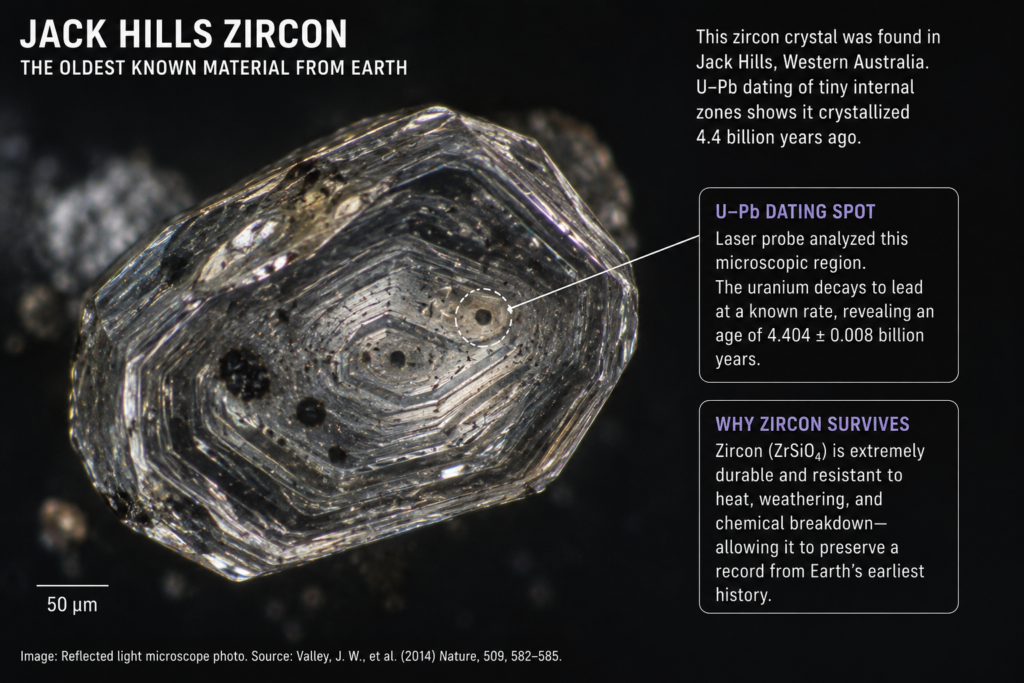
Here is something wild. Earth has almost no rocks left from the Hadean eon. Weathering, plate tectonics, and time erased nearly all of it. The one exception is a tough little mineral called zircon.
Zircons from the Jack Hills region of Western Australia are some of the oldest materials ever found on our planet, dated to as far back as 4.4 billion years (Science, AAAS). Because zircon resists chemical change, it locks in tiny clues about the environment it formed in, almost like a geological time capsule.
Oxygen isotopes trapped inside these crystals suggest liquid water was present far earlier than anyone expected, which pushes back the timeline for when life in the Hadean eon could have had a chance (CNN).
That does not prove life existed. But it knocks down one of the biggest arguments against it, the idea that there was simply no water for life to use.
The 2015 Discovery That Shook Scientists
In 2015, geochemist Elizabeth Bell and her team at UCLA examined a 4.1 billion year old zircon and found a speck of graphite inside it. The carbon in that graphite had an isotopic signature that looked biological, meaning it resembled carbon that had passed through a living organism rather than carbon from ordinary rock chemistry (Science, AAAS).
If confirmed, that would push the record for life in the Hadean eon back by roughly 300 million years compared to the previous earliest evidence, which was about 3.8 billion years old.
Here is the honest part. Bell herself said the scientific reaction was excited but skeptical, and she admitted this was only one data point. I am less than fully confident in this claim myself, and so are many researchers, because one zircon is not enough to rewrite the textbooks. More samples are needed before anyone calls this proven.
LUCA and the Race to Rewrite the Timeline
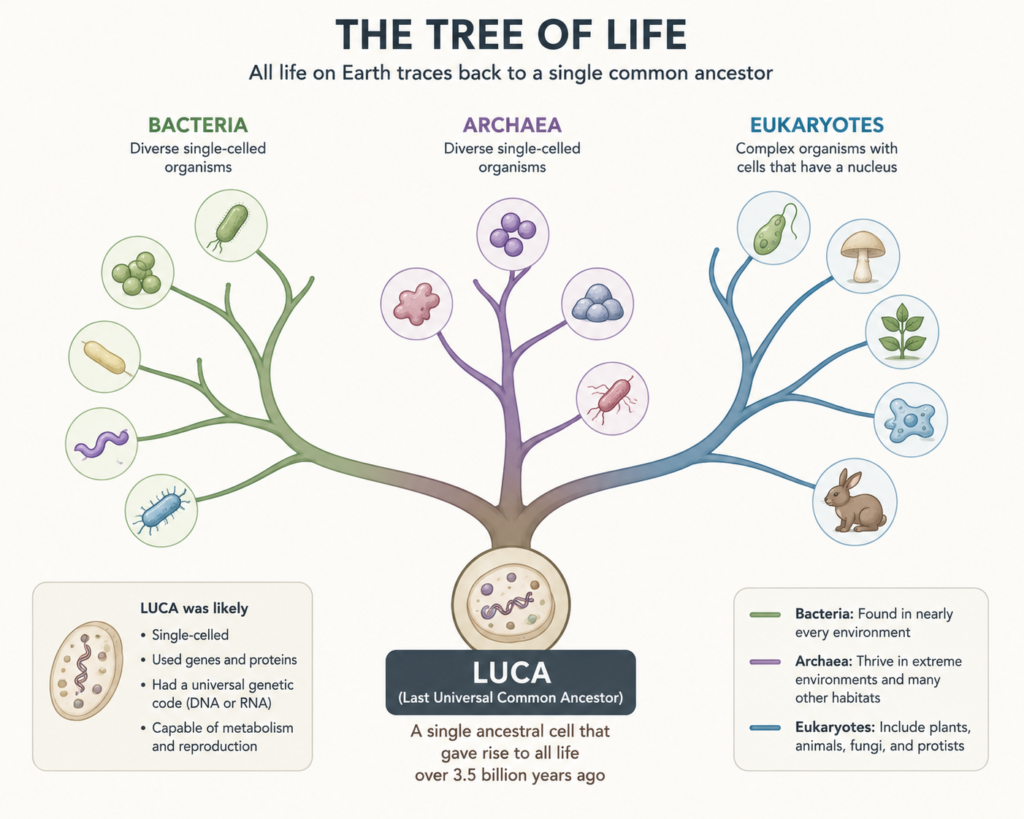
LUCA stands for the Last Universal Common Ancestor. It is the single population of microbes that every living thing on Earth today descended from, whether it is a mushroom, a shark, or you.
In 2024, a team from the University of Bristol used a genetic clock method, comparing mutation patterns across living species, to estimate that LUCA existed about 4.2 billion years ago (Nature Ecology and Evolution). That date lands squarely inside the Hadean eon.
If that estimate holds up, it means life did not creep in slowly after things calmed down. It means life in the Hadean eon appeared fast, maybe within just 100 to 200 million years of Earth becoming even remotely liveable.
That is a genuinely surprising idea. It suggests that wherever conditions allow it, life might not need much time to get started at all, which has big implications for the search for life on other planets.
A quick note on confidence here. Genetic clock estimates carry real uncertainty, and the study itself gives a range of 4.09 to 4.33 billion years rather than one fixed number. Treat 4.2 billion years as a strong estimate, not a hard fact carved in stone.
So, Did Life Exist in the Hadean Eon? Weighing the Evidence
Let’s put the pieces side by side.
Evidence that supports life in the Hadean eon:
- Liquid water may have existed as early as 4.4 billion years ago based on zircon oxygen isotopes.
- A 4.1 billion year old graphite sample has a carbon signature that resembles a biological origin.
- Genetic modeling places LUCA at roughly 4.2 billion years old, right inside this eon.
- Impact modeling suggests the Late Heavy Bombardment likely did not fully sterilize the planet.
Evidence urging caution:
- No actual fossils survive from the Hadean eon. Every clue is indirect.
- The 2015 graphite finding rests on a single zircon sample.
- Estimates for LUCA’s age still carry a wide range and depend on the model used.
- Some scientists argue the Late Heavy Bombardment was less dramatic than once believed, which changes how we interpret survival odds either way.
Put simply, life in the Hadean eon is no longer a fringe idea. It has real, published, peer reviewed support. But it is not proven the way we know, say, that dinosaurs existed. It sits in that fascinating space between plausible and confirmed, which is exactly where good science tends to live.
Frequently Asked Questions
Did life exist in the Hadean eon?
It might have. Zircon evidence points to liquid water as early as 4.4 billion years ago, and a 2024 genetic study estimated LUCA lived around 4.2 billion years ago, inside the Hadean eon (Nature Ecology and Evolution, 2024). Nothing is fully proven yet, but the evidence keeps growing.
What destroyed most evidence from the Hadean eon?
Billions of years of weathering, erosion, and plate tectonics recycled almost all of Earth’s original crust. The main survivors are tough zircon crystals, mostly from Jack Hills in Western Australia, which is why they carry so much scientific weight.
Did the Late Heavy Bombardment kill off early life?
Probably not completely. Modeling from impact researchers shows that even intense bombardment would have melted only a portion of Earth’s crust, leaving room for microbes to survive underground or near hydrothermal vents.
How old is the oldest confirmed fossil evidence of life?
The most widely accepted microfossil evidence dates to about 3.5 billion years ago, in the Archean eon, after the Hadean ended. Anything older, including the 2015 Hadean graphite claim, is still considered a hypothesis under investigation.
Final Thoughts
So, did life exist in the Hadean eon? The honest answer is that scientists genuinely do not know for certain, but the evidence has shifted hard toward yes being possible. Water showed up earlier than expected. A graphite sample looks suspiciously biological. And LUCA’s estimated birthday keeps creeping deeper into this supposedly hellish eon.
Science rarely hands us a clean answer overnight. What we get instead is exactly this, one zircon, one gene tree, one careful study at a time, slowly building a case that Earth’s first chapter may have been far more alive than its name suggests.sts.
