


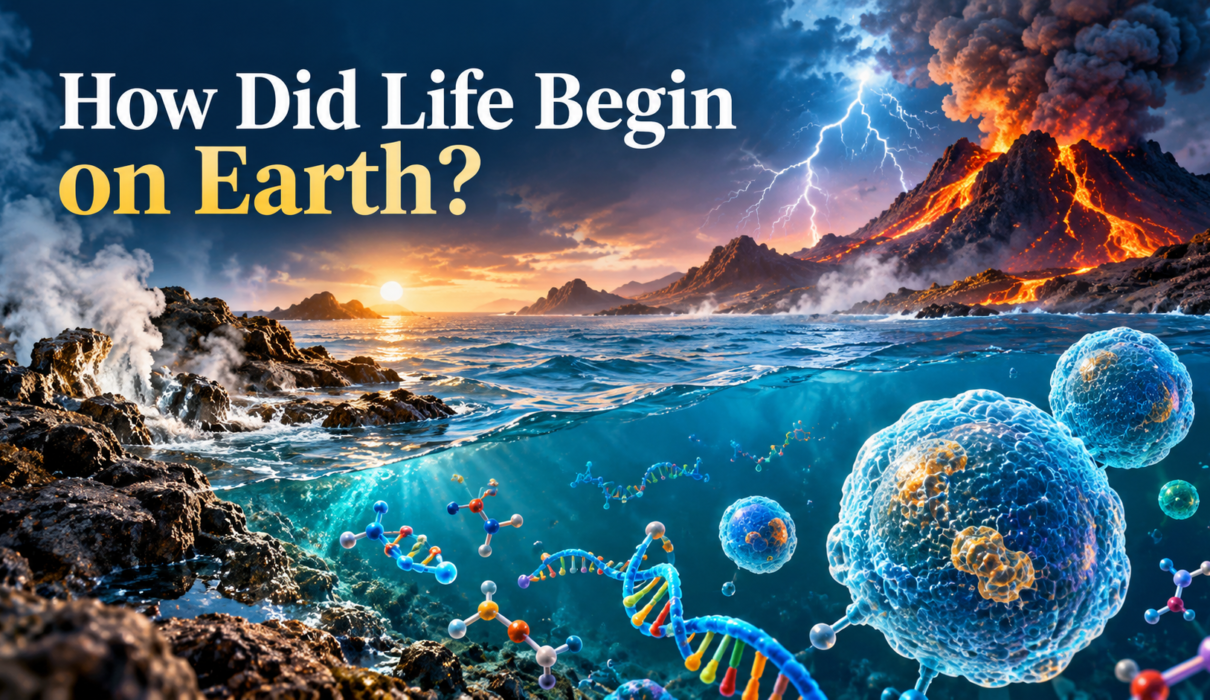
How did life begin on Earth? It’s the kind of question that sounds simple until you actually try to answer it. One day, around 4.5 billion years ago, our planet was a molten, lifeless rock getting pounded by space debris. If you want the full backstory on that violent stage, we’ve covered how Earth actually formed and what the Late Heavy Bombardment did to the young planet in separate articles. A few hundred million years later, something was alive. That’s the real story behind how life began on Earth, and it’s stranger than most people expect.
This isn’t a story with one neat answer. It’s a case that scientists have been working for over a century, and the leading suspects have changed more than once. We’re going to walk through what the evidence actually shows, not what sounds good in a textbook.
Key Takeaways
- Life may have started as early as 4.2 billion years ago, based on genetic dating of the ancestor shared by everything alive today.
- The oldest confirmed fossil evidence of life is about 3.5 billion years old, found in Western Australia.
- Two competing ideas lead the field: a “primordial soup” struck by lightning, and mineral-rich vents on the ocean floor.
- Nobody has recreated life from scratch in a lab, so the full story is still being written.
Table of Contents
What Does “How Did Life Begin on Earth” Actually Mean?
When scientists ask how did life begin on Earth, they’re really asking a narrower question than it sounds. They’re not asking how giraffes or oak trees came to exist. That’s evolution’s job, and evolution only kicks in once something is already alive and able to reproduce. The real puzzle sits earlier, and it’s weirder.
It’s about how non-living ingredients like water, rock, gas, and lightning somehow organized themselves into something that could copy itself and pass on information. Scientists call this process abiogenesis. It sounds intimidating, but the core idea is simple: life came from non-life through ordinary chemistry, not a single miraculous spark. Getting from a puddle of chemicals to a self-replicating cell is one of the biggest gaps in all of science. Honestly, that gap is bigger than most people realize.
The Primordial Soup Idea That Started It All
Long before anyone ran an experiment, two scientists working separately, Alexander Oparin in Russia and J.B.S. Haldane in Britain, proposed something radical in the 1920s. They suggested early Earth’s atmosphere had almost no oxygen, and that simple gases like methane and ammonia could react under sunlight or lightning to form the building blocks of life.
This became known as the primordial soup idea. It sat mostly untested for thirty years. Then a graduate student decided to actually try it, and the results changed the field for good. For a closer look at what that early air was actually made of, we’ve broken down the Hadean atmosphere in more detail elsewhere.
The Miller-Urey Experiment That Changed Everything

In 1953, Stanley Miller, a young chemistry student, and his supervisor Harold Urey built a sealed glass apparatus at the University of Chicago. They filled it with water, methane, ammonia, and hydrogen, the gases they believed matched early Earth’s atmosphere, and zapped it with electric sparks to mimic lightning.
Within a week, the water inside turned pink, then a deep red. When they analyzed it, they had created amino acids, the basic building blocks of proteins, using nothing but simple gases and electricity according to the Miller-Urey experiment record. Later re-analysis of Miller’s preserved samples, using modern lab equipment, actually found over twenty different amino acids, far more than he originally reported.
It didn’t create life. But it proved something huge: the chemistry of life doesn’t need life to get started. That single result reshaped how scientists thought about how life began on Earth for the next seventy years.
Deep-Sea Vents: A Different Kind of Beginning
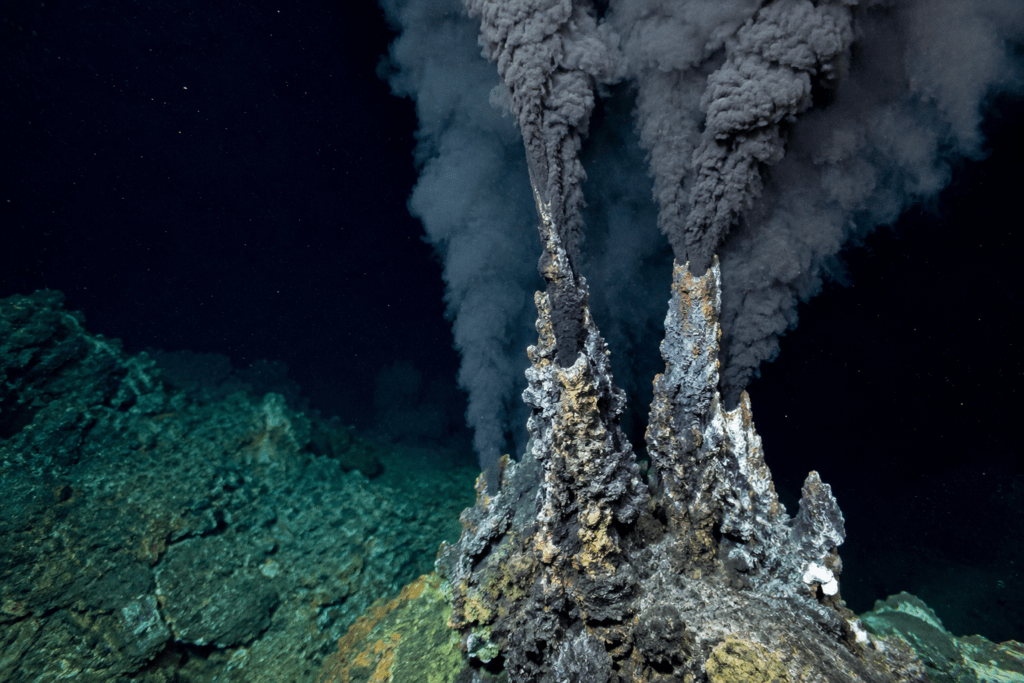
Not every scientist buys the soup story anymore. Biochemist Nick Lane at University College London and evolutionary biologist William Martin proposed something different. They argued that life didn’t start in a warm puddle at the surface, but deep in the ocean, inside alkaline hydrothermal vents.
These are towers of porous rock that leak warm, mineral-rich fluid through thousands of tiny interconnected chambers, each one roughly the size of a cell per UCL’s research on deep-sea vent conditions. Lane’s argument is about energy, not just chemistry. He points out that living cells everywhere on Earth store energy in a very specific way, as a gradient of protons across a membrane, and vents naturally produce exactly that gradient for free as detailed in ScienceDaily’s coverage of the Lane-Martin hypothesis.
This vent idea offers a genuinely different answer to how life began on Earth than the soup theory does. In 2019, Lane’s team actually built protocells under vent-like conditions in the lab and watched them hold together on their own. That’s not proof life started there. But it’s a strong hint, and it’s part of why the debate is still very much alive. These vents could only exist once Earth actually had oceans in the first place, and we’ve traced <u>how Earth’s first oceans formed in a dedicated piece if you want that backstory too.
The RNA World: Life’s First Molecule?

Here’s a chicken-and-egg problem that origin-of-life researchers argue about constantly. DNA needs proteins to copy itself, and proteins need DNA to tell them how to form. So which came first?
The leading answer is neither. Many researchers now think RNA came first, a molecule that can both store genetic information like DNA and, in some forms, act as a chemical catalyst like a protein explained in the RNA world hypothesis overview. This is called the RNA world hypothesis, and it offers another possible answer to how life began on Earth. If it’s right, the earliest form of life ran on RNA alone, before DNA and proteins ever split off to specialize. It’s a tidy solution to the chicken-and-egg puzzle, even if nobody has watched it happen from scratch in a lab.
Could Life Have Come From Space Instead?
Not everyone thinks Earth cooked up life entirely on its own. The panspermia hypothesis suggests that the raw ingredients for life, or maybe even simple microbes themselves, hitched a ride to Earth on comets, asteroids, or interstellar dust.
This isn’t as fringe as it sounds. Complex organic molecules have genuinely been found in meteorites and in the clouds of gas between stars. Still, panspermia doesn’t fully explain how life began on Earth on its own, since it just moves the question somewhere else. If life’s ingredients arrived from space, something still had to turn them into living, replicating cells, and that part of the puzzle stays unsolved either way.
So, When Did Life Actually Begin on Earth?

This is where the timeline gets genuinely surprising. Earth itself formed about 4.54 billion years ago, while it was still a hellish ball of magma getting hit by asteroids and comets nonstop. That whole stretch is what geologists call the Hadean Eon, and we’ve separately asked whether life could have existed during the Hadean Eon itself. Depending on which technique researchers use, life’s own toehold looks incredibly recent by comparison, and also incredibly early at the same time. Here’s roughly how the pieces line up:
- Earth forms: about 4.54 billion years ago
- LUCA, the shared ancestor of all life today: roughly 4.2 billion years ago
- Oldest confirmed fossils: about 3.5 billion years ago, in Western Australia
- Contested older fossil claims: up to 3.7 billion years ago, in Greenland
The oldest confirmed fossil evidence comes from Western Australia, where 3.5-billion-year-old rock structures called stromatolites still show patterns created by ancient microbial mats Smithsonian’s report on the oldest confirmed evidence of life. Some researchers argue for even older evidence, pointing to 3.7-billion-year-old rock formations in Greenland, though that claim is more contested among geologists covered in this University of Wollongong research release.
Then, in 2024, a team from the University of Bristol and UCL used genetic dating to estimate when LUCA, the Last Universal Common Ancestor of every living thing today, actually existed. Their answer: roughly 4.2 billion years ago, only about 300 million years after Earth itself formed per UCL’s summary of the LUCA dating study. I’ll admit, that number still catches me off guard every time I read it. Earth had barely cooled down, and life was already up and running.
What Scientists Still Don’t Know
For all this progress, nobody has taken a beaker of chemicals and produced a living, replicating cell from scratch. Not once. Every theory here, soup, vents, RNA, panspermia, explains a piece of the puzzle, but not the whole picture.
Scientists still don’t agree on where life started, what the first genetic molecule really was, or how many failed chemical experiments Earth ran before one finally worked. That’s not a weakness in the science. It’s an honest admission that we’re describing one of the hardest problems anyone has ever tried to solve, using evidence that’s billions of years old and mostly erased by time.
Frequently Asked Questions
How did life begin on Earth in simple terms?
In simple terms, non-living chemicals like water, gases, and minerals combined and reacted over millions of years until one combination could copy itself. Scientists call this abiogenesis. Nobody knows the exact steps, but strong evidence points to either shallow pools zapped by lightning or deep-sea vents rich in minerals and energy.
What is the oldest evidence of life on Earth?
The oldest confirmed fossil evidence is about 3.5 billion years old, found in Western Australia’s Pilbara region. Some researchers argue for older evidence in Greenland, dating back roughly 3.7 billion years, though that claim remains debated among geologists.
Did life on Earth come from space?
It’s possible, according to the panspermia hypothesis. Complex organic molecules have been found in meteorites and interstellar dust, suggesting some of life’s raw ingredients could have arrived from space. This doesn’t fully answer how did life begin on Earth, since those ingredients would still have needed to become living.
Can scientists recreate the origin of life in a lab?
Not yet, not fully. Experiments like Miller-Urey in 1953 and Nick Lane’s 2019 protocell study show that pieces of the puzzle work under lab conditions. But nobody has built a self-replicating cell from raw chemicals, so the complete process remains unproven.
Conclusion
So, how did life begin on Earth? The honest answer is that we don’t have one single, confirmed story yet. What we have are several strong, evidence-backed possibilities: chemistry brewing in a warm pool, energy pouring out of ocean vents, ingredients arriving from space, or some mix of all three that scientists haven’t fully mapped out. What we do know for certain is that life showed up shockingly fast on a young, hostile planet, and that alone should make you look at the ground beneath your feet a little differently.
If this kind of question keeps you up at night in a good way, you’re in good company. Some of the best scientists alive are still chasing the exact same answer.
Life’s story doesn’t stop at the first cell, either. Billions of years and countless branches later, it eventually led to us. If you want to keep following that thread, we’ve also covered what human species existed before us further along that same timeline.

1 Comment