


Right now, about 3,000 kilometers beneath your feet, a swirling ocean of molten iron is doing something that keeps you alive. It’s generating the invisible force field wrapped around our planet. So how did Earth develop its magnetic field, and why does it matter so much that scientists still argue about the details? To really answer that, it helps to first understand how Earth formed in the first place, since the field’s story starts almost as early as the planet’s.
Here’s the short version before we dig in. Earth’s core has been spinning and churning for billions of years, and that motion turns liquid metal into a giant, natural electromagnet. But the full story? It’s stranger, older, and more uncertain than most textbooks let on. Grab a cup of tea, because this one’s genuinely fascinating.
Key Takeaways
- Earth’s magnetic field is generated by moving liquid iron in the outer core, a process called the geodynamo.
- Paleomagnetic evidence from ancient zircon crystals suggests the field may be at least 4.2 billion years old, according to research led by John Tarduno at the University of Rochester.
- A 2025 study in Nature, from ETH Zurich and SUSTech, shows a fully liquid core (before the solid inner core existed) could still have powered a stable field.
- The field isn’t static. NOAA reports the magnetic north pole is currently drifting at roughly 36 km per year, and the field has lost about 9% of its strength globally over the last 200 years, per ESA data.
Table of Contents
What Exactly Is Earth’s Magnetic Field, Anyway?
Picture a giant bar magnet buried inside the planet, tilted slightly off from the axis Earth spins on. That’s basically what the magnetic field looks like from space. It stretches out thousands of kilometers into a region called the magnetosphere, and it’s the reason a compass needle points north.
But there’s no actual bar magnet down there. It wouldn’t survive the heat anyway, since iron loses its magnetism above about 770°C, and the core runs far hotter than that. So the real answer to how Earth developed its magnetic field has nothing to do with a solid chunk of magnetized metal. It comes from movement, not material.
How Did Earth Develop Its Magnetic Field in the First Place?
The honest answer is: through a process called the geodynamo, and it’s wilder than it sounds. Earth’s core has two parts. There’s a solid inner core, and surrounding it, a liquid outer core made mostly of iron and nickel. That outer layer is where the magic happens. The heavy iron that ended up down there is largely a leftover of how the solar system formed, when metal sank toward the center of the young, molten Earth.
The Geodynamo Engine Inside Our Planet

As the planet slowly loses heat, the liquid metal in the outer core rises and sinks in convection currents, kind of like water boiling in a pot, except this pot is thousands of kilometers wide and made of molten metal. Earth’s rotation twists these currents into corkscrew patterns (a physicist would call this the Coriolis effect at work).
Since liquid iron conducts electricity extremely well, moving it through existing weak magnetic fields generates electric currents. Those currents produce their own magnetic fields. And here’s the elegant part: the process feeds itself. The new fields reinforce the motion that created them, and the whole system becomes self-sustaining. That’s the geodynamo, and it’s genuinely one of nature’s more elegant tricks.
Why Iron and Nickel Matter
Not every planet gets this lucky. You need a core that’s electrically conductive, still partly liquid, and losing heat fast enough to keep the fluid moving. Mars, for comparison, apparently lost this ability roughly 4 billion years ago when its small core cooled down too much, according to Scientific American’s reporting on Tarduno’s research. Its magnetic field switched off, and its atmosphere has been getting stripped away by solar wind ever since. Earth, so far, hasn’t had that problem, and that same heat and metal sorting also shaped how Earth’s crust formed on top of the churning core below.
When Did Earth’s Magnetic Field Actually Turn On?
This is where things get genuinely debated among geophysicists, and I’ll admit, the numbers keep moving, which makes this topic more fun to follow than most.
The Jack Hills Zircon Clues

The oldest direct evidence comes from tiny zircon crystals found in the Jack Hills of Western Australia, some of the oldest known minerals on Earth. These crystals trap microscopic grains of magnetite that record the magnetic field’s strength at the moment they formed, dating all the way back to the Hadean eon, Earth’s earliest and most violent chapter. Research led by John Tarduno at the University of Rochester found signatures suggesting the field existed at least 4.2 billion years ago, and possibly as far back as 4.2 to 4.4 billion years, based on multiple zircon samples analyzed with an ultra sensitive magnetometer. If you’re curious what the planet actually looked like back then, what Earth was like in the Hadean era is worth a read on its own.
That’s wild when you consider Earth itself is only about 4.5 billion years old. It means our planet’s magnetic shield may have switched on almost immediately after the planet finished forming, not slowly over hundreds of millions of years like scientists once assumed.
An earlier 2010 study by the same team, using rocks from South Africa, had placed the field’s age at around 3.45 billion years. The newer zircon data pushed that estimate back by roughly 750 million years. Honestly, that jump still surprises me. Rewriting a billion year old timeline based on crystals smaller than a grain of sand is not a small feat.
Why Scientists Still Disagree
Not everyone agrees on the exact number, and that’s normal in active research. Ancient zircons can get reheated by later geologic events, which can scramble the magnetic record they’re holding. Researchers have to carefully rule out that kind of resetting before trusting a sample, and some scientists remain cautious about pushing the timeline quite that far back. So if you see the field’s age listed anywhere between 3.45 and 4.2 billion years, that range reflects real, ongoing scientific debate rather than sloppy reporting.
Did Earth’s Magnetic Field Exist Before the Inner Core Even Formed?
Here’s a genuinely tricky problem that puzzled researchers for over a century. Today’s dynamo gets a big energy boost from the solid inner core. As it slowly crystallizes, it releases heat and lighter elements that stir up the outer core and help power the field. But that solid inner core is relatively young. Estimates for when it formed vary widely, from around 565 million years ago (per Tarduno’s team) to roughly 1 to 1.5 billion years ago (per other geophysical models), and scientists haven’t fully settled on which is right.
So if the inner core wasn’t there for most of Earth’s history, what powered the field back then, when the entire core was liquid, and while the young planet was still getting pummeled during the Late Heavy Bombardment?
A study published in Nature in July 2025 by geophysicists from ETH Zurich and SUSTech in China tackled exactly this question using supercomputer simulations. Their models showed that a completely liquid core, without any inner solid core to help, could still generate a stable, self sustaining magnetic field on its own. That single finding closes a gap that had bothered scientists for more than a hundred years, and it’s a strong piece of the puzzle for anyone asking how Earth developed its magnetic field so early in its history.
Why Does Earth’s Magnetic Field Matter for Life?

Without this invisible shield, life as we know it probably wouldn’t exist, and that’s not an exaggeration. The magnetic field deflects most of the solar wind, a constant stream of charged particles blasting out from the sun. That deflection protects our atmosphere from being slowly stripped away, the way it appears to have happened on Mars. It’s the same reason the Hadean atmosphere didn’t just get sandblasted off the planet before it had a chance to stabilize.
The zircon research also hints that the early field, back in the Hadean and early Archean eons, may have been weaker but still present, ranging from roughly 12% to 100% of today’s strength depending on the time period studied. Even a partial shield during those early, chaotic years may have made a real difference for water and volatile compounds staying on the planet, an idea Smithsonian Magazine covers in detail, long enough for Earth’s first oceans to form and possibly for life to exist in the Hadean eon far earlier than once assumed.
Is Earth’s Magnetic Field Changing Right Now?

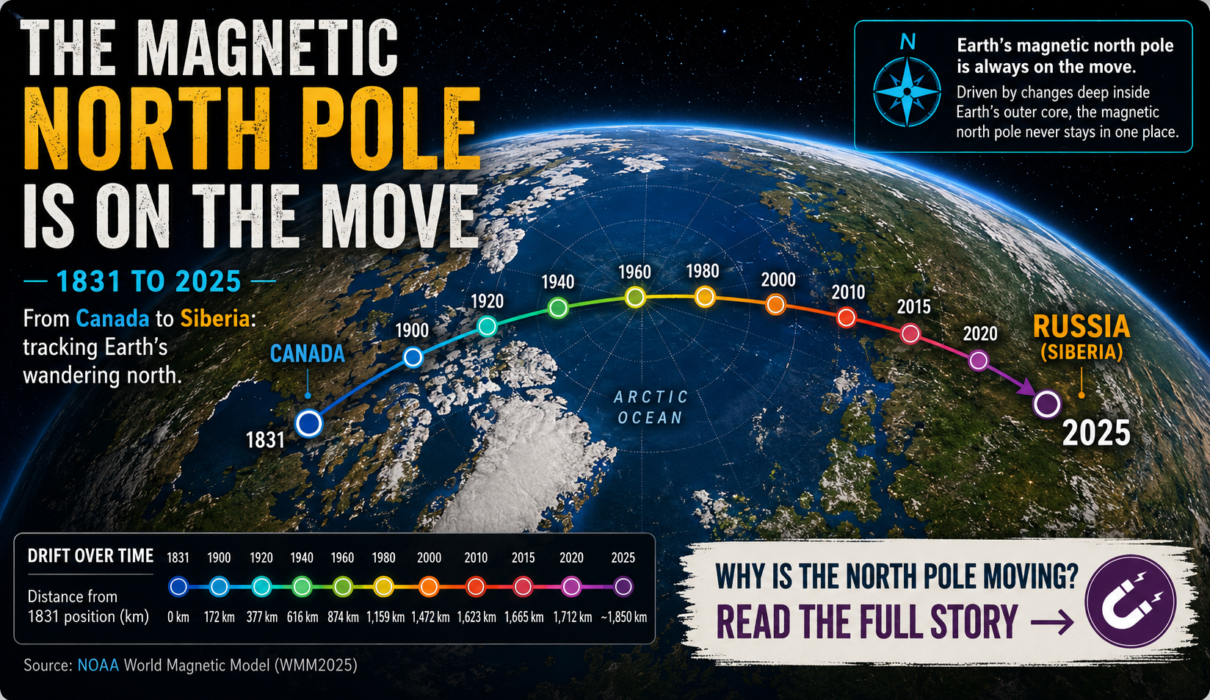
Yes, and it’s changing in ways you can actually track. The magnetic north pole isn’t fixed. It has drifted more than 2,200 kilometers since it was first documented in 1831, moving from the Canadian Arctic toward Siberia. For much of the 20th century it crept along at just a handful of kilometers per year, then sped up dramatically in the 1990s to somewhere around 50 to 60 km per year, before unexpectedly slowing again. NOAA’s most recent State of the Geomagnetic Field report puts the current average speed at about 36 km per year for the north magnetic pole and roughly 9 km per year for the south, based on data through late 2025.
Meanwhile, a region called the South Atlantic Anomaly, where the field is noticeably weaker than everywhere else, keeps growing. NOAA’s National Centers for Environmental Information reported that this weak zone expanded by about 8% over the past year alone, and continues deepening in strength. On a longer timescale, the European Space Agency estimates the global field has lost close to 9% of its strength over the last two centuries. None of this means the field is about to vanish. Reversals and fluctuations have happened hundreds of times across geologic history, and the dynamo has always come back stronger. But it does mean the answer to how Earth developed its magnetic field isn’t just ancient history. It’s an ongoing, living process happening under your feet at this very moment.
Frequently Asked Questions
How did Earth develop its magnetic field? Earth developed its magnetic field through the geodynamo, a process where the rotation of the planet stirs molten, electrically conductive iron in the outer core. That motion generates electric currents, which in turn produce a self sustaining magnetic field, a process that paleomagnetic evidence suggests began at least 4.2 billion years ago.
How old is Earth’s magnetic field? The best current evidence, from zircon crystals studied by John Tarduno’s team at the University of Rochester, points to an age of at least 4.2 billion years, with some data suggesting it could be even older. Earlier estimates from 2010 put the age at around 3.45 billion years, so this is still an active area of research.
Why doesn’t the Moon have a magnetic field like Earth’s? The Moon’s core is much smaller and has largely cooled and solidified, so it lacks the vigorous liquid metal convection needed to sustain a dynamo. Without ongoing fluid motion in a conductive core, there’s no mechanism left to generate a global magnetic field. That size difference traces all the way back to how the Moon formed out of debris rather than as a fully independent planet.
Is Earth’s magnetic field going to disappear? Not anytime soon, as far as scientists can tell. The field has weakened and reversed many times over Earth’s history without ever switching off completely. Current weakening trends, like the growing South Atlantic Anomaly, are being monitored closely, but researchers don’t see evidence of an imminent total collapse.
How fast is the magnetic north pole moving today? According to NOAA’s late 2025 State of the Geomagnetic Field report, the north magnetic pole is currently drifting at an average of about 36 kilometers per year toward Siberia, a noticeable slowdown from the 50 to 60 km per year pace recorded during the 1990s and 2000s.
Wrapping It Up
So, how did Earth develop its magnetic field? Through billions of years of a molten metal core slowly cooling, stirring, and generating electric currents that built up into the protective shield surrounding us today. It probably switched on almost as soon as the planet itself finished forming, kept working even before the solid inner core existed, and it’s still shifting and evolving right now, one kilometer of pole drift at a time.
It’s easy to take a compass, or GPS, or simply being alive, for granted. But underneath all of that sits one of the most quietly dramatic processes in the solar system, still running after 4.2 billion years.
