


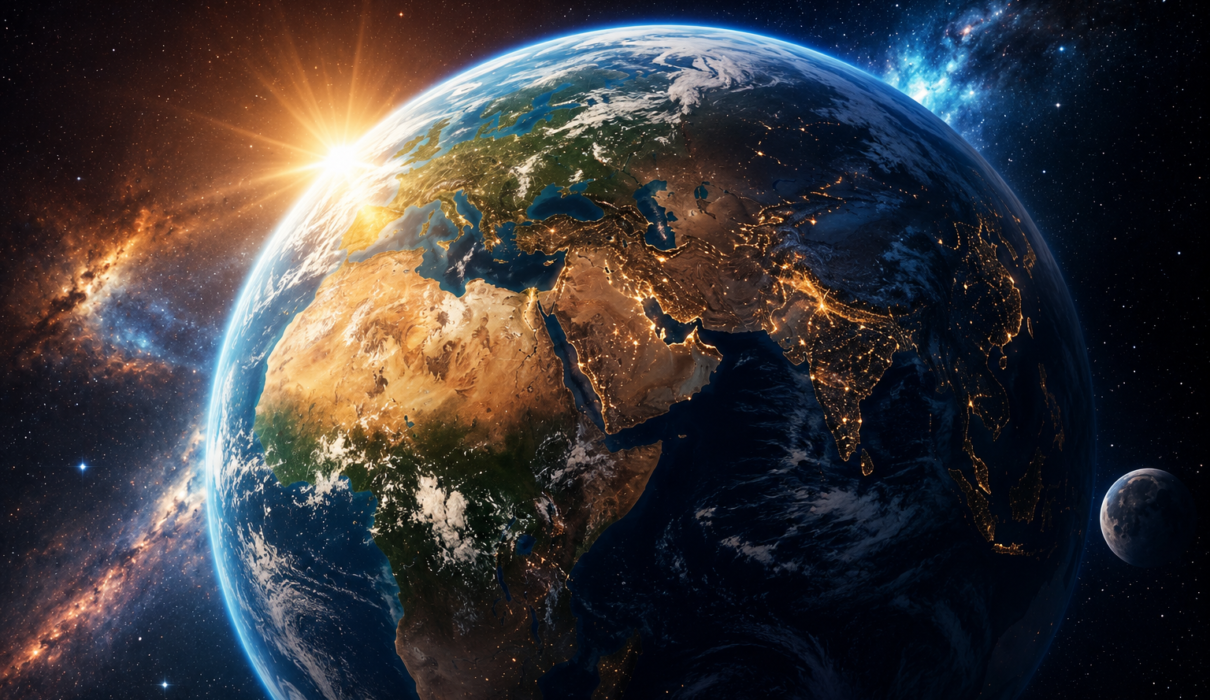
Right now, under your feet, sits a planet built entirely from leftover dust and gas that once orbited a star still switching on. That’s the short answer to how did Earth form: gravity slowly pulled cosmic debris together over tens of millions of years until it became the rocky world we call home.
Here’s what makes that answer so wild, though. Earth is about 4.54 billion years old, give or take only 50 million years, a number scientists worked out by radiometrically dating meteorites, the leftover building blocks from the solar system’s earliest days (USGS). That’s not a rough guess. It’s one of the most rigorously tested numbers in all of science.
Key Takeaways
- Earth formed roughly 4.54 billion years ago from dust and gas orbiting the young Sun (USGS).
- Tiny dust grains stuck together, grew into planetesimals, then merged into a full-sized protoplanet through repeated collisions.
- A Mars-sized body nicknamed Theia likely slammed into early Earth and created the Moon (NASA).
- The oldest surviving fragment of Earth, a zircon crystal from Australia, is 4.4 billion years old (Nature Geoscience).
This article walks through the whole story of how did Earth form, from swirling dust to a molten fireball to the blue planet floating in space today. No physics degree required, just real, sourced science explained in plain English.
Table of Contents
When Did Earth Form? Answering the Age Question First
Earth formed about 4.54 billion years ago, with an uncertainty of only plus or minus 50 million years (USGS). That kind of precision, under 1 percent, is honestly one of my favorite facts in all of geology. We can pin down something that happened before there was even a Moon in the sky, and we’re barely off by a rounding error in cosmic terms.
Scientists don’t get that number by digging up a fossil labeled “day one.” They date meteorites instead, chunks of rock and metal left over from the same cloud of material that built every planet. The Canyon Diablo meteorite, the one that carved out Arizona’s Meteor Crater, has been especially important here, dated using a technique called lead-lead isochron dating (Study.com).
A few things worth knowing about how that dating actually works:
- Radiometric dating measures how radioactive elements decay at fixed, known rates, almost like a very slow, very reliable clock.
- Uranium slowly turns into lead, and comparing those ratios across many meteorite samples gives a consistent age.
- More than 70 meteorites have been dated this way, and they cluster tightly between 4.53 and 4.58 billion years old (USGS).
That tight cluster across dozens of independent samples is exactly why scientists trust the figure. It isn’t one lucky measurement. It’s dozens of them, from different rocks, using different methods, all landing in the same neighborhood.
Where Did Earth Form? Inside the Solar Nebula
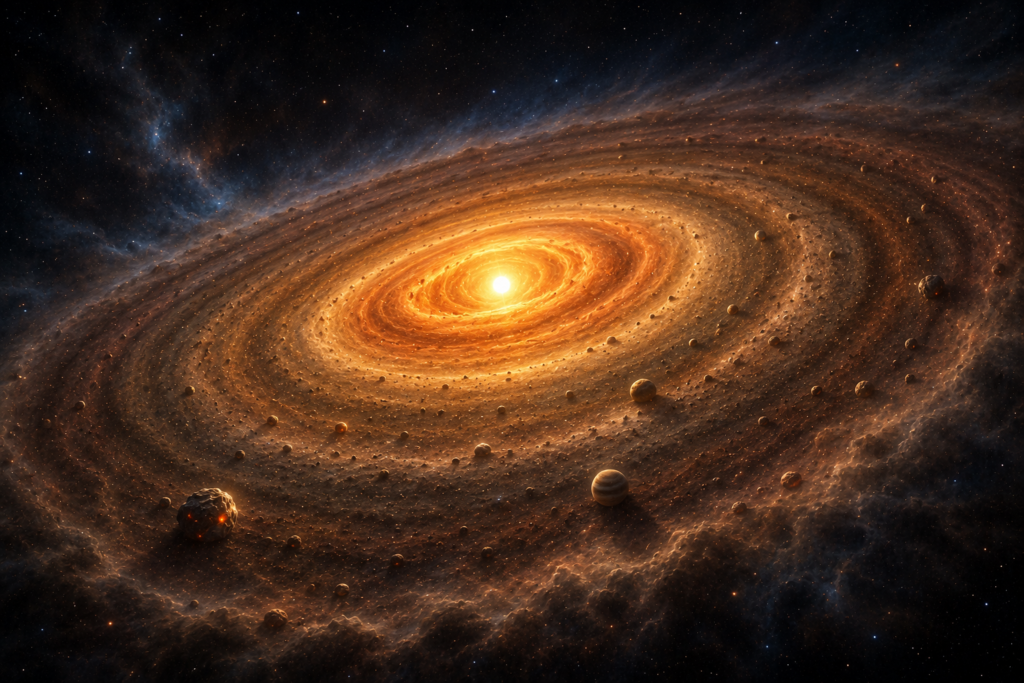
Earth didn’t form off in isolation somewhere. It formed inside a spinning disk of gas and dust called the solar nebula, the very same cloud of material that built the Sun. As that cloud collapsed under its own gravity, it flattened into a disk, with a glowing new star at the center and planets slowly assembling in the material swirling around it (NASA Science).If you want the fuller picture of how this all got started, we’ve broken down how did the solar system form
This structure is what astronomers call a protoplanetary disk, and we’re not just guessing what it looked like. Telescopes have photographed similar disks around young stars elsewhere in the galaxy, essentially showing us baby versions of our own solar system frozen at different stages of the exact process that built Earth.
Earth specifically came together in the inner region of this disk, close enough to the young Sun that ice couldn’t survive the heat. That’s the whole reason Earth ended up rocky and dense instead of a gas giant like Jupiter, which formed farther out, where ice could stick around and pile on enormous extra mass. Distance from the Sun, more than anything else, decided what kind of planet you’d end up with.
How Did Earth Form? The Step-by-Step Process
This is the heart of the story, so let’s slow down. Building a planet the size of Earth out of scattered dust took somewhere between 10 and 100 million years, and it happened in distinct stages.
Dust and Gas Surrounded the Young Sun
At the very start, the material available to build Earth was almost unimaginably fine, smaller than grains of flour, drifting through a disk that stretched more than a hundred times farther than the distance from Earth to the Sun today (NASA Science). Nothing about this cloud looked remotely like a planet yet. Just rock, ice, vaporized metal, and hydrogen gas, all swirling around a star that had only just switched on.
Dust Particles Began to Stick Together
Static electricity, the same force that makes a balloon stick to your hair, caused these microscopic grains to clump together first. Some of this material may have briefly flash-heated and resolidified into tiny mineral spheres called chondrules. Little by little, dust bunnies became pebbles, and pebbles became something worth calling a building block.
Planetesimals Formed
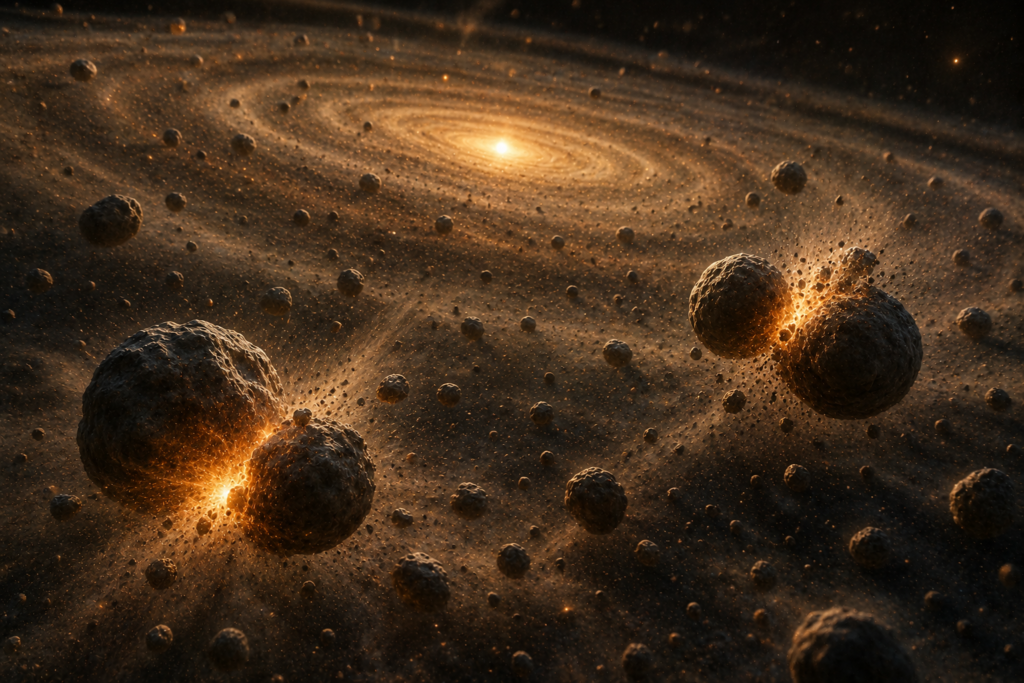
Once clumps reached a certain size, somewhere between a few hundred meters and a few hundred kilometers wide, gravity took over as the dominant sticking force (NASA Science). Scientists call these bodies planetesimals, and they’re the true building blocks of Earth. Within roughly a million years of the Sun’s birth, collisions between planetesimals had already produced bodies as massive as Mars, called planetary embryos.
Gravity Built a Protoplanet
From here on, it was survival of the biggest. Larger planetesimals had stronger gravity, so they pulled in material faster than their smaller neighbors, a runaway process that snowballed quickly once it got going. This mechanism, called accretion, is what turned scattered rubble into an actual protoplanet with real mass and its own gravitational pull.
Violent Collisions Shaped Early Earth
Don’t picture this stage as gentle merging. The final phase of building a planet involved genuinely violent, high-speed impacts between bodies ranging from Mercury to Mars in size. Early Earth would have looked less like a quiet nursery and more like a demolition derby that lasted several million years.
Earth Became a Molten World
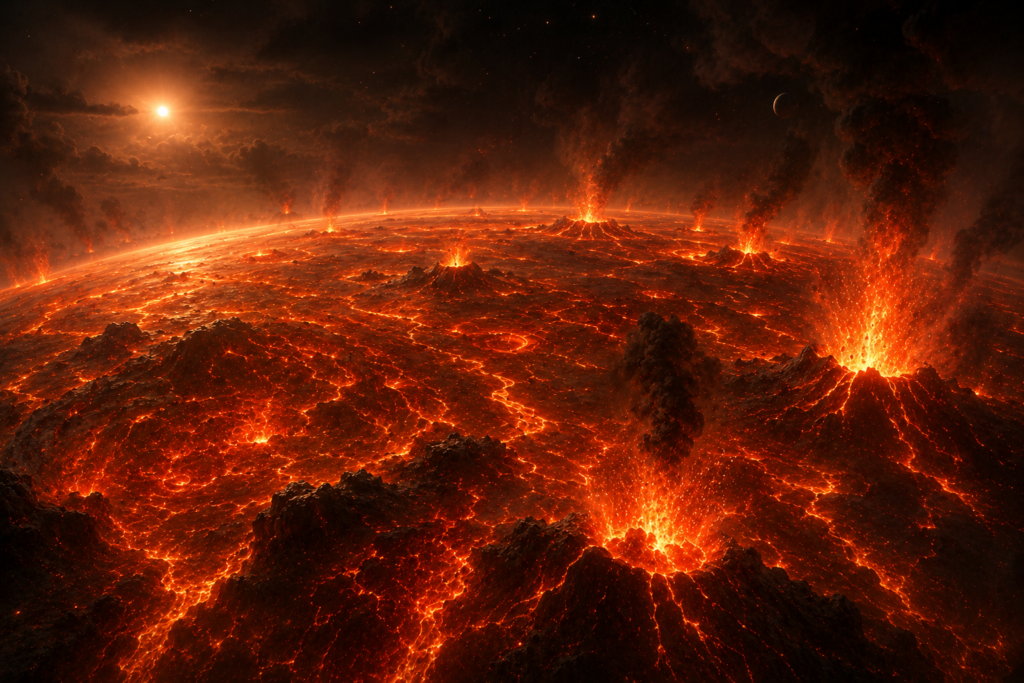
All that impact energy had to go somewhere, and it went into heat. Combined with the decay of short-lived radioactive elements like aluminum-26 and the sheer pressure of gravity squeezing the growing planet, temperatures inside early Earth eventually reached the melting point of iron, about 1,538 degrees Celsius (National Geographic Education). Scientists call this turning point the iron catastrophe, and it happened roughly 500 million years after Earth began forming.
Earth’s Interior Differentiated
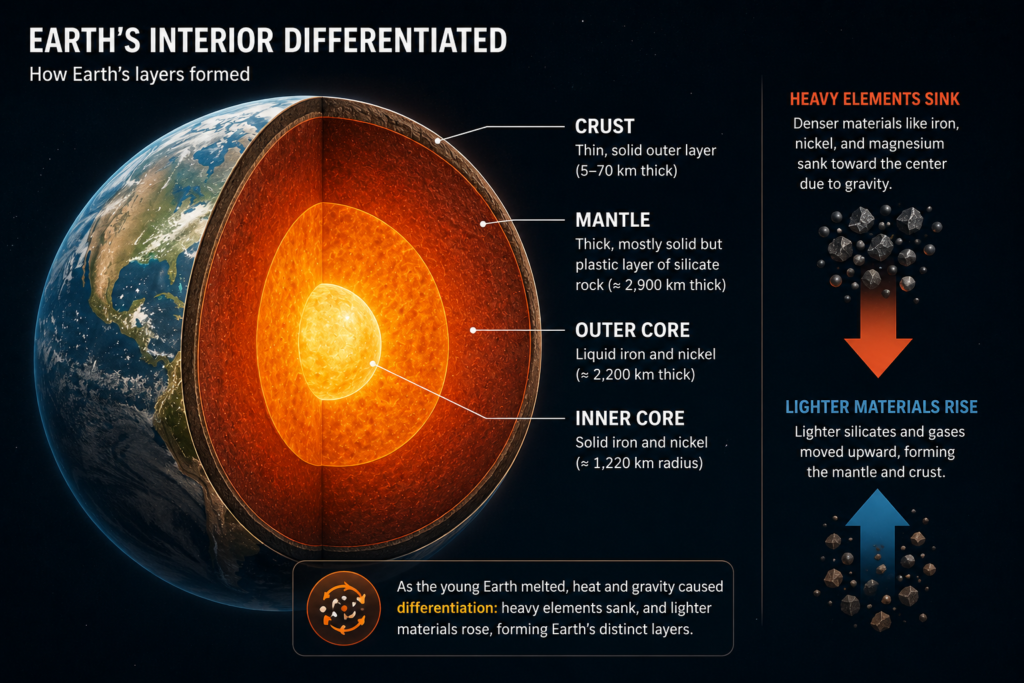
Once iron melted, it behaved like oil separating from water in a bottle. Dense liquid iron and nickel sank toward the center to form Earth’s core, while lighter silicate material floated upward to become the mantle and, eventually, the crust (National Geographic Education). This layering process, called differentiation, is why Earth today has a metallic core, a rocky mantle, and a thin crust on top instead of being mixed evenly all the way through.
How Did the Moon Form?
No article about how did Earth form is really complete without the Moon, because the two events are tangled together. The leading explanation, known as the giant impact hypothesis, holds that a Mars-sized body nicknamed Theia collided with early Earth at a low, glancing angle sometime in the solar system’s first hundred million years (Astronomy.com).
The impact was catastrophic enough to melt and partially vaporize both bodies. Debris thrown into orbit around Earth eventually clumped together into the Moon, while much of Theia itself merged directly into our planet. Newer computer simulations from Durham University and NASA’s Ames Research Center even suggest the Moon might have assembled in a matter of hours, not the months or years scientists long assumed (NASA). I’ll be honest, that timeline still messes with my head a little. An entire moon, in an afternoon.
Whichever timeline turns out to be exactly right, the giant impact hypothesis remains the best fit for the evidence we have, including the surprising chemical similarity between Moon rocks and Earth’s own mantle (Natural History Museum).
What Was Earth Like Right After It Formed?
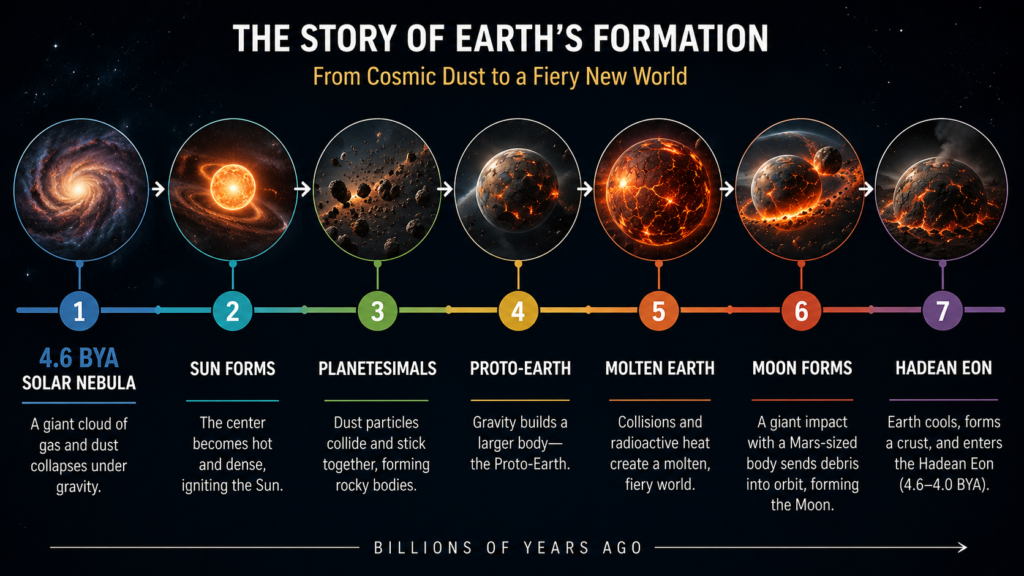
Picture Earth in its first several hundred million years, a period geologists call the Hadean Eon, and you won’t picture anything friendly. Oceans of molten rock covered much of the surface. Volcanic activity never really stopped. Space debris kept slamming into the ground long after the main building phase of the planet had technically ended, in a period scientists refer to as the Late Heavy Bombardment.
For decades, scientists assumed the whole Hadean was basically hell on Earth, and yes, that’s literally where the name comes from. But that picture has softened quite a bit. The discovery of 4.4-billion-year-old zircon crystals in Australia’s Jack Hills, chemically consistent with contact with liquid water, suggests Earth cooled and formed oceans far earlier than anyone expected, possibly within just 100 to 200 million years of the planet’s birth (Smithsonian Magazine).
That’s genuinely one of the most surprising findings in this whole story, at least to me. A planet everyone assumed was a fiery wasteland may have had oceans while it was still, geologically speaking, practically a newborn.
What Evidence Do We Have for How Earth Formed?
None of this is built on guesswork. Meteorites give one line of evidence, with more than 70 of them radiometrically dated to a tight cluster between 4.53 and 4.58 billion years old. Jack Hills zircon crystals from Western Australia add another, standing as the oldest known material from Earth’s own crust at roughly 4.404 billion years old (Nature Geoscience).
Lunar rocks returned by the Apollo missions support the giant impact timeline and confirm the Moon’s chemical relationship to Earth, while telescope observations of protoplanetary disks around young stars let astronomers watch other solar systems go through the very same process Earth went through billions of years ago. Computer simulations of planetary collisions round things out, recreating the physics of the Moon-forming impact in extraordinary detail.
Every one of these data points comes from a completely different scientific method. And yet they all point toward the same rough timeline for how did Earth form. That kind of agreement across independent evidence is exactly what scientists look for before calling something settled.
Frequently Asked Questions About How Earth Formed
How old is Earth?
Earth is approximately 4.54 billion years old, with an uncertainty of about 50 million years, based on radiometric dating of meteorites and the oldest known terrestrial and lunar rock samples (USGS).
What formed Earth?
Earth formed from dust and gas inside the solar nebula surrounding the young Sun. Gravity pulled that material together into planetesimals, then into a full-sized planet through repeated collisions over tens of millions of years.
How long did it take Earth to form?
Most of Earth’s mass likely came together within about 10 to 100 million years, though the final stages, including the Moon-forming impact, may have continued for up to 100 million years after the solar system began forming (Earth and Planetary Science Letters).
Was early Earth ever completely solid?
No. Around 500 million years after it began forming, heat from impacts, gravity, and radioactive decay melted Earth’s interior enough to trigger the iron catastrophe, the event that separated the core from the mantle.
Why is Earth different from Mars or Venus?
All three planets formed from the same inner solar nebula, but small differences in original mass, position, and impact history sent them down very different paths, differences scientists are still actively researching today.
The Bottom Line
So, how did Earth form? Out of dust. Out of collision after collision. Out of a young Sun’s leftover material, pulled together by gravity over tens of millions of years, then melted, layered, and slowly cooled into the only planet we know of that supports life. It’s a genuinely wild story, and the fact that we can reconstruct it from meteorites, zircon crystals no bigger than a dust mite, and moon rocks says a lot about how far science has come.
