


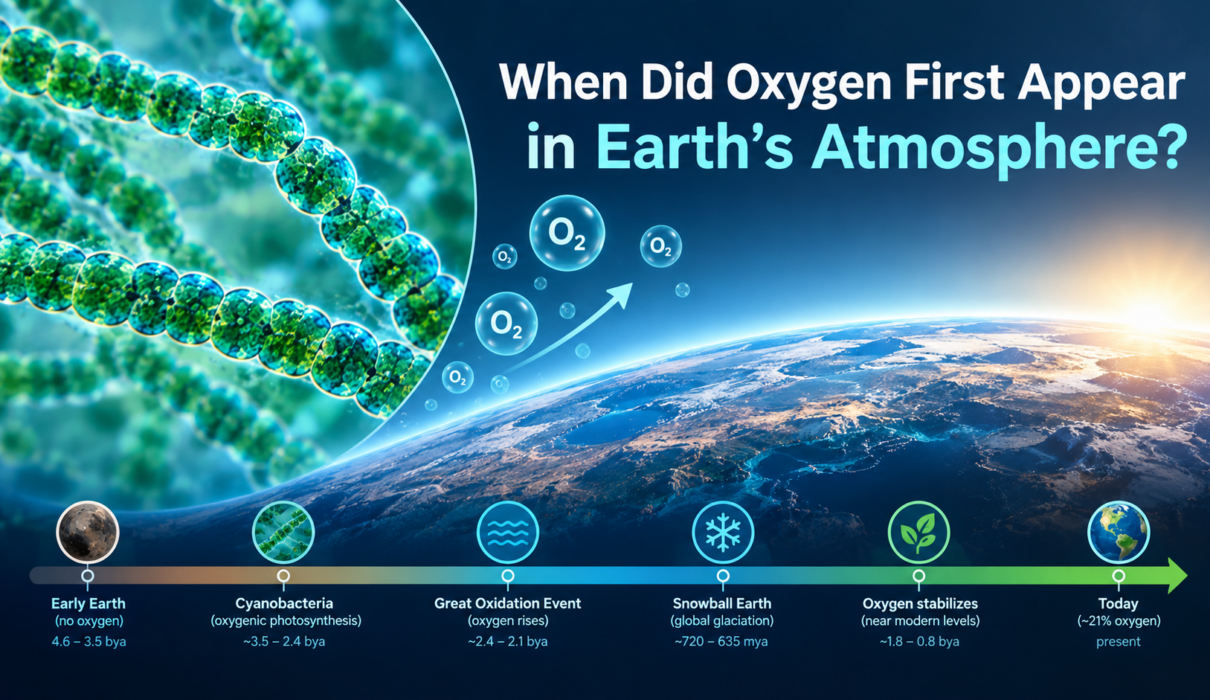
Take a deep breath right now. That’s not something the early Earth could have offered you. For almost half of our planet’s 4.5 billion year history, there was practically no breathable oxygen anywhere on Earth, not in the air, not in the oceans, nowhere. If you want the full backstory on that early, oxygen free world, we’ve covered it in our piece on what Earth was like in the Hadean era. So when did oxygen first appear in Earth’s atmosphere, and how did our planet go from a suffocating, rusty orange world to the oxygen rich place we know today?
The short answer is startling. Oxygen first began building up in Earth’s atmosphere around 2.4 to 2.3 billion years ago, during an event geologists now call the Great Oxidation Event. But here’s the twist that most articles skip: the story didn’t start there, and it definitely didn’t end there either. It’s a much stranger, messier tale involving tiny bacteria, a near total extinction of ancient life, and a second surge of oxygen that came almost two billion years later.
Key Takeaways
- Oxygen first appeared in Earth’s atmosphere in significant amounts around 2.4 to 2.3 billion years ago, during the Great Oxidation Event (University of Leeds, 2021).
- Tiny cyanobacteria were producing oxygen through photosynthesis long before that, possibly as far back as 3 billion years ago (Nature, 2024).
- The sudden rise of oxygen was so toxic to existing microbes that scientists sometimes call it the “Great Oxidation Catastrophe.”
- A second major oxygen surge, called the Neoproterozoic Oxygenation Event, happened between 800 and 540 million years ago and helped pave the way for animal life.
Table of Contents
When Did Oxygen First Appear in Earth’s Atmosphere? The Short Answer
Here’s the thing that surprises most people: oxygen didn’t just switch on one day. Scientists studying ancient rock layers have found that free oxygen started accumulating in Earth’s atmosphere sometime between 2.5 and 2.3 billion years ago, with most researchers pointing to roughly 2.4 billion years ago as the real turning point (Arizona State University via NASA Astrobiology Institute, 2019). This period is called the Great Oxidation Event, or GOE for short, and it’s honestly one of the most important moments in the entire history of life on Earth.
Before you picture a sudden green light switching on, though, it’s worth knowing that this rise was slow, patchy, and even reversed itself more than once. Research from the University of Leeds found that early atmospheric oxygenation was actually short lived, and it took roughly 200 million more years before oxygen became a permanent fixture of the atmosphere (University of Leeds, 2021) . So while 2.4 billion years ago marks the beginning of the story, oxygen didn’t really settle in for good until closer to 2.2 billion years ago.
What Was Earth’s Atmosphere Like Before Oxygen?

Picture this. No blue sky. No breathable air. Just a hazy, orange tinted atmosphere thick with methane and almost completely devoid of free oxygen. Scientists estimate that atmospheric oxygen levels before the Great Oxidation Event were less than one hundred thousandth of what they are today (ScienceDirect, 2009). That’s not a typo. It was practically zero.
This ancient world wasn’t lifeless, though. It was full of microbes that thrived without oxygen, the kind of organisms we’d now call anaerobic. Many of them actually found oxygen poisonous, which matters a lot for what happens later in this story. The atmosphere back then was dominated by methane, a powerful greenhouse gas, and it looked nothing like the sky we know today. We go into much more depth on that hazy early sky in our explainer on the Hadean atmosphere, and it’s worth a read if you want the full picture.
None of this could have happened without water in the first place, either. How Earth’s first oceans formed is its own fascinating story, and it matters here because those early oceans became the chemical “sponge” that soaked up oxygen for hundreds of millions of years before the atmosphere ever got its share.
Here’s a quick snapshot of what changed and when:
- Before 2.4 billion years ago: Virtually no atmospheric oxygen. Methane rich, hazy skies.
- 2.4 to 2.2 billion years ago: The Great Oxidation Event begins. Oxygen starts accumulating, in fits and starts.
- 2.2 billion years ago to roughly 800 million years ago: Oxygen levels stabilize at a low but persistent level, often called the “Boring Billion.”
- 800 to 540 million years ago: The Neoproterozoic Oxygenation Event pushes oxygen toward modern levels.
- Today: Oxygen makes up 21% of the atmosphere we breathe (FutureLearn/Cardiff University, 2022).
Meet the Cyanobacteria: The Tiny Organisms That Changed Everything

So who actually made all this oxygen? The answer is cyanobacteria, sometimes called blue green algae, even though they aren’t technically algae at all. These microscopic organisms were the first (and for a very long time, the only) life forms capable of oxygenic photosynthesis, meaning they could split water molecules using sunlight and release oxygen as a byproduct. If you’re curious how life got started at all before cyanobacteria came along, we’ve broken that down separately in how life began on Earth, and in did life exist in the Hadean eon.
Honestly, it’s wild to think that something this small reshaped an entire planet. Cyanobacteria didn’t set out to change the world. Oxygen was basically their trash, a waste product they needed to get rid of to survive (NIH/PMC, 2022). But because they were so successful and so numerous, that “trash” slowly filled the oceans, then the atmosphere, then everything else.
How Oxygenic Photosynthesis Works (In Simple Terms)
You don’t need a chemistry degree to understand this part. Cyanobacteria use sunlight as energy to split water (H2O) into hydrogen and oxygen. They keep the hydrogen to build sugars for energy, and the leftover oxygen gets released into the surrounding water and, eventually, the air. Multiply that by trillions of cyanobacteria working for hundreds of millions of years, and you get a planet wide chemical revolution. Curious how the very first cells capable of doing this even came together? Our post on how the first cells formed on Earth walks through that earlier chapter in detail.
Did Oxygen Exist Before the Great Oxidation Event?
This is where the story gets genuinely fascinating, and where a lot of blog posts get it wrong. Even though the Great Oxidation Event marks when oxygen first became a permanent, significant part of the atmosphere, there’s strong evidence that cyanobacteria were quietly producing oxygen for hundreds of millions of years before that.
Genetic and molecular clock studies suggest that the core proteins needed for oxygenic photosynthesis may have originated as early as 3.6 to 3.2 billion years ago, long before the GOE actually occurred (Cell Press, Trends in Microbiology, 2021). Some researchers have even pushed that estimate further, suggesting photosynthesis capable of producing oxygen could date back 3.4 to 3.6 billion years (ScienceDaily, Imperial College London research).
So why the gap? Scientists call these early traces “whiffs” of oxygen, brief, localized bursts that got absorbed almost immediately by rocks, minerals, and the ocean before they could ever build up in the atmosphere (NASA Astrobiology, 2023). It’s a bit like trying to fill a bathtub that has the drain wide open. The oxygen was being produced, sure, but it had nowhere to accumulate until the “drain” (all those oxygen absorbing minerals) finally got plugged up.
The Great Oxidation Event: When Oxygen First Appeared in Earth’s Atmosphere for Good
Around 2.4 billion years ago, something shifted. The Earth’s rocks and oceans had finally soaked up as much oxygen as they could hold, sort of like a sponge reaching its limit. Once that happened, the extra oxygen being pumped out by cyanobacteria had nowhere left to go except up into the atmosphere.
This is genuinely the moment most scientists mean when they answer the question, when did oxygen first appear in Earth’s atmosphere in a way that actually stuck around. Geologists have confirmed this shift using something called mass independent fractionation of sulfur isotopes, a mouthful of a term that basically works as a chemical fingerprint showing exactly when oxygen levels crossed a critical threshold (ScienceDirect, 2010). Before that threshold, the fingerprint pattern looks one way. After it, the pattern disappears completely, and it never comes back.
Why Did It Take So Long For Oxygen to Build Up?
A few things had to happen first, and none of them happened quickly.
- Oxygen sinks needed to fill up. Iron in the oceans and volcanic gases in the air were soaking up free oxygen almost as fast as it was produced.
- Cyanobacteria populations had to grow massively. It takes an enormous, sustained amount of photosynthesis to overwhelm a planet’s chemical buffers.
- Methane levels had to drop. Methane reacts with oxygen, so as long as methane stayed high, oxygen kept getting consumed instead of accumulating.
- Tectonic and volcanic activity shifted. Changes in Earth’s geology altered how much reducing gas was being pumped into the atmosphere.
The Great Dying: How the First Oxygen Was a Disaster for Ancient Life
Here’s a detail that genuinely surprises people every time I mention it. When oxygen first appeared in Earth’s atmosphere in large amounts, it wasn’t a happy moment for most life on the planet. It was closer to a mass extinction.
Remember those anaerobic microbes we mentioned earlier? For them, oxygen wasn’t a life giving gas, it was a toxic poison that damaged their cells. As oxygen levels climbed during the Great Oxidation Event, huge populations of these ancient organisms were wiped out, in what some scientists half jokingly call the “Oxygen Catastrophe” or the “Oxygen Holocaust.” It’s one of the earliest known mass extinctions in Earth’s history, and it happened almost two billion years before the more famous dinosaur extinction.
There was a climate twist too. Rising oxygen reacted with and removed much of the methane greenhouse gas that had been keeping the planet warm. Some researchers believe this triggered one of Earth’s earliest and most severe ice ages, sometimes called the Huronian glaciation, which may have frozen the planet for tens of millions of years (ASM.org, 2022).
The Second Oxygen Boost: The Neoproterozoic Oxygenation Event

If you thought the story ended with the Great Oxidation Event, here’s the part that gets left out of most articles. After that initial rise, oxygen levels plateaued at a fraction of modern values for well over a billion years, a stretch geologists sometimes nickname the “Boring Billion” because so little seemed to change.
Then, between roughly 800 and 540 million years ago, oxygen surged again in what’s now called the Neoproterozoic Oxygenation Event, sometimes referred to as the Second Great Oxidation Event (Wikipedia, summarizing peer reviewed geochemistry research). This second push is believed to have coincided with dramatic climate events called Snowball Earth glaciations, when the entire planet may have frozen over more than once.
This second oxygen boost mattered enormously for us. It’s widely thought to have helped set the stage for the evolution of the first animals, since larger, more complex, multicellular life generally needs higher oxygen levels to survive and grow (Geological Society of America, GSA Today). Without this second surge, it’s genuinely possible complex animal life as we know it never would have gotten off the ground.
How Do Scientists Actually Know All This?

You might be wondering how researchers can possibly know what happened billions of years before anyone was around to measure it. It’s a fair question, and the answer involves some pretty clever detective work.
- Sulfur isotope fingerprints: A specific chemical signature in ancient rocks disappears abruptly once atmospheric oxygen crosses a critical level, giving scientists a precise marker in time.
- Red beds and rusted rocks: Iron rich rock layers that only turn red (oxidize) once enough oxygen is present in the environment.
- Fossilized cyanobacteria: Microscopic fossils, some containing internal membrane structures called thylakoids, show direct physical evidence of ancient photosynthesis dating back at least 1.75 billion years (Nature, 2024, reported by Smithsonian Magazine).
- Carbon and vanadium isotope records: Subtle shifts in these elements within ancient shale layers reveal when ocean chemistry started favoring oxygen rich conditions.
Why This 2.4 Billion Year Old Event Still Matters Today
It’s easy to treat ancient geology as trivia, something interesting but disconnected from your actual life. It isn’t. Every single breath you’re taking right now exists because of a chain reaction that started with microscopic bacteria billions of years ago. Without cyanobacteria and the slow, chaotic rise of atmospheric oxygen, none of us would be here to ask the question in the first place.
There’s also a bigger lesson buried in here about how life and planets shape each other. Earth’s atmosphere wasn’t just a backdrop that life happened to exist in. Life actively rebuilt the atmosphere, twice, on a planetary scale. That’s part of why astrobiologists searching for life on other planets treat atmospheric oxygen as such a strong potential biosignature, a chemical hint that something alive might be busy changing the air on a distant world. It also helps that Earth had a working magnetic field holding that hard won atmosphere in place. We cover the surprisingly close call of how Earth developed its magnetic field in another post, and it pairs nicely with this one.
Millions of years later, oxygen kept reshaping life in ways that still echo today. If you enjoyed this deep dive, you might also like how climate change affected human evolution, which picks up this same theme of atmosphere and climate steering the course of life, just much closer to our own species.
Frequently Asked Questions
When did oxygen first appear in Earth’s atmosphere?
Oxygen first appeared in Earth’s atmosphere in significant, lasting amounts around 2.4 to 2.3 billion years ago, during the Great Oxidation Event. Smaller, localized traces of oxygen may have existed even earlier, possibly as far back as 3 billion years ago (University of Leeds, 2021; NASA Astrobiology, 2019).
What caused oxygen to first appear in Earth’s atmosphere?
Photosynthetic cyanobacteria produced oxygen as a waste product of splitting water molecules using sunlight. Once Earth’s oceans and rocks stopped absorbing all of it, the excess oxygen began building up in the atmosphere for the first time (NIH/PMC, 2022).
Was there any oxygen on Earth before the Great Oxidation Event?
Yes, in small, scattered amounts. Scientists have found “whiffs” of oxygen in ancient rock layers dating back hundreds of millions of years before the main event, though it never accumulated in the atmosphere until around 2.4 billion years ago (NASA Astrobiology, 2023).
How much oxygen is in Earth’s atmosphere today?
Oxygen currently makes up about 21% of Earth’s atmosphere, a level reached gradually after two major surges, the Great Oxidation Event and the later Neoproterozoic Oxygenation Event (FutureLearn/Cardiff University, 2022).
Did the first appearance of oxygen harm life on Earth?
Yes, dramatically. Many ancient microbes found oxygen toxic, and its rise triggered what some scientists call the Great Oxidation Catastrophe, one of the earliest known mass extinctions in Earth’s history (ASM.org, 2022).

1 Comment