


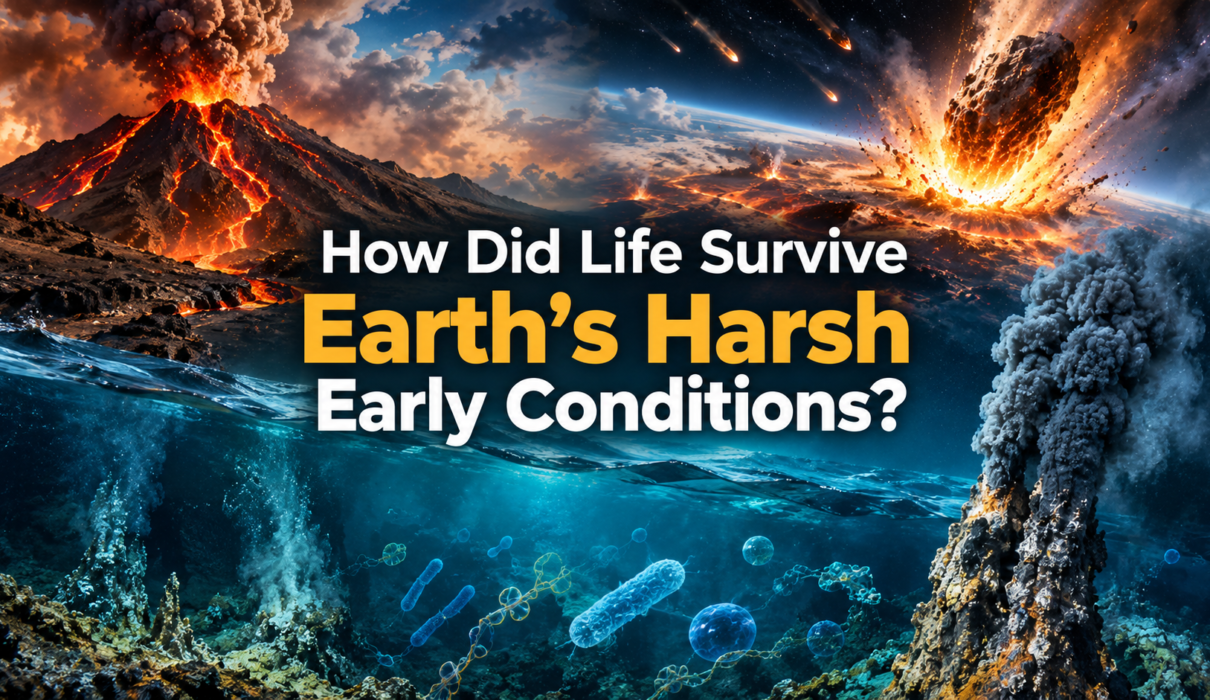
How did life survive Earth’s harsh early conditions when our planet looked more like hell than home? That’s not an exaggeration. Picture oceans of molten rock, skies choked with toxic gas, and asteroids the size of small countries slamming into the surface every so often. It sounds like something out of a disaster movie. Yet somehow, against odds that still puzzle scientists today, life found a way through.
This isn’t a simple story with one clean answer. It’s messy, it’s still being pieced together, and honestly, that’s what makes it so fascinating. In this article, we’ll walk through what Earth’s early years actually looked like, where the evidence for the harshness comes from, and the leading ideas for how life survived Earth’s harsh early conditions anyway. No fluff, no guessing games, just what the research actually shows.
Key Takeaways
- Earth’s earliest era, called the Hadean, may have had surface temperatures above 200°C soon after the planet formed (Universe Today).
- Zircon crystals from Australia’s Jack Hills suggest liquid water existed as far back as 4.4 billion years ago (NASA Earth Observatory).
- Even during heavy asteroid bombardment, research shows underground microbial life likely survived (Science News).
Table of Contents
What Made Early Earth So Harsh in the First Place?
It’s hard to overstate just how brutal early Earth was. Right after the planet formed about 4.6 billion years ago, it was basically a ball of molten rock. There was no solid ground to stand on, not that anyone existed yet to try. The atmosphere back then held roughly 100,000 times more carbon than it does today, and that thick blanket of gas trapped heat the way it still does on Venus (Universe Today).
Add to that a young Sun that behaved unpredictably, constant volcanic eruptions, and a barrage of space debris left over from the solar system’s formation, and you get a planet that seems like the last place life could ever take hold. Scientists even named this period the Hadean Eon, after Hades, the Greek god of the underworld. If you want the full picture of what Earth actually looked like during the Hadean era, that’s a good next stop after this one.
How Did Life Survive Earth’s Harsh Early Conditions? The Cooling Clue

Here’s where things get interesting. For decades, researchers assumed the Hadean stayed molten and hostile for its entire 500 million year span. But that picture has changed a lot.
In 2014, a team led by geochemist John Valley studied a tiny zircon crystal from Western Australia’s Jack Hills region. This crystal, only about the width of a hair, turned out to be 4.4 billion years old, making it the oldest known fragment of Earth’s crust (University of Wisconsin-Madison). Its chemical makeup pointed to something surprising: liquid water may have already existed by then, which lines up with what we know about how Earth’s first oceans formed.
That single finding flipped a lot of assumptions on their head. If water was around that early, Earth might have cooled and stabilized far sooner than scientists once believed. This is often called the “cool early Earth” theory, and it’s one of the biggest reasons researchers now think life could have survived Earth’s harsh early conditions much earlier than the traditional timeline suggested (NASA Earth Observatory).
Did Asteroid Bombardment Wipe Everything Out?

You’d think a rain of asteroids would sterilize a planet completely, right? That was the assumption for a long time too. Earth went through a period known as the Late Heavy Bombardment, when asteroids some the size of Kansas struck the surface. This likely happened somewhere between 4.48 and 3.9 billion years ago, though researchers still debate the exact window (Astronomy.com).
A NASA funded study modeled how much heat these impacts would have generated underground. The surprising result? While the surface may have been scorched repeatedly, microbial life hiding beneath it likely would have survived just fine (Astronomy.com). Later research went even further, estimating that after the first few hundred million years of bombardment, somewhere between 10 and 75 percent of the top kilometer of Earth’s subsurface stayed warm enough, not too hot, not too cold, for microbes to thrive (Science News).
That’s honestly one of the more surprising numbers in this whole story. A planet getting hammered from space, and life underground barely noticed.
Underground Refuges: Life’s Secret Hideout
So where exactly did early organisms hide out during all this chaos? Scientists point to a few likely refuges:
- Cracks and pores deep in Earth’s crust, insulated from surface heat and radiation
- Underwater environments shielded by layers of ocean water
- Hydrothermal vent systems on the seafloor, rich in chemical energy
- Pockets within newly formed rock that stayed at stable, livable temperatures
These weren’t luxury accommodations. But they were enough. This question of whether anything could have made it through that era at all is actually its own debate, one we cover in more depth in Did Life Exist in the Hadean Eon?. And that’s really the theme running through how life survived Earth’s harsh early conditions: it didn’t need paradise, it just needed somewhere stable enough to hang on.
Hydrothermal Vents: The Nursery of Life?
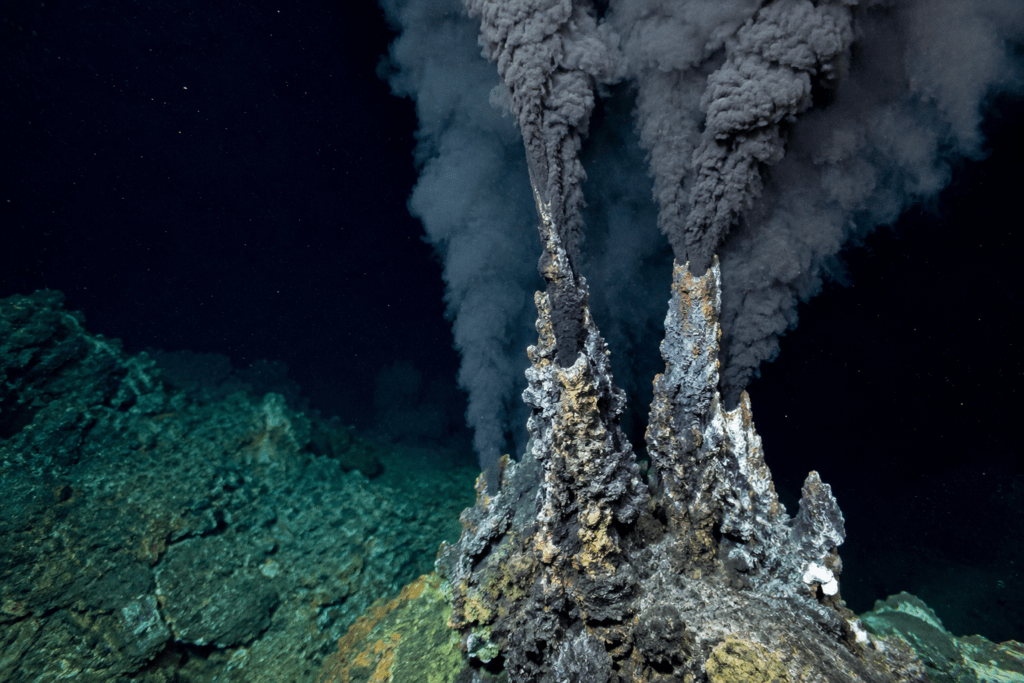
If there’s one place that keeps coming up in origin of life research, it’s hydrothermal vents. These are cracks in the ocean floor where superheated, mineral rich water pours out and meets cold seawater. That collision creates chimney like structures and a chemical soup that some scientists believe was the perfect setting for the first cells.
In 2017, researchers led by Matthew Dodd at University College London examined ancient rock from Canada’s Nuvvuagittuq belt, dated between 3.77 and possibly 4.28 billion years old. Inside, they found microscopic tubes and filaments made of hematite, an iron rich mineral, that closely resemble structures produced by bacteria living around vents today (World Economic Forum). If confirmed, these could be the oldest fossils ever found, and they connect directly to the bigger question of how the first cells formed on Earth.
There’s also genetic evidence supporting this vent theory. LUCA, short for the Last Universal Common Ancestor, the organism believed to be the shared ancestor of all life on Earth, appears to carry genes associated with using hydrogen gas for energy, exactly the kind of chemistry you’d find near a hydrothermal vent.
What Was Earth’s Atmosphere Actually Like?
Beyond heat and impacts, early Earth’s air itself was a problem. The Hadean atmosphere lacked the oxygen we depend on today. Instead, it likely contained gases like methane, carbon dioxide, and hydrogen cyanide, hardly breathable by modern standards.
Oddly enough, this chemistry may have helped rather than hurt. Researchers studying Hadean atmospheric models suggest that reducing gases could have driven photochemical reactions that produced hydrogen cyanide, a key building block for the molecules that eventually formed RNA. These chemicals may have rained down and pooled in small bodies of water called warm little ponds, slowly concentrating into the ingredients for life (arXiv research summary).
It’s a genuinely wild idea when you sit with it. The same toxic air that would kill us instantly may have been quietly cooking up the raw materials for biology. Life didn’t survive Earth’s harsh early conditions by avoiding the chaos. It seems to have used it.
Why Does This Debate Still Continue Among Scientists?
Not everyone agrees on every detail here, and that’s worth being upfront about. Some researchers remain skeptical that the Nuvvuagittuq fossils are truly biological in origin, arguing the structures could form through non living geological processes (NPR/KCUR). Others question the exact timing of the Late Heavy Bombardment altogether, with newer models suggesting there may not have been one single dramatic spike at all.
This uncertainty isn’t a weakness of science. It’s actually how good science works. Researchers keep testing, re-examining old samples with new tools, and adjusting the story as better evidence comes in. A 2024 paper on early Earth habitability put it well, noting that the roadmap from the Hadean, despite many still fuzzy details, gives scientists a strong foundation for understanding what came next (arXiv).
So How Did Life Really Survive Earth’s Harsh Early Conditions?
Pulling all this together, the honest answer is: through a mix of luck, resilience, and hiding in the right places at the right time. Life likely survived Earth’s harsh early conditions by retreating underground and underwater, away from surface heat and impacts. It probably used chemical energy from hydrothermal vents instead of sunlight, since there may not have been much stable surface to sit under anyway. And it may have been built from molecules that formed in the planet’s own toxic, chaotic atmosphere.
None of this happened instantly. It likely took hundreds of millions of years of trial, failure, and adaptation before anything resembling a stable cell existed. If you want to dig deeper into that next chapter, our guides on how did life begin on Earth and when oxygen first appeared in Earth’s atmosphere walk through what happened once life finally got a foothold.
Frequently Asked Questions
How did life survive Earth’s harsh early conditions if the planet was covered in magma?
Life almost certainly did not exist during the earliest, fully molten phase. Once Earth’s crust cooled and liquid water appeared, possibly by 4.4 billion years ago, conditions became survivable, especially underground and underwater (NASA Earth Observatory).
Could anything have survived the Late Heavy Bombardment?
Research modeling the heat from asteroid impacts suggests that while the surface may have been repeatedly scorched, microbial life sheltered beneath the surface likely would have survived the bombardment (Astronomy.com).
What is the oldest known evidence of life on Earth?
Some scientists point to hematite tube fossils from Quebec’s Nuvvuagittuq belt, potentially between 3.77 and 4.28 billion years old, though this dating and interpretation is still debated among researchers (World Economic Forum).
Did hydrothermal vents really give rise to the first life?
It’s one of the leading hypotheses. The chemistry and genetics of LUCA, life’s shared ancestor, line up closely with conditions found at deep sea hydrothermal vents, though this remains an active area of research.
