


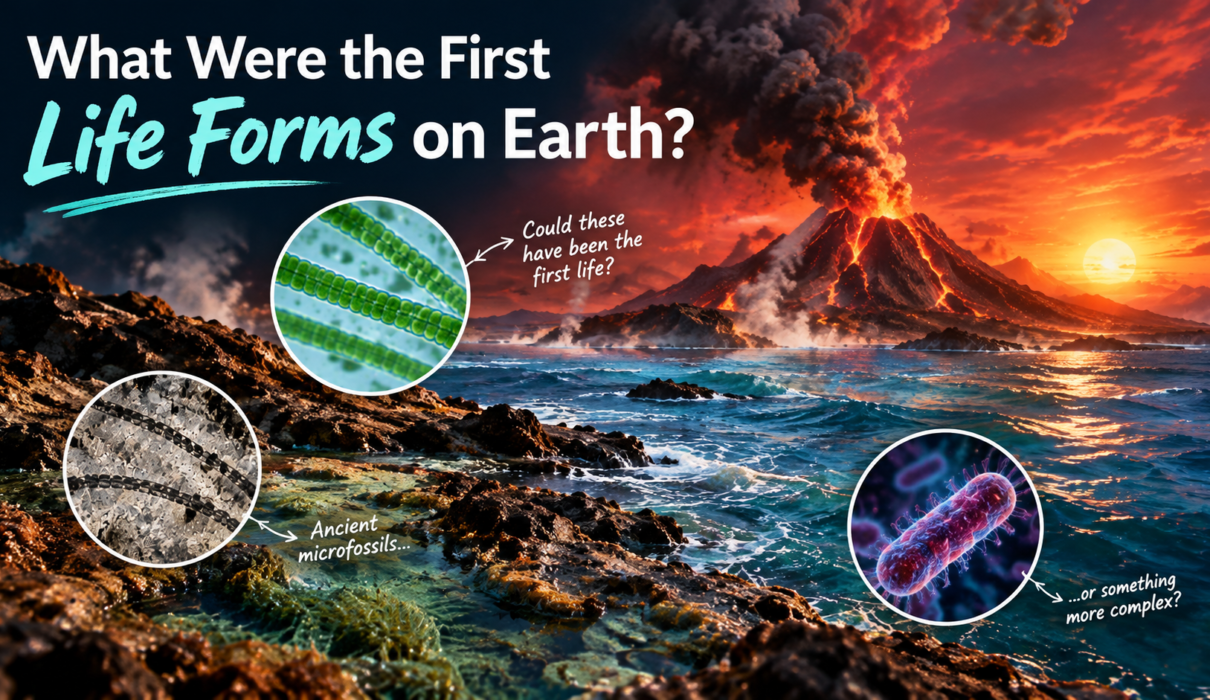
What were the first life forms on Earth? Honestly, that question has kept scientists up at night for over a century, and we still don’t have one clean, tidy answer. But here’s what’s wild: we’re not totally in the dark either. Tiny fossils trapped inside rocks older than 3 billion years, chemical fingerprints invisible to the naked eye, and genetic detective work on modern microbes have all pointed scientists toward the same rough picture. The first life forms on Earth were almost certainly simple, single celled microbes, not the dinosaurs or sea creatures you might picture when you think “ancient life.”
If you’ve ever wondered how something as complicated as a human being traces back to a speck too small to see, you’re in the right place. We’re going to walk through where the oldest fossils were found, what those first organisms probably looked like, how they may have gotten started in the first place, and why one particular microscopic ancestor named LUCA matters to every living thing on the planet, including you.
Key Takeaways
- The first life forms on Earth appeared somewhere between 3.7 and 4.1 billion years ago, based on fossil and chemical evidence from Greenland, Australia, and Canada.
- The oldest confirmed microfossils, found in Western Australia’s Apex Chert, are about 3.465 billion years old (University of Wisconsin-Madison, 2017).
- A 2024 genomic study places LUCA, the ancestor shared by all life today, at roughly 4.2 billion years old, living near hydrothermal vents (Nature Ecology & Evolution, 2024).
- It took over a billion more years before oxygen producing cyanobacteria triggered the Great Oxidation Event around 2.4 billion years ago (ASM.org, 2022).
Table of Contents
What Were the First Life Forms on Earth, Really?

So, what were the first life forms on Earth made of? Not much, at least compared to us. They were single celled microorganisms, prokaryotes without a nucleus, similar in structure to modern bacteria and archaea. No bones. No shells. No eyes. Just a membrane, some genetic material, and a way to pull energy out of their surroundings.
That simplicity is exactly why finding proof of them is so hard. You can’t dig up a skeleton of something that never had one. Instead, researchers hunt for microscopic filaments preserved in ancient rock, chemical signatures left behind by biological processes, and mineral structures called stromatolites that form when colonies of microbes trap sediment layer by layer. It’s less like paleontology as you picture it and more like forensic chemistry on a 4 billion year old crime scene.
How Old Is Earth, and When Did Life Actually Begin?
Earth itself formed roughly 4.5 billion years ago, coalescing out of dust and debris left over from how the solar system formed (ASM.org, 2022). For the first few hundred million years, the planet was a genuinely brutal place, a stretch of time geologists call the Hadean Eon. Constant asteroid impacts from the Late Heavy Bombardment, a molten surface in many regions, and no stable liquid water for a good stretch of that time. Not exactly hospitable.
Yet life seems to have shown up remarkably fast once conditions calmed down. Current estimates put the emergence of the first life forms on Earth somewhere between 3.7 and 4.1 billion years ago, though scientists openly admit that pinning down an exact date is one of the most debated questions in all of science (ScienceInsights, 2026). That’s a genuinely surprising timeline. If it’s accurate, life got going within the planet’s first few hundred million years, almost as soon as the surface stopped trying to kill everything on it.
I’ll be honest, that speed still catches me off guard every time I read about it. We tend to assume life is rare and slow to form, yet the geological record suggests it showed up almost as fast as the planet allowed, not long after Earth’s first oceans formed. Some researchers even ask whether life could have existed in the Hadean Eon itself, before the timeline this article focuses on even begins.
Where Scientists Found the Oldest Evidence of the First Life Forms on Earth
Three sites, on three different continents, carry most of the weight of this story. None of them hand over a smoking gun on their own, but together they build a fairly convincing case.
Isua Greenstone Belt, Greenland
In southwest Greenland, researchers led by Allen Nutman identified structures called stromatolites in rocks dated to about 3.7 billion years old (CBC News, 2016). These small humps, some barely an inch tall, resemble microbial mats still found today in places like Bermuda and parts of Australia. Nutman described the finding simply: it showed Earth was no longer a hostile wasteland by that point, but a place where life could actually take hold.
The Apex Chert, Western Australia
This is the site with the strongest scientific consensus behind it. In 2017, a team led by J. William Schopf of UCLA and John Valley of the University of Wisconsin-Madison confirmed that microscopic fossils in a nearly 3.465 billion year old rock represent the oldest verified direct evidence of life on Earth (University of Wisconsin-Madison, 2017). Using detailed chemical analysis, the team linked eleven separate microbial specimens across five distinct taxa to biological, not mineral, origins. Some resembled bacteria. Others were closer to a completely different domain of life called Archaea.
Nuvvuagittuq Belt, Quebec, Canada
Here’s where things get genuinely debated. In 2017, researchers led by Matthew Dodd and Dominic Papineau at University College London described microfossils in hydrothermal vent rock that could be at least 3.77 billion years old, and possibly as old as 4.28 billion years (NASA Astrobiology Institute, 2017). If that upper estimate holds up, it would push the first life forms on Earth back to within a few hundred million years of the planet’s formation.
I want to flag something important here: this particular claim is genuinely contested. Some scientists argue the filament shaped structures could have formed through non-biological chemical processes near the vents, not biology at all (ScienceInsights, 2026). This back and forth is actually pretty normal for claims this old. The rocks have been squeezed, heated, and altered by billions of years of geology, which blurs the line between “definitely alive” and “just an odd mineral shape.”
Interestingly, a newer wave of evidence keeps arriving. In November 2025, a team at the Carnegie Institution for Science, led by Robert Hazen, paired chemical analysis with machine learning to detect faint biological signatures in rocks more than 3.3 billion years old, and found molecular traces suggesting oxygen producing photosynthesis may have started nearly a billion years earlier than previously thought (Phys.org, 2025). Science on this topic doesn’t sit still for long.
What Did the First Life Forms on Earth Look Like and Eat?

Picture something closer to a bacterium than anything with a name you’d recognize. These early organisms had no nucleus, no complex internal structures, and almost certainly no ability to use oxygen, since there wasn’t any real oxygen in the atmosphere yet.
Most researchers believe the earliest organisms were:
- Anaerobic, meaning they survived without oxygen, since none was available.
- Chemosynthetic rather than photosynthetic, pulling energy from chemical reactions involving hydrogen, iron, or sulfur compounds instead of sunlight.
- Heat tolerant, likely thriving in warm, mineral rich water near volcanic vents.
- Extremely simple in structure, closer to a single sealed bag of chemistry than a modern cell.
That last point is worth sitting with for a second. These weren’t primitive versions of a cow or a fish. They were something closer to self sustaining chemical reactions wrapped in a membrane, which slowly, over enormous stretches of time, became the ancestors of every plant, animal, fungus, and bacterium alive right now. If you want the deeper mechanics of that step, we’ve broken it down separately in how the first cells formed on Earth.
How Did the First Life Forms on Earth Come to Exist?
This is the part nobody can fully answer yet, and any blogger who tells you otherwise is skipping the fine print. Scientists have a handful of serious, evidence backed theories rather than one confirmed story.
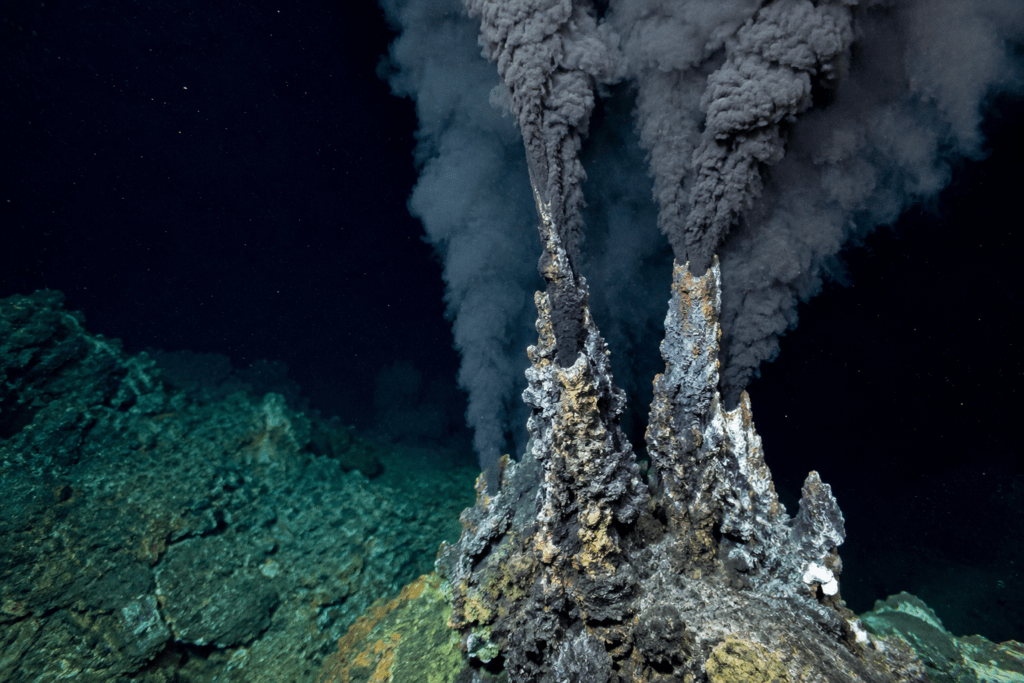
The hydrothermal vent hypothesis is currently the leading contender. The idea is that warm, mineral rich water flowing through cracks in the seafloor created the right chemical gradients and catalysts to stitch together the first organic molecules, eventually leading to self replicating chemistry (NASA Astrobiology).
A separate but related idea, the RNA world hypothesis, suggests that RNA molecules, capable of both storing genetic information and speeding up chemical reactions, came before DNA and proteins, acting as an early all purpose toolkit for life. And then there’s the classic Miller-Urey experiment from 1953, in which chemists Stanley Miller and Harold Urey recreated Earth’s early atmosphere in a lab flask, ran electric sparks through it to mimic lightning, and produced amino acids, the basic building blocks of proteins, essentially by accident.
None of these theories are mutually exclusive, by the way. Most researchers today think the real answer probably borrows pieces from several of them, and we go into more depth on the leading contenders in how did life begin on Earth Understanding the Hadean atmosphere these organisms had to work with helps explain why chemosynthesis, not photosynthesis, came first.
Meet LUCA: The Shared Ancestor Behind All First Life Forms on Earth
Here’s where it gets genuinely mind bending. Every living thing on this planet, from mushrooms to whales to you, traces back to a single common ancestor scientists call LUCA, short for the Last Universal Common Ancestor. LUCA wasn’t the very first living thing. It was simply the last one whose descendants split into the major branches of life we see today: bacteria, archaea, and eukaryotes (the group that includes us).
A comprehensive 2024 study combined genomics, molecular clock analysis, and models of early Earth conditions to estimate that LUCA lived around 4.2 billion years ago (Nature Ecology & Evolution, 2024). According to that research, LUCA was a heat loving, oxygen free organism that fed on hydrogen gas and likely lived in or near hydrothermal vent systems. An earlier genomic survey of nearly 2,000 modern microbial genomes reached a strikingly similar conclusion, describing LUCA as a thermophile that never encountered oxygen in its entire existence (Science, AAAS).
What strikes me most about LUCA isn’t the age estimate, it’s the implication. Every argument you’ve ever had, every sunset you’ve watched, every cell in your body, all of it traces back through an unbroken chain to a heat loving microbe that lived in the dark, ate hydrogen, and never saw a single photon of sunlight.
From First Life Forms to a Breathable Planet: The Great Oxidation Event

For well over a billion years after life began, Earth’s atmosphere had essentially no oxygen in it. That changed with the rise of cyanobacteria, a group of microbes that evolved the ability to perform photosynthesis, splitting water molecules using sunlight and releasing oxygen as a byproduct.
Cyanobacteria are believed to have evolved around 2.7 billion years ago, and their oxygen output eventually overwhelmed the planet’s ability to absorb it, triggering what’s now called the Great Oxidation Event roughly 2.4 to 2.1 billion years ago (ASM.org, 2022). A 2024 geochemical study found this oxygenation process actually unfolded gradually, lasting more than 200 million years rather than happening in one abrupt shift (NatureWorldNews, 2024). We cover the full timeline in when oxygen first appeared in Earth’s atmosphere. For most anaerobic organisms alive at the time, oxygen was toxic. It’s a strange thought: the gas that keeps us alive today functioned as a mass extinction event for the first life forms on Earth and their descendants.
Why Does It Matter What the First Life Forms on Earth Were?
Understanding how the first life forms on Earth emerged isn’t just trivia for a science quiz night. It shapes how astrobiologists search for life on Mars, Europa, and other worlds with similar early conditions to young Earth. If life can start near a hydrothermal vent here, the reasoning goes, maybe it can start the same way somewhere else, hidden under an icy moon’s ocean, far from any sun.
It also reframes something pretty basic about being alive. You and every organism you’ve ever met share a direct, unbroken line of ancestry stretching back roughly 4 billion years, through countless generations of microbes, through the rise of oxygen, through mass extinctions, all the way to a single ancestor living in total darkness near a deep sea vent. That’s not a metaphor. That’s biology.
Frequently Asked Questions
What were the first life forms on Earth called?
Scientists don’t use a single species name, since these organisms predate the classification systems we use today. Researchers generally refer to them as prokaryotic microbes, and the shared ancestor of all life is called LUCA, estimated to have lived around 4.2 billion years ago near hydrothermal vents (Nature Ecology & Evolution, 2024).
How do we know how old these fossils are?
Scientists date the surrounding rock using radiometric dating, which measures the decay of naturally occurring radioactive elements trapped in the minerals. Combined with chemical and structural analysis of the fossils themselves, this lets researchers estimate both the age of the rock and whether the embedded structures are biological in origin.
Were the first life forms on Earth plants or animals?
Neither. They were single celled microorganisms, structurally closer to modern bacteria than to any plant or animal. Complex multicellular life, including the earliest plants and animals, didn’t appear until roughly 1.6 billion years later (EBSCO Research, 2025).
Could life have started somewhere other than hydrothermal vents?
It’s possible. While hydrothermal vents remain the leading hypothesis, some researchers point to shallow hot springs or tidal pools on land as alternative candidates, since certain genetic markers found in LUCA’s reconstructed genome hint at exposure to ultraviolet light, which wouldn’t happen in the deep ocean (Genes, Genomics, Genetics, Epigenetics and the Environment, 2025).
The Bottom Line
So, what were the first life forms on Earth? Based on the best evidence available right now, they were simple, single celled, oxygen free microbes that appeared somewhere between 3.7 and 4.1 billion years ago, most likely near hydrothermal vents on the ocean floor. We can’t pin down an exact date, and honestly, we may never be able to. But the fossil record in Greenland, Australia, and Canada, combined with genetic detective work on LUCA, gives us a remarkably detailed picture of life’s earliest chapter.
Next time you look at a sunset, a garden, or even your own hand, it’s worth remembering where the story actually started: not with something grand, but with a microbe in the dark that simply refused to stop existing.
If you found this breakdown of early Earth useful, you might also want to read our guide to the Hadean Eon for a broader look at the conditions life had to survive, or how did life begin on Earth for a closer look at the leading origin theories mentioned above.

1 Comment