


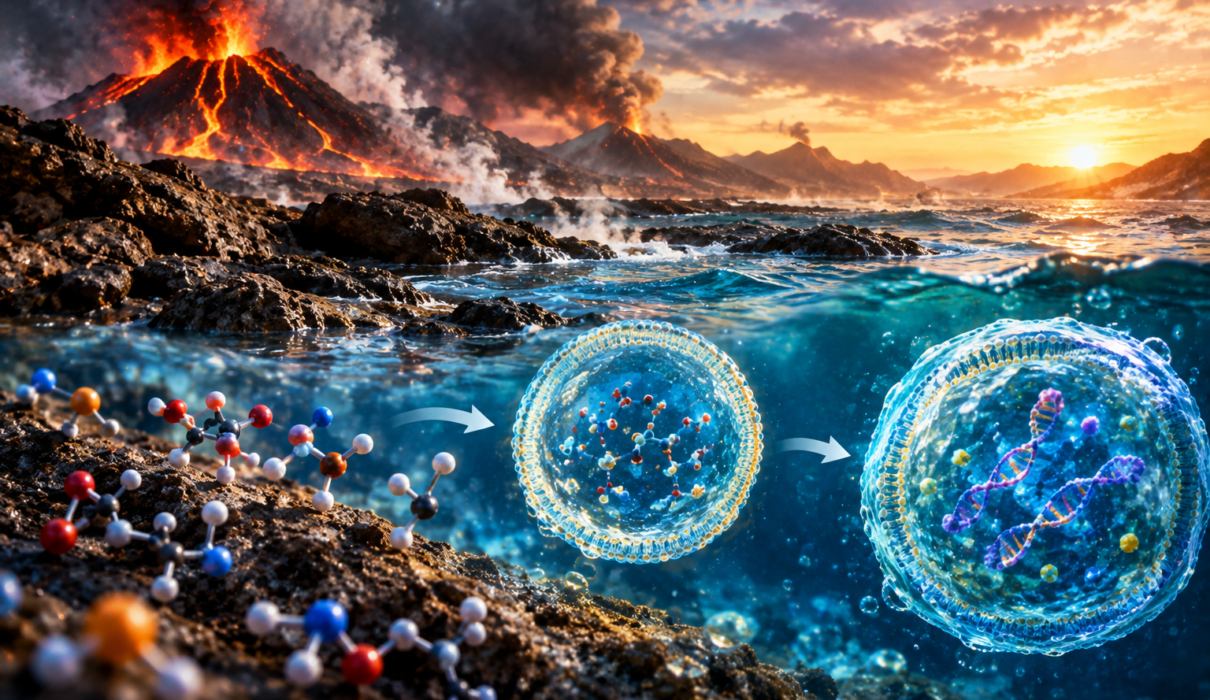
How did the first cells form on Earth? It’s one of the biggest mysteries in science, and honestly, nobody has the full answer yet. But here’s the wild part: researchers have pieced together enough evidence over the past seventy years to sketch a pretty convincing picture of what probably happened, billions of years before anyone was around to see it.
We’re talking about a planet that looked nothing like the one you know. No oceans full of fish, no green hills, not even oxygen to breathe. Just a molten, violent rock slowly cooling down, getting pounded by asteroids, and somehow, out of all that chaos, life managed to spark. If that doesn’t amaze you a little, I don’t know what will.
In this guide, you’ll learn what early Earth actually looked like, the leading scientific theories on how did the first cells form on Earth, what real evidence backs those theories up, and why scientists still argue about the details even today.
Key Takeaways
- Earth is about 4.6 billion years old, and the earliest hints of life may date back 3.7 to 4.3 billion years, based on rock evidence from Quebec, Canada.
- The 1953 Miller-Urey experiment showed that simple gases plus electricity could form amino acids, the building blocks of proteins.
- Most scientists think simple fat bubbles called protocells came before true cells, and a 2024 Scripps Research study helped explain how those bubbles grew tougher and more complex.
- The exact birthplace of life, deep sea vents versus shallow ponds, is still hotly debated.
How Did the First Cells Form on Earth? Setting the Scene
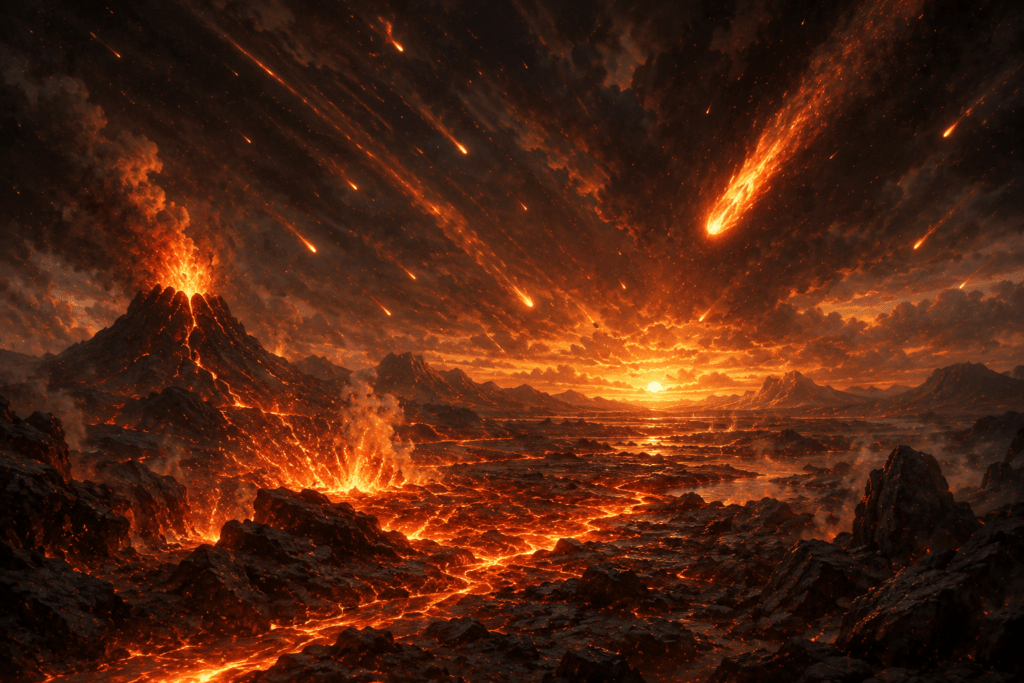
Let’s rewind about 4.6 billion years. Earth had just formed, and it was basically hell on Earth (that phrase actually comes from this exact period, called the Hadean eon). There was barely any solid crust at first. Volcanoes were everywhere. The Hadean atmosphere was thick with gases like methane, ammonia, and water vapor instead of the oxygen rich air we breathe now.
Somewhere in that mess, though, conditions calmed down just enough. Earth’s first oceans formed. Rock cooled. And chemistry, left to its own devices for long enough, started doing something remarkable. It began building more and more complicated molecules out of simple ingredients.
This is the environment scientists point to when they try to answer how did the first cells form on Earth. It wasn’t a single lightning bolt moment, even though lightning probably helped. It was millions of years of trial and error, molecule bumping into molecule, until something finally stuck.
The Leading Theories on How the First Cells Formed on Earth
Nobody was filming this process, so scientists have had to work backward from chemistry, geology, and fossils. A few theories have risen to the top, and each one explains a different piece of the puzzle.
The Primordial Soup Theory

This is the classic one you probably learned in school. In 1953, a graduate student named Stanley Miller, working with his advisor Harold Urey, built a sealed glass apparatus filled with water, methane, ammonia, and hydrogen, the gases they believed matched early Earth’s atmosphere. Then they zapped the mixture with electricity to mimic lightning.
Within just a week, the water turned brownish red and contained more than twenty amino acids, according to Britannica. That result was huge. It proved, for the first time, that the raw materials of life could form from nonliving chemistry alone. No magic required.
Later scientists questioned whether early Earth’s atmosphere really matched Miller and Urey’s exact gas mix, and that’s a fair critique. Still, the experiment’s core idea (simple chemistry plus energy equals life’s building blocks) has held up remarkably well. It remains one of the most cited experiments in origin of life research.
The Hydrothermal Vent Hypothesis
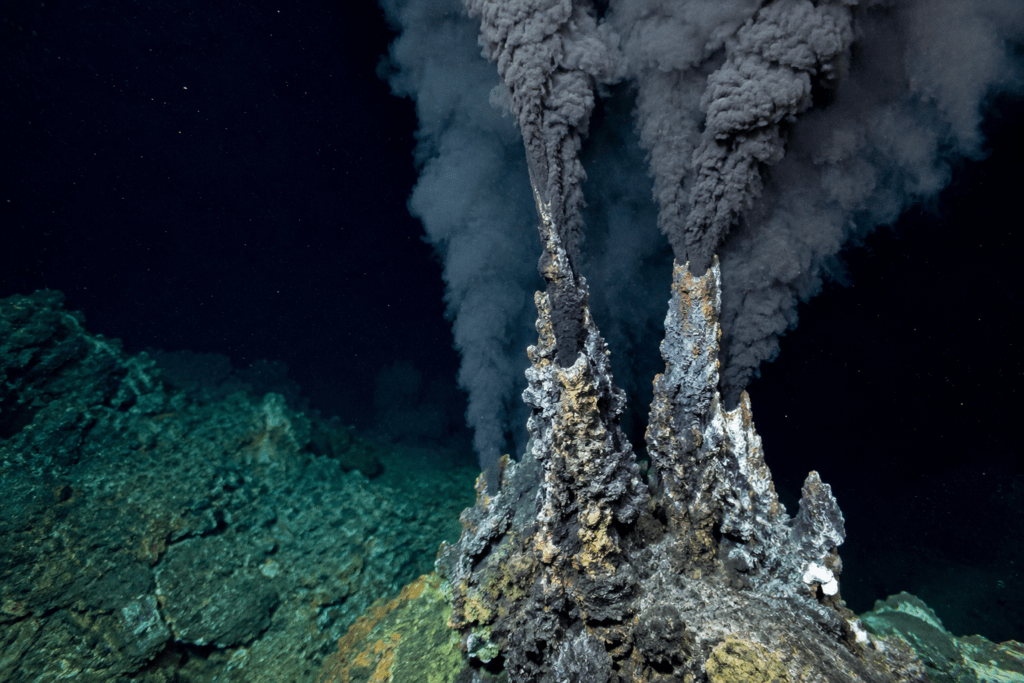
Here’s a theory that always surprises people. Instead of a lightning lit pond, life may have started at the bottom of the ocean, in total darkness.
Deep sea hydrothermal vents spew mineral rich, scalding water from cracks in the seafloor. According to researchers at UC Berkeley, this theory currently has the most supporting evidence behind it, and it suggests life arose in these vents roughly four billion years ago, not long after Earth itself formed. The vents supply a steady stream of chemical energy and mineral surfaces where simple molecules could latch on, react, and slowly grow more complex.
It’s a strange thought, isn’t it? That the story of every living thing on this planet, humans included, might trace back to a crack in the ocean floor that never once saw sunlight.
The RNA World Hypothesis
There’s also a genetics side to this puzzle. Before DNA existed, many scientists believe RNA did the job of both storing information and speeding up chemical reactions, a dual role no single molecule performs quite so well in modern cells. Researchers describe this stage as the RNA world.
A study in the journal PNAS modeled how the raw ingredients of RNA might have formed and linked together in shallow, sun warmed ponds that dried out and refilled over and over, a wet dry cycle that helps chemical building blocks bond together. So there are really two competing birthplaces on the table here: deep sea vents and warm little ponds. Scientists haven’t settled the argument, and that’s honestly part of what makes this field so fun to follow.
How Did Protocells Turn Into Real Cells?

Chemistry alone doesn’t make a cell. You need a container, and that container is a big part of the answer to how did the first cells form on Earth. That’s where protocells come in.
Picture a tiny soap bubble, except instead of soap, it’s made of simple fatty molecules called lipids. Drop lipids into water and they’ll often clump together into little spheres on their own, with no instructions needed. NASA describes this self assembly as one of the most plausible starting points for the first cell-like structures, since these bubbles could trap useful molecules inside while keeping the outside world out.
But early protocells were leaky and fragile. So how did they become sturdy enough to survive, grow, and eventually divide the way real cells do? A February 2024 study from Scripps Research, published in the journal Chem, found a possible answer. Phosphorylation, the process of attaching phosphate groups to molecules, may have happened earlier in this process than scientists previously thought. That extra step helped build tougher, double chained protocell membranes capable of holding chemical reactions and splitting into new copies, according to Scripps Research.
Separately, chemists at UC San Diego found that two simple molecules could react together to form the fatty chains needed for early membranes, chains short enough (under ten carbon bonds) to have realistically existed on primitive Earth, as reported by UC San Diego. Put those two discoveries together and a workable path starts to appear: simple lipids form bubbles, phosphate groups toughen them up, and slowly, generation after generation, those bubbles start behaving less like soap and more like cells.
What Evidence Do We Actually Have?

I’ll be upfront about this: nobody has a fossil of the literal first cell, so no single rock will ever fully answer how did the first cells form on Earth. That moment is lost to deep time. But there’s real, physical evidence that life showed up remarkably early in Earth’s history, and how early it might be still surprises me every time I read the numbers.
Rocks from the Nuvvuagittuq Belt in Quebec, Canada, are now dated to at least 4.16 billion years old, according to a 2025 study in the journal Science, which would make them the oldest known surviving rocks on the planet. Some formations within this same belt show tiny mineral structures that a separate research team has argued could represent the oldest fossil evidence of life yet found, possibly dating close to 3.75 billion years old. On top of that, the Apex chert in Western Australia holds fossilized cell-like structures dated to about 3.465 billion years old, first identified by paleontologist J. William Schopf, and a 4.1 billion-year-old zircon crystal was found carrying a carbon signature typical of living organisms.
Taken together, this evidence tells scientists that life got started fast, geologically speaking. Earth formed 4.6 billion years ago, and some evidence suggests biology, or at least its earliest chemical precursors, was already underway within a few hundred million years of that, which raises a genuinely open question: did life exist in the Hadean eon itself, the planet’s harshest and earliest chapter? That’s a blink of an eye on a cosmic timescale, and it’s still debated exactly how much of this early evidence reflects true biology versus non-biological chemistry that simply mimics it.
Who Was LUCA, and Why Does It Matter?
Once the first true cells existed, evolution took over. Eventually, one population of ancient microbes became the ancestor of every living thing we know today, from mushrooms to whales to you. Scientists call this ancestor LUCA, short for the Last Universal Common Ancestor.
LUCA wasn’t necessarily a single organism. It’s more likely a whole community of related microbes, the ones whose descendants happened to survive and spread while others died out. Genetic reconstructions suggest LUCA thrived in hot, sulfur rich environments, the kind you’d find near a hydrothermal vent, which lines up nicely with the vent hypothesis mentioned earlier. It’s one more piece of the puzzle pointing toward the same rough neighborhood for where this all began.
Common Myths About How the First Cells Formed on Earth
A lot of the popular explanations floating around online oversimplify this story, so let’s clear a few things up.
Scientists have not “solved” the origin of life. They’ve built strong, evidence backed models, but plenty of gaps remain, and researchers openly debate the details. Lightning also didn’t single-handedly create a fully formed cell in one dramatic strike; it was one small piece of a process that took many millions of years. And this isn’t some fringe or unproven field, either. It’s an active area of peer reviewed research at places like NASA, Scripps Research, and UC San Diego, with new findings published nearly every year.
Frequently Asked Questions
How did the first cells form on Earth, according to scientists? Most researchers believe simple lipid molecules self-assembled into protocells, tiny bubble-like containers, which then developed more complex chemistry over millions of years, eventually gaining the ability to hold genetic material and divide, based on findings from NASA and Scripps Research.
When did the first cells appear on Earth? Evidence suggests early life may go back as far as 3.7 to 4.3 billion years, not long after Earth’s oceans formed, though researchers still debate the exact timing and how to interpret the oldest signs of biology.
Where did the first cells form, in the ocean or on land? Two main sites are debated: deep sea hydrothermal vents and shallow, sun warmed surface ponds. Both offer conditions that could support early chemistry, and scientists haven’t reached a full consensus yet.
Was the Miller-Urey experiment proof that life came from nothing? Not exactly. It proved that amino acids, which are life’s building blocks, can form from simple chemicals and energy. It didn’t create a living cell, but it showed the first chemical step toward life is scientifically plausible.
Who was LUCA? LUCA, or the Last Universal Common Ancestor, is the ancient population of microbes from which all current life on Earth descended. Genetic evidence suggests LUCA lived in a hot, sulfur rich environment, likely near a hydrothermal vent.
The Bottom Line
So, how did the first cells form on Earth? The honest answer is that we don’t have every detail nailed down, and maybe we never will completely. But between the Miller-Urey experiment, hydrothermal vent chemistry, the RNA world, and fresh protocell research from labs like Scripps and UC San Diego, scientists have built a genuinely compelling, evidence based story. Simple molecules met energy. Fatty bubbles formed and toughened up over time. Somewhere along the way, chemistry crossed a line into biology.
We’re still filling in the gaps, and honestly, that’s what makes this one of the most exciting corners of science to keep watching. (Source for the 2025 rock dating:CNN.)
