


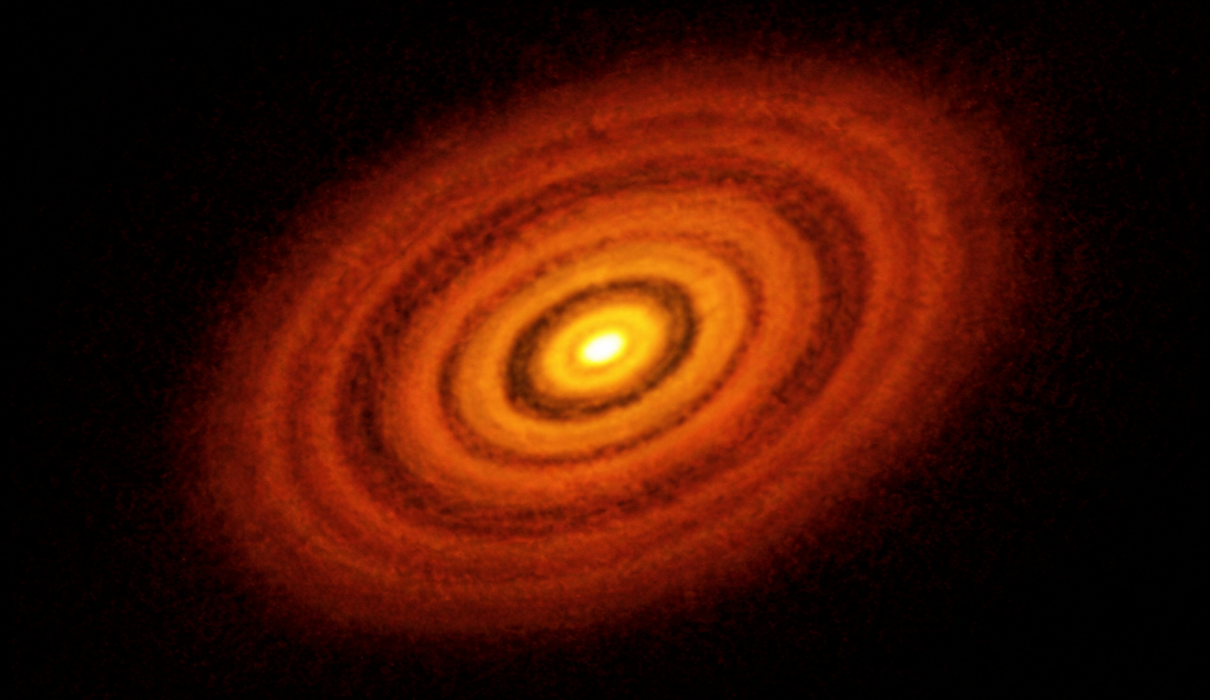
What is a protoplanetary disk? Picture a giant, spinning pancake made of gas and dust, wrapped around a baby star that’s still growing up. That flat, swirling cloud is where every planet you’ve ever heard of, including Earth, actually got its start. It sounds like something out of a science fiction movie, but it’s completely real. Astronomers have photographed these disks with powerful telescopes, and what they found is honestly kind of stunning.
Here’s the short version: a protoplanetary disk is a disk of leftover gas and dust that surrounds a young star. Over a few million years, tiny grains inside that disk clump together, grow bigger, and eventually become planets, moons, comets, and asteroids. You’re standing on the leftovers of one right now, and we’ve actually covered how the solar system formed from that same leftover material in a separate guide. This one focuses on what a protoplanetary disk is made of, how long it lasts, and what scientists have learned by pointing some of the world’s best telescopes straight at one.
Key Takeaways
- A protoplanetary disk is a rotating disk of gas and dust around a young star, and it’s the raw material planets are built from (ScienceDirect).
- Most protoplanetary disks dissipate within about 1 to 10 million years, with an average lifespan close to 3 million years (arXiv, 2025).
- In 2014, ALMA’s image of the HL Tau disk showed clear rings and gaps, the first direct evidence of planets forming in real time.
- Our own solar system formed from a protoplanetary disk roughly 4.6 billion years ago.
Table of Contents
What Is a Protoplanetary Disk, Exactly?
A protoplanetary disk is a rotating disk of dense gas and dust that surrounds a newly formed star, and it’s considered the direct precursor to a planetary system. That’s the textbook definition, and it comes straight from planetary science research (ScienceDirect). But here’s what that actually means in plain English. When a star is born, it doesn’t come out of nowhere. It forms inside a massive cloud of gas, and whatever material doesn’t fall directly into the star gets left spinning around it in a thin, flat disk shape.
Scientists sometimes call this a circumstellar disk, and it’s found around young stars known as T Tauri stars or Herbig Ae/Be stars, depending on their mass. It’s not the same thing as the accretion disks you’d find around a black hole, though the physics shares some similarities. Think of it less like a hole sucking material in and more like a slow, patient workshop where planet-building actually happens.
How Does a Protoplanetary Disk Form?
It all starts with a molecular cloud, an enormous, cold pocket of gas floating in space. When a dense clump inside that cloud gets heavy enough, gravity takes over and the whole thing starts collapsing in on itself. As it shrinks, something interesting happens because of a basic law of physics called conservation of angular momentum. You’ve probably seen a figure skater pull their arms in and spin faster. The collapsing cloud does the same thing, and as it spins faster, it flattens out, kind of like tossing pizza dough into the air and watching it spread into a flat circle instead of staying a lump.
That flattening is what creates the disk. The center of the collapsing cloud becomes the protostar, while the material still orbiting it settles into that rotating, pancake shaped disk. This entire process happens surprisingly fast in cosmic terms, often within just a few hundred thousand years. It’s one of the reasons researchers get so excited when they find a protoplanetary disk that’s only a million years old. That’s basically a newborn, astronomically speaking.
This whole collapse and flatten process is actually the modern version of an old idea. If you want the full backstory, our guide on <u>what the nebular hypothesis is</u> walks through how scientists first figured this out, long before anyone had a telescope powerful enough to prove it.
What’s Inside a Protoplanetary Disk?
So what’s actually in one of these disks? Mostly hydrogen and helium gas, since that’s what most of the universe is made of, plus a smaller amount of solid dust grains. Those grains are made of silicates, carbon based material, and ices, and researchers have found that a typical disk’s total mass adds up to only a few percent of its central star’s mass (arXiv research paper). It’s not much material in relative terms, but it’s more than enough to build entire planetary systems.
Here’s a quick breakdown of what you’ll typically find inside one:
- Hydrogen and helium gas, making up the vast majority of the disk’s mass
- Microscopic dust grains built from silicates and carbon compounds
- Frozen ices, especially further out where it’s colder
- Trace amounts of heavier elements like carbon, oxygen, and nitrogen
- Complex organic molecules, which JWST has recently detected in surprising amounts
That last point matters a lot. In 2023, astronomers using the James Webb Space Telescope found complex chemistry happening inside these disks, including carbon dioxide variants and temperature ranges from around 200 Kelvin near the disk’s middle plane to roughly 500 Kelvin at its surface (phys.org). That’s a huge temperature swing packed into one system, and it helps explain why planets end up so different from one another even when they come from the same disk.
How Long Does a Protoplanetary Disk Actually Last?
Not forever, that’s for sure. Most research puts the typical lifespan of a protoplanetary disk somewhere between 1 and 10 million years, with an average of around 3 million years before the gas disperses. A few disks around smaller, lower mass stars seem to stick around longer, sometimes past 5 million years, according to a 2022 study covered by AAS Nova that suggested planets may actually have more time to form than researchers previously assumed.
Why does the disk eventually disappear? A few things are happening at once. The young star keeps pulling gas inward through accretion, radiation from the star and nearby massive stars burns off material through a process called photoevaporation, and dust grains keep clumping together into bigger and bigger objects that no longer count as “disk material.” Once the gas is gone, the clock runs out. Whatever planets managed to form by that point are what the system is stuck with, more or less permanently.
How Do Planets Actually Form Inside a Protoplanetary Disk?

This is the part that used to be pure theory, and it’s honestly wild that we can now watch it happen. Tiny dust grains inside the disk collide and stick together through simple static and gravity, slowly building up into larger clumps. Over time those clumps become planetesimals, which are rocky or icy bodies that can be kilometers wide. Planetesimals then collide and merge further, eventually forming planetary embryos ranging from moon sized to Mars sized objects. If a disk has enough material left over, some of those embryos keep growing into full sized planets, while gas giants like Jupiter pull in huge amounts of leftover hydrogen and helium before the disk runs dry. We’ve written a full walkthrough of this whole ladder if you want more detail on how planets are formed.
The wildest part is that we’ve actually seen this in progress. When ALMA, a powerful radio telescope array in Chile, imaged the young star HL Tau in 2014, it revealed a series of bright rings separated by dark gaps in the disk. Researchers believe those gaps are cleared out by planets that are actively sweeping up material along their orbits (ALMA Observatory). HL Tau is only about a million years old, and finding such clear structure that early genuinely surprised a lot of astronomers who assumed planet formation took much longer to show visible signs.
What Has HL Tau Taught Us About Protoplanetary Disks?
The HL Tau image, released by the European Southern Observatory in 2014, is honestly one of the most important pictures in modern astronomy, and it still gets cited constantly. It showed a protoplanetary disk located about 450 light years away in the constellation Taurus, with a level of detail that beat what Hubble could achieve at visible wavelengths. That single image has since appeared in more than a thousand scientific papers, which tells you just how much it reshaped the field.
A similar pattern later showed up around a different, older star called TW Hydrae, with gaps located at distances comparable to where Uranus and Pluto sit in our own solar system (ALMA Observatory). Since then, ALMA’s DSHARP survey imaged twenty more nearby disks and found that these rings and gaps aren’t rare outliers at all. They’re common. That single detail changed how scientists think about how often, and how early, planets form.
Did Our Solar System Start as a Protoplanetary Disk?
Yes, and this is where things get personal, because it’s literally your origin story. About 4.6 billion years ago, a cloud of gas and dust collapsed to form the Sun, and the leftover material flattened into what scientists call the solar nebula, essentially our own protoplanetary disk. Our star and its disk came from that exact same collapsing cloud, and we go into that process in more depth in our piece on <u>the formation of the Sun</u>. Every planet, moon, asteroid, and comet in our solar system, along with the metals in your phone and the calcium in your bones, came from material that once floated around in that disk, including the rocky world under your feet.
We can’t travel back in time to photograph our own disk directly, which is exactly why images like HL Tau matter so much. Studying young disks around other stars gives astronomers a working model of what our solar system likely looked like billions of years ago, before Earth even existed. If you want to see what happened to our own planet once that dust finally settled, our guide on how Earth formed picks up the story right where this one ends.
Frequently Asked Questions
What is a protoplanetary disk in simple terms?
A protoplanetary disk is a spinning disk of gas and dust around a young star, and it’s the material that planets, moons, and asteroids eventually form from. Think of it as raw construction material still floating around a newborn star before it gets built into anything solid.
How big is a typical protoplanetary disk?
Protoplanetary disks generally range from a few hundred to about a thousand astronomical units across, according to research on circumstellar discs (arXiv). One astronomical unit equals the distance between Earth and the Sun, so even a modest disk stretches far wider than our entire solar system.
Can you actually see a protoplanetary disk?
Yes, but not with a backyard telescope. Instruments like ALMA and the James Webb Space Telescope use radio and infrared wavelengths to see through the dust and capture detailed images, including the famous 2014 photo of the HL Tau disk with its visible rings and gaps.
Is a protoplanetary disk the same as an accretion disk?
Not quite. They’re similar in shape, but an accretion disk is generally hotter, spins faster, and can form around objects like black holes, not just stars. A protoplanetary disk is specifically the planet forming material around a young star.
The Bottom Line
So, what is a protoplanetary disk? It’s a spinning cloud of gas and dust around a newborn star, and it’s genuinely the birthplace of every planet, moon, and asteroid we know about, including the ground under your feet. These disks typically last somewhere between 1 and 10 million years before the gas disperses, and in that surprisingly short window, dust grains manage to build entire worlds.
What gets me every time I read about this is how fast it all happens on a cosmic scale. A few million years sounds like forever to us, but compared to a star’s multi billion year lifespan, it’s a blink. Next time you look up at a clear night sky, remember that somewhere out there, a young star is doing right now exactly what our Sun did 4.6 billion years ago, quietly building a family of planets out of leftover dust.
If you want to keep following that timeline forward, from the dust in this disk all the way to the first signs of life, our piece on whether life existed in the Hadean eon picks up right where this one leaves off.
