


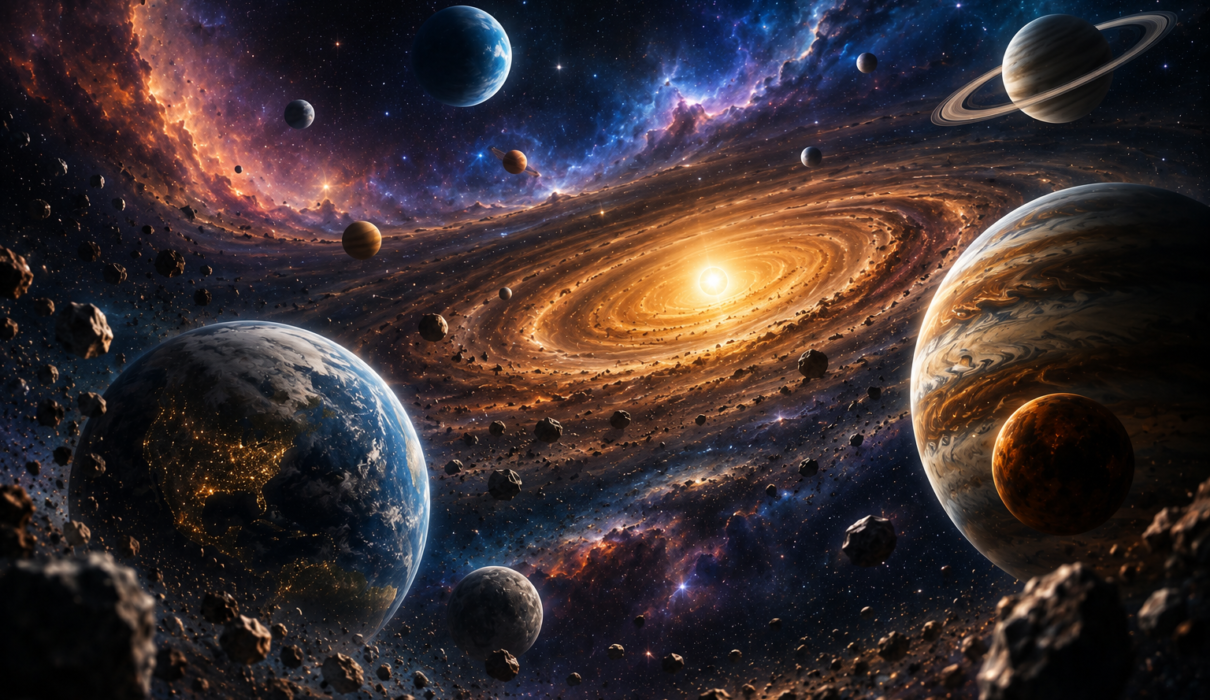
Look up at the night sky and it’s easy to think planets have just always been there, quietly circling the Sun like they were carved from stone. They weren’t. Every planet you can name, Earth, Mars, Jupiter, Saturn, started out as nothing more than a speck of dust floating in a cloud of gas. So how are planets formed, exactly? The short answer is that they grow, slowly, from tiny grains that stick together and keep sticking together until, millions of years later, you’ve got a full sized world.
This isn’t a guess. Scientists have pieced the story together using telescopes that photograph baby star systems in the act of building planets, meteorites that still carry a chemical fingerprint from the very beginning, and computer models that test whether our theories actually hold up. According to NASA Science, our Sun came from the middle of a big cloud in space, and the planets of our solar system also formed from that same cloud, roughly 4.6 billion years ago.
In this guide, you’ll learn exactly how do planets form, step by step, why some planets ended up rocky while others became gas giants, how long the whole process actually took, and what evidence convinces scientists this theory is right. By the end, you’ll understand planet formation well enough to explain it to a curious kid, and honestly, once you see the full picture, it’s hard not to want to explain it to someone.
Key Takeaways
- Planet formation begins inside a collapsing cloud of gas and dust, not from nothing.
- Our solar system, and every planet in it, formed about 4.6 billion years ago, confirmed by dating meteorites (Wikipedia, 2026).
- Dust grains grow into planetesimals, then protoplanets, then full planets over millions of years.
- Rocky planets and gas giants form differently because of a temperature boundary called the frost line.
- Telescopes like ALMA have photographed other solar systems building planets right now, which is remarkable evidence this process is real.
Table of Contents
What Is Planet Formation?
Planet formation is the process by which a planet grows out of the leftover gas and dust surrounding a newborn star. It isn’t a single event. It’s a chain of smaller events, dust grains bumping into each other, sticking, growing, colliding again, that plays out over millions of years.
Here’s a simple way to picture it. Imagine rolling a snowball down a snowy hill. It starts tiny, but every bit of snow it rolls over adds to its size, and the bigger it gets, the more snow it picks up with each rotation. Planet formation works on a similar snowball principle, except instead of snow, you’ve got dust, ice, and rock, and instead of a hill, you’ve got a spinning disk around a young star.
This is the process that built every planet in our solar system, and based on everything astronomers have observed with modern telescopes, it appears to be how planets form around other stars too.
Where Do Planets Come From?
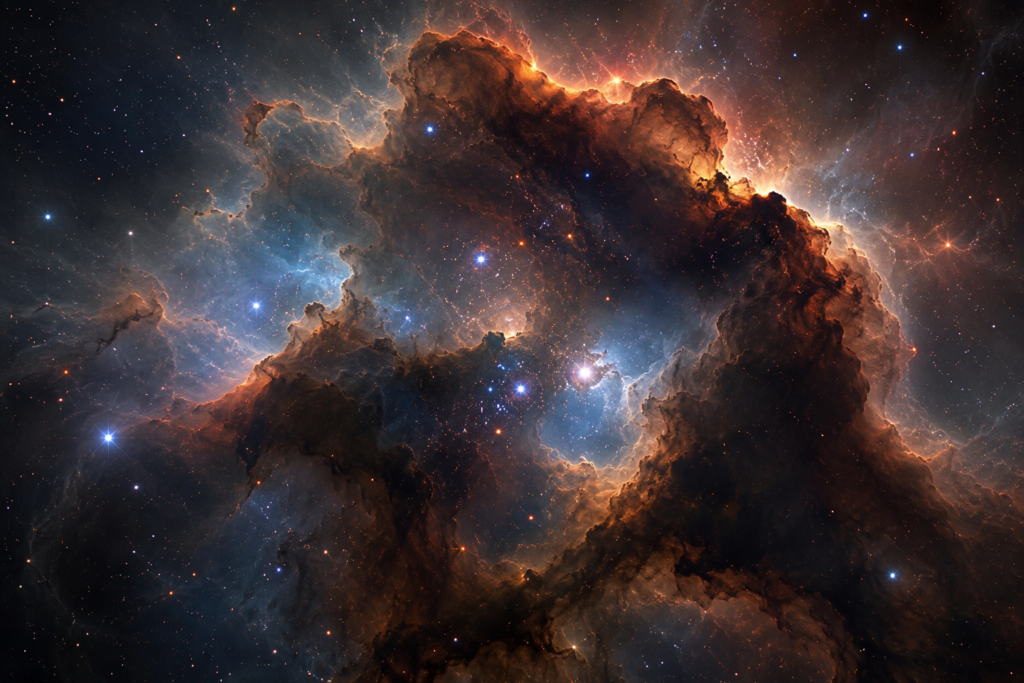
Before there’s a planet, before there’s even a star, there’s a cloud. Understanding where planets come from means starting with three ingredients: a giant molecular cloud, a solar nebula, and a protoplanetary disk.
Giant molecular cloud. Stars form in massive and dense clouds of molecular hydrogen called giant molecular clouds, explains the nebular hypothesis entry on Wikipedia. These clouds are gravitationally unstable, and matter coalesces within them into smaller, denser clumps that eventually rotate, collapse, and ignite into stars.
Solar nebula. When one of those dense clumps collapses under its own gravity, it heats up and starts spinning faster (think of a figure skater pulling in their arms). Astronomers call this collapsing, spinning clump the solar nebula, the raw material that will eventually become both a star and its planets.
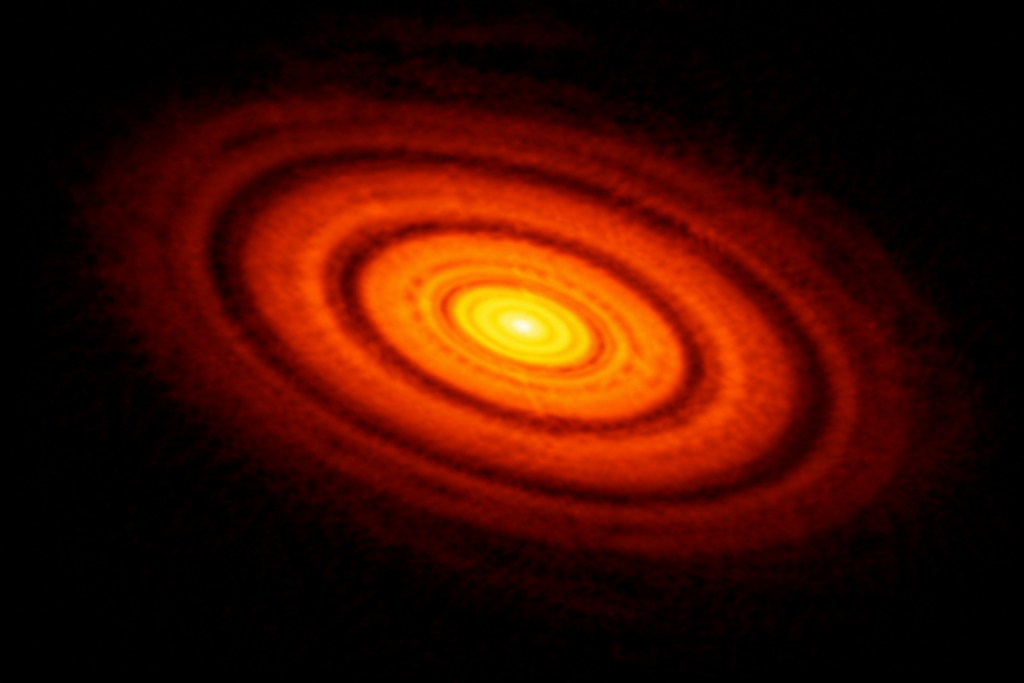
Protoplanetary disk. As gas falls toward the center, it heats up and rotates faster, flattening into a disk. The glowing central mass becomes a newborn star, while farther out in the disk, solid particles of rock and ice collide and merge to build up ever larger objects, according to NASA’s overview of planetary systems. This protoplanetary disk is the nursery where planet formation actually happens, and it can stretch more than 100 times Earth’s distance from the Sun.
How Are Planets Formed? (Step by Step)
This is the heart of the question. So how are planets formed, from that first spinning disk all the way to a finished world? It happens in six overlapping stages.
A Star Begins to Form
Everything starts with gravity. A region inside the giant molecular cloud gets dense enough that its own gravity takes over, and the cloud begins to collapse inward. As the material falls toward the center, it heats up, and eventually the pressure and temperature at the core get high enough to ignite nuclear fusion. That’s the moment a true star is born, and in our case, that star is the Sun.
A Disk of Gas and Dust Forms
Not all the material falls into the new star. The action of molecules bumping into each other over and over slowly caused the pre-solar nebula to flatten into a spinning disk of dust and gas, sometimes called a circumstellar disk. This leftover material, spinning around the young Sun, is the raw ingredient list for every planet that would eventually form.
Tiny Dust Grains Stick Together
Inside that disk, microscopic dust grains, smaller than a grain of sand, start colliding at low speeds. Instead of bouncing apart, they stick together through weak electrostatic forces, kind of like how lint clings to a sweater. It’s a slow process, but it’s the very first step of actual planet building, and it’s honestly wild that something as delicate as static cling is where every planet’s story begins.
Planetesimals Form
As grains keep clumping, they grow from dust sized specks to pebbles, then boulders, then objects a kilometer or more across. Scientists call these planetesimals. There’s still real debate about exactly how they jump from pebble sized to kilometer sized so quickly, but research suggests planetesimal formation may have been triggered within the first half a million years by dust piling up at specific locations in the disk.
Protoplanets Grow
Once planetesimals exist, gravity starts doing more of the heavy lifting. Larger planetesimals pull in smaller ones, growing faster and faster in a runaway process. If the disk is massive enough, runaway accretion begins, resulting in the rapid formation, taking just 100,000 to 300,000 years, of Moon to Mars sized planetary embryos. These embryos are what scientists call protoplanets.
Full-Sized Planets Emerge
In the final stage, planetary embryos near the star go through a stage of violent mergers, producing a handful of terrestrial planets, a process that takes roughly 100 million to a billion years to fully settle. Farther out, where ice is more abundant, protoplanets can grow massive enough to pull in huge envelopes of hydrogen and helium gas, becoming gas giants. Once this stage wraps up, you’ve got a stable, fully formed planetary system, which is exactly how our own solar system ended up looking the way it does today.
Why Are Some Planets Rocky and Others Gas Giants?
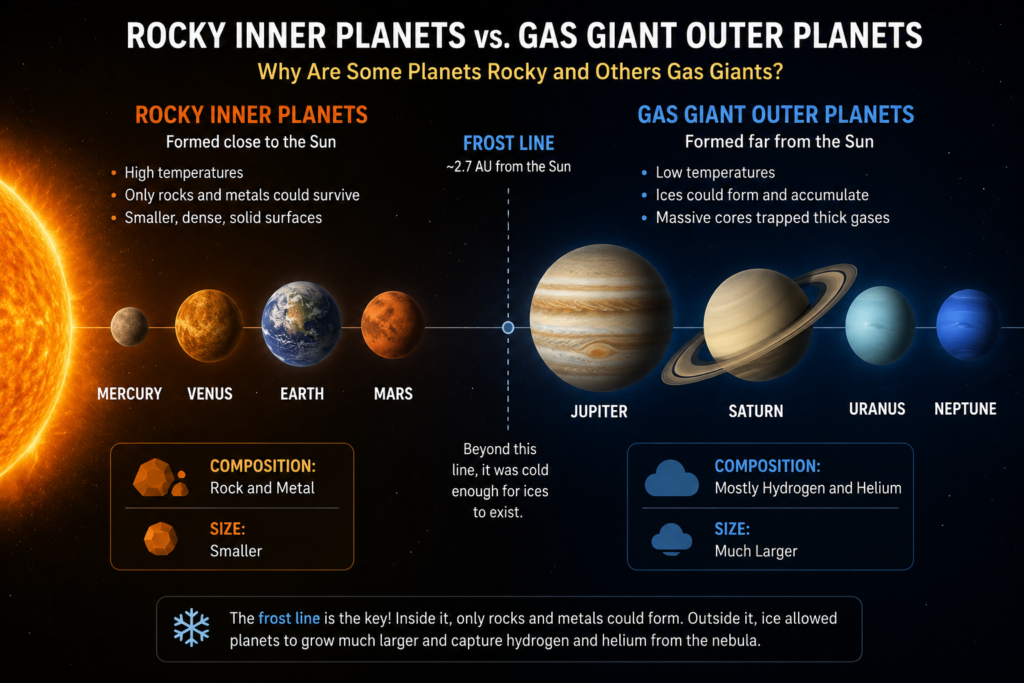
If you’ve ever wondered why Mercury is a scorched ball of rock while Jupiter is a swirling giant made mostly of gas, the answer comes down to temperature and a boundary called the frost line.
Beyond the frost line, water ice joined rocky and metallic dust grains, effectively doubling or tripling the mass of solids available for accretion. This boost allowed cores in the outer solar system to grow far more rapidly and to much greater sizes than their inner counterparts. Close to the Sun, it’s too hot for ice to survive, so only rock and metal condense, which is why Mercury, Venus, Earth, and Mars ended up small and rocky.
Once these outer cores reached a critical mass, estimated at around 10 Earth masses, their gravity became strong enough to capture vast quantities of hydrogen and helium gas directly from the surrounding nebula, building the gas giants we see today: Jupiter, Saturn, Uranus, and Neptune. In other words, the same planet formation process produced two very different outcomes, purely because of where each planet happened to form relative to the frost line. That single boundary line is doing a lot of work in shaping our entire solar system, which still catches me off guard every time I think about it.
How Long Did Planet Formation Take?
This is where planet formation gets genuinely surprising, because the timeline isn’t uniform at all. Dust grains stick together in a matter of years. Planetesimals can form within roughly half a million years of the disk’s birth. Rocky planetary embryos assemble in as little as 100,000 to 300,000 years, but the final violent merger stage that builds a full sized rocky planet like Earth drags on for 100 million to a billion years.
Gas giants are trickier. Older models suggested it took tens of millions of years for their solid cores to form, which was a problem, because protoplanetary disks tend to dissipate within just a few million years, according to reporting in Quanta Magazine, not leaving enough gas around to build a Jupiter sized planet.
Newer research proposes that a single large planetesimal can sweep up material like a vacuum cleaner, growing to a huge size in just a few million years instead, which would explain how gas giants managed to grab their thick atmospheres before the surrounding gas disk disappeared. Either way, we’re talking about millions of years for the fast stages and hundreds of millions for the slow ones. Planet formation isn’t a single event you could point to on a calendar. It’s a long, layered process.
What Evidence Shows How Planets Form?
None of this is speculation dressed up as science. Four separate lines of evidence back up how planets form, and they all point in the same direction.
Direct images of protoplanetary disks give astronomers a literal photograph of planet formation in progress. In 2014, the European Southern Observatory reported that ALMA had captured an image of the disk around the young star HL Tauri showing multiple concentric rings separated by clearly defined gaps, structures that suggest planet formation was already well underway. HL Tauri’s disk appeared far more developed than expected for a star that young, hinting that planet formation may happen faster than scientists previously assumed.
Meteorites work like time capsules. Calcium aluminum rich inclusions found inside carbonaceous chondrite meteorites have been radiometrically dated to about 4,567 million years old, making them the oldest known solids in the solar system, and that number is essentially the birth certificate for our entire planetary system.
Computer simulations let researchers test the theory under different conditions. Models of pebble accretion, runaway growth, and disk evolution consistently reproduce systems that look like ours, complete with small rocky planets close to the star and gas giants farther out.
And then there are exoplanets. As of mid 2026, the NASA Exoplanet Archive lists more than 6,000 confirmed planets orbiting other stars, and while our own solar system hosts an equal number of rocky and giant planets, rocky planets actually appear to be more common across the universe as a whole. Every new exoplanet discovery gives scientists another data point to test planet formation theory against, and so far the theory keeps holding up remarkably well.
What Happened After Earth Formed?
Once Earth finished assembling from planetesimals and protoplanets, roughly 4.5 billion years ago, its story was far from over. The planet entered a violent early period known as the Hadean Eon, marked by intense volcanic activity, a molten surface, and a massive collision with a Mars sized object that’s thought to have formed our Moon. Curious what happened in those first chaotic hundreds of millions of years? Read our full breakdown of what the Hadean Eon was actually like, or explore how Earth eventually cooled enough to develop its first atmosphere and its first oceans.
Frequently Asked Questions
Can planets still form today?
Yes, though not around our Sun anymore, since our solar system’s protoplanetary disk dissipated billions of years ago. Astronomers regularly observe planet formation happening right now around young stars like HL Tauri, which is only about a million years old and still surrounded by an active protoplanetary disk (ALMA Observatory, 2014).
Do all stars have planets?
Not every star hosts planets, but current estimates suggest planetary systems are extremely common throughout the galaxy. With over 6,000 confirmed exoplanets already cataloged and thousands more candidates awaiting confirmation, researchers increasingly think planet formation is closer to the rule than the exception for young stars.
What is a planetesimal?
A planetesimal is a solid object, typically a kilometer or more across, formed when dust grains and pebbles collide and stick together inside a protoplanetary disk. Planetesimals are the direct building blocks of protoplanets, and the asteroids and comets in our solar system today are essentially leftover planetesimals that never got incorporated into a full planet.
What is a protoplanet?
A protoplanet is a planetary embryo, roughly Moon to Mars sized, that forms when planetesimals collide and merge through runaway accretion. Protoplanets are the next to last stage of planet formation. Given enough time, and enough additional collisions or gas capture, a protoplanet can grow into a full sized planet.
The Bottom Line
So, how are planets formed? They start as dust. That dust sticks together into pebbles, the pebbles build into planetesimals, planetesimals merge into protoplanets, and protoplanets slowly become the full sized worlds we recognize today, some rocky, some gas giants, depending entirely on how close they formed to their star. It’s a process that took our own solar system somewhere between 4.5 and 4.6 billion years to complete, and it’s a process astronomers can now watch happening in real time around other stars.
Next time you look up and see Jupiter as a bright point of light, or you’re standing on solid ground here on Earth, it’s worth remembering that every bit of it started as a speck of dust smaller than anything you could see. That’s a genuinely humbling thought, isn’t it?
