


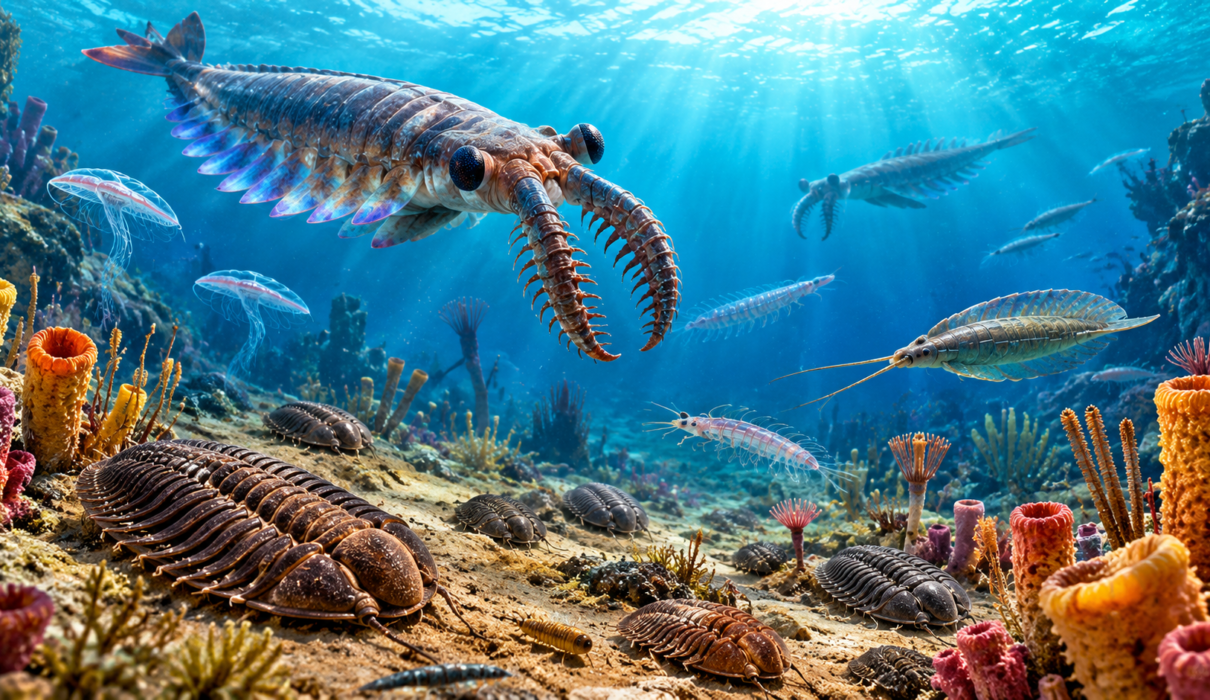
What caused the Cambrian explosion? Honestly, it’s one of the best mysteries in all of science, and nobody has fully cracked it yet.
Picture the ocean about 541 million years ago. Before this moment, the sea held very few animals with hard parts. Then, in a blink of geological time, it fills up with creatures that have eyes, legs, shells and spines. Hunters appear. Prey learns to hide.
So what flipped the switch? Stick with me, because there are five big clues. By the end, you’ll know which ones scientists lean on most, and which ones still start arguments.
Key Takeaways
- The big burst of animal life started about 541 million years ago and lasted roughly 20 million years, based on a study of trilobite fossils.
- Nobody has proven one single answer to what caused the Cambrian explosion. A mix of causes is the best bet.
- The five clues are oxygen, seawater chemistry, genes, eyes and hunters, and ecosystems pushing each other.
- Every clue has fans and critics, and that’s exactly why the debate is still alive.
Table of Contents
What Caused the Cambrian Explosion? The Short Answer

Here’s the honest short answer to what caused the Cambrian explosion: scientists haven’t pinned it on one thing. One research paper on the topic says a combination of ecological, environmental, genetic and developmental factors was probably involved (Holland, a review on PubMed Central).
Picture a long row of dominoes, the kind you’ve probably set up on a rainy afternoon. One tile falls, then the next, then the next. Our job’s to find out which one fell first.
Here’s the lineup we’ll walk through:
- Clue 1: a rise in oxygen
- Clue 2: changes in seawater chemistry
- Clue 3: new genetic tools
- Clue 4: eyes and a hunter versus prey arms race
- Clue 5: ecosystems pushing each other to change
I’ll tell you what each clue says, where it’s strong, and where it wobbles. When the science isn’t settled, I’ll say so. You deserve the real story, not a tidy one. And if you’re new to early life, warm up with the first life forms on Earth first.
How Fast Was the Cambrian Explosion, Really?

The word “explosion” is a little dramatic, and it’s easy to picture the wrong thing. Nothing blew up. It just happened fast, at least on the clock of Earth’s history.
A team studied trilobites, a famous group of extinct sea animals, and measured how quickly their bodies changed over time. They found that the fast burst began around 541 million years ago and was finished by about 521 million years ago, so roughly 20 million years (the PNAS trilobite study).
Twenty million years still feels odd to call a blink. Yet next to the whole story of life, that’s exactly what it is.
Other scientists use slightly different dates. The Natural History Museum in London, for example, describes the burst as 545 to 530 million years ago (Natural History Museum). So treat the numbers as a range, not a stamp.
Clue 1: Did Oxygen Spark the Cambrian Explosion?
Animals need oxygen to power their bodies, a bit like a campfire needs air. Big, busy animals need even more. That’s why oxygen is the oldest and most popular idea. The Burgess Shale science team at the Royal Ontario Museum explains that photosynthesis could have raised oxygen in the seas and air, which would allow larger animals with breathing and blood systems (Royal Ontario Museum).
If you’re asking what caused the Cambrian explosion, oxygen is the answer you’ll hear first.
Curious where all that oxygen came from? Here’s the story of when oxygen first appeared in Earth’s atmosphere, plus a look at what the Great Oxygenation Event was.
What the Chemistry Says
Scientists can read ancient oxygen levels from metals locked in old sea mud. One team measured a metal called molybdenum in rocks from South China. Their results suggest modern like ocean oxygen showed up around 521 million years ago, right when trilobites and nearly all the animal groups were appearing (a molybdenum study on PubMed Central).
That’s a neat match. Maybe too neat?
Why Scientists Still Disagree About Oxygen
Here’s the catch. The Burgess Shale team points out that oxygen doesn’t seem to have changed much across the line between the Ediacaran and the Cambrian. They add that a later rise might have let animals swim and hunt, which means oxygen could be a result instead of a cause.
The molybdenum paper itself admits that deep ocean conditions in the early Cambrian aren’t settled. It also notes that some researchers think ocean oxygen didn’t reach today’s levels until much later.
My take? Oxygen probably built the stage. Whether it lit the fuse is a harder question.
Clue 2: Seawater Chemistry and the First Hard Shells
Now let’s talk shells. To build a shell or a skeleton, an animal needs the right ingredients in the water, and calcium is a big one. Researchers studied tiny drops of ancient seawater trapped inside salt crystals. They found that calcium in the sea rose about threefold during the early Cambrian (a Geological Society of America abstract).
The authors suggest this may have made it easier for animals to build skeletons from calcium carbonate and calcium phosphate.
Is it proven? No. The abstract only calls it a suggestion. It’s also from 2002, so newer work may have refined it, and I’d say it explains hard parts better than it explains new eyes, legs or body shapes. So treat it as one piece in the puzzle of what caused the Cambrian explosion, not the whole picture.
Clue 3: What Caused the Cambrian Explosion? Look Inside Animal Genes
Every animal body gets built from instructions written in DNA, so maybe that’s where the secret hides. The Burgess Shale team notes it could be argued that the fuse was lit once the ancestor of all modern animals reached a level of genetic complexity, including Hox like genes, high enough to create brand new body plans.
Hox Genes: The Body Plan Builders
Hox genes act like a blueprint for a building. They help decide where the head goes and where the tail goes. One researcher proposed that when Hox and related genes were copied and changed, animals could build more complex bodies, including a mouth at one end and a separate exit at the other (Holland’s review again).
Cool, right? It also shows how a tiny change in DNA can reshape a whole animal.
There’s a twist, though. The Natural History Museum says molecular dating of living animals predicts that a shared set of eye building genes appeared before the Cambrian even began. So the toolkit may be older than the explosion.
Picture owning a piano for years before anyone plays a song. The piano matters, but it isn’t the music. That’s how I think about genes here: they gave animals the tools, and something else probably pushed them to use those tools.
Want the backstory? Animals had to inherit their building blocks from somewhere, and that story starts with how Earth’s first complex cells evolved.
Clue 4: Eyes, Hunters and an Ancient Arms Race

Now for my favorite one. Imagine playing hide and seek, and suddenly the seeker can actually see you. Everything’s different.
That’s roughly what some scientists think eyes did. The Natural History Museum says the evolution of the eye was likely a catalyst, starting an arms race between animals that were becoming more aware of their surroundings. Fossils show complex, well developed eyes by about 517 million years ago, and the museum describes Anomalocaris as a formidable predator of that time.
Here’s how the idea works. Hunters get sharper senses, so prey needs armor, spines, burrows or speed. Then hunters need better claws, and prey needs even better armor. Each side pushes the other.
Does this answer what caused the Cambrian explosion? Maybe part of it. Honestly, it’s the clue that makes me want to travel back in time with a snorkel.
Not everyone’s sold, and eyes may be one piece among several. That’s fair. Science works best when people poke holes in good ideas.
Clue 5: Ecosystems Pushing Each Other to Change

The last clue says the answer might not be outside the animals at all. According to the Burgess Shale team, the explosion may have come from complex interactions between animals, with different residents of the same ecosystem pushing each other to evolve. Scientists call this coevolution.
Think of a school playground. One kid gets a faster bike, so the next kid wants one too. Soon everyone’s racing, and nobody remembers who started it.
This idea fits nicely with the eyes and hunters story. It also explains why one trigger wouldn’t be enough to answer what caused the Cambrian explosion. A small push could snowball when many living things respond to each other at once.
Why Darwin Worried About the Cambrian Explosion
Charles Darwin felt the puzzle behind what caused the Cambrian explosion long before it had a name. In On the Origin of Species in 1859, he admitted he had no satisfactory answer for why rich fossils weren’t found in rocks older than the Cambrian. That worry became known as Darwin’s dilemma (a review of the Ediacaran fossil record).
Since then, fossil hunters have uncovered Ediacaran fossils from the time just before the Cambrian. That fills in part of the story, but it doesn’t explain the fast burst itself.
I find it kind of comforting that Darwin didn’t pretend to know. He said what he didn’t know, and that’s exactly what good scientists do.
So, What Caused the Cambrian Explosion? What Scientists Mostly Agree On
So, what caused the Cambrian explosion? Most of the evidence points to a team effort. Oxygen and seawater chemistry likely set the stage. Genes supplied the tools. Eyes and hunting probably turned up the pressure, and ecosystems kept feeding on themselves as every new change forced the next one.
I’m not fully certain about the order of events, and honestly, nobody is. The start and end dates don’t match across sources. The oxygen story isn’t settled. And no single clue has been proven on its own. If someone tells you the mystery is completely solved, be a little suspicious.
Frequently Asked Questions
What caused the Cambrian explosion in simple words?
The best answer to what caused the Cambrian explosion is a mix of things. More oxygen, richer seawater, useful genes, the arrival of eyes and hunters, and animals pushing each other to change all likely played a part. Scientists haven’t proven one single cause yet.
How long did the Cambrian explosion last?
A study of trilobite fossils suggests the fast burst lasted about 20 million years, starting near 541 million years ago and finishing by about 521 million years ago. Other scientists give slightly different windows, so the exact length is still debated.
Was the Cambrian explosion really sudden?
It was fast, but only by geological standards. Twenty million years is a long time to us, and that’s fair. Ediacaran fossils also show that complex life existed just before the Cambrian, so the story is less like a sudden switch and more like a speed up.
Did oxygen cause the Cambrian explosion?
Maybe, but scientists don’t agree. Some data link rising ocean oxygen to the burst, while other evidence suggests oxygen changed little across the boundary or rose afterward. Oxygen probably helped animals grow bigger and more active, but whether it started everything isn’t clear.
Final Thoughts
Now you know what caused the Cambrian explosion, or at least the best clues we’ve got. Oxygen, shells, genes, eyes and ecosystems each tell part of the tale. Together, they paint a picture of a planet where life suddenly got busy.
Here’s a question for you: which clue feels most convincing? I’d love to hear your pick in the comments, and if you’ve seen Cambrian fossils at a museum, tell us about it.
If you enjoyed this, read how life began on Earth next.

2 Comments