


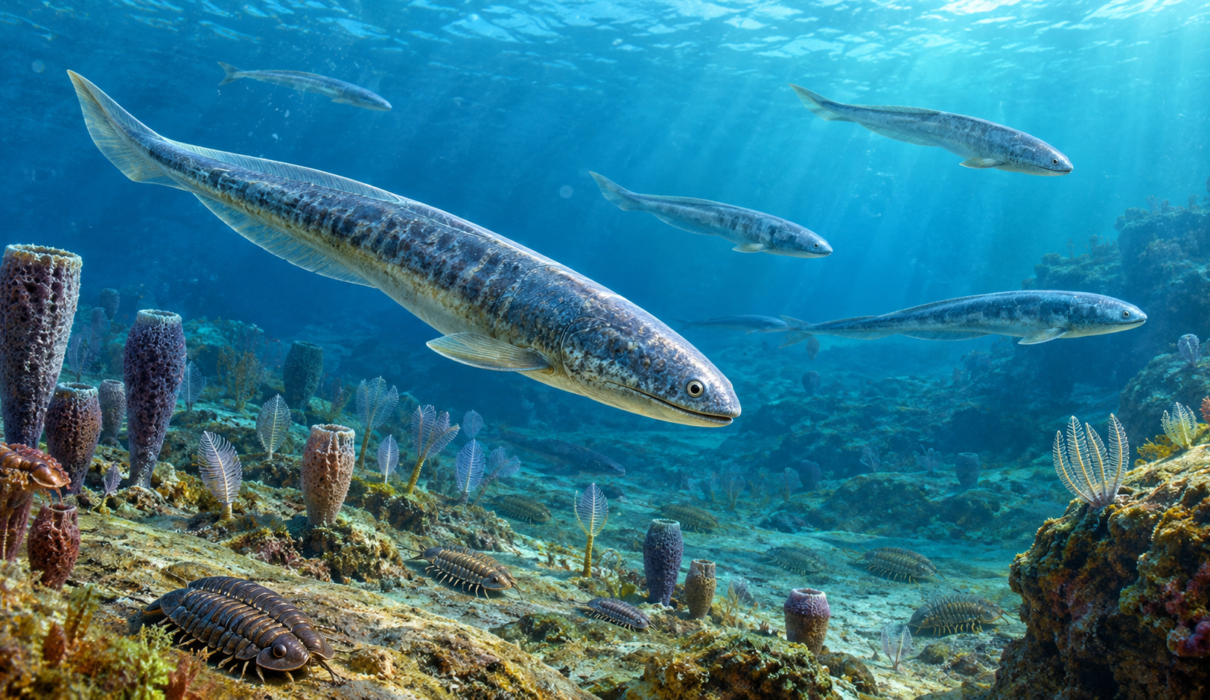
Picture the ocean more than 500 million years ago. No sharks, no frogs, no people. Not a single backbone was anywhere in sight, which is a strange thing to picture. So how did the first vertebrates evolve, and how did a tiny swimmer become the great great grandparent of every fish, bird, lizard and human? Here’s the wild part. The answer hides in old rocks, in baby animal cells and in genes that got copied by accident. Stick with me, because you’ll finish this post knowing the key fossils, the strange cells behind the story and the one body part that changed the sea forever.
I’ve checked every fact below against journals, university archives and museum research pages. The links sit right in the text, so you can read the originals yourself. Where scientists still argue, I’ll say so plainly.
Short on time? Here are four quick answers to “how did the first vertebrates evolve?”
- The oldest known fossil vertebrates come from Chengjiang in China, and they’re no older than about 518 million years.
- Those early fish didn’t have jaws, and hard armor showed up later.
- A special group of embryo cells called the neural crest helped build the head and face.
- Jaws came next, and today more than 99% of living vertebrate species have them.
How Did the First Vertebrates Evolve? The Short Answer
How did the first vertebrates evolve? Step by step, and over a very long time. Soft sea animals with a stiff rod down their backs slowly gained a head, eyes and gills. Later came a special group of embryo cells, then hard armor, and finally jaws.
Think of building a car one part at a time. First you’d get a frame, then wheels, then doors and a roof. Nobody could drive the finished car on day one, and nature couldn’t make a shark on day one either.
If you’re curious about the bigger burst of animal life around this time, here’s what caused the Cambrian Explosion.
Who Were the First Vertebrates?
A vertebrate is an animal with a skull and, in most cases, a backbone. That’s you, your dog and the goldfish at the pet shop. When people ask, “How did the first vertebrates evolve?” scientists usually point to a place in southern China first. It’s called Chengjiang. Before those fish came simpler creatures, and you can meet them in what were the first animals on Earth.
The rocks there preserve soft animals in remarkable detail. A 2018 dating study measured tiny zircon crystals from the fossil layer, and the youngest gave an age of about 518 million years. That’s a maximum age, so these animals lived at that time or later.
In 1999, a team reported two small fish from Chengjiang in the journal Nature. Both were jawless. One looked a bit like a lamprey, while the other was closer to a hagfish.
Before that, the oldest sure jawless fish were about 475 million years old. So these two pushed the record back by tens of millions of years. The authors even guessed that the wider chordate family, the group that includes vertebrates, began in the Ediacaran, around 555 million years ago or earlier. Honestly, that number still surprises me every time I read it.
Meet Two of the First Vertebrates: Myllokunmingia and Haikouichthys

Picture a small swimmer, closer to a lamprey than a goldfish. It didn’t have jaws and, as far as we can tell, it didn’t wear bony armor. Think of a soft body built for wiggling through water. That’s the kind of animal these two were.
Metaspriggina: A Fish With a Hint About Jaws

Next stop is Canada. Metaspriggina comes from the Burgess Shale and is about 505 million years old, which makes it the second oldest fish occurrence, according to the Royal Ontario Museum. It’s rare too. Out of more than 200 species and 200,000 specimens found there since 1909, only this one can be placed among the fish.
A 2014 paper in Nature studied about 100 specimens, including new ones from a 2012 expedition. The researchers saw seven pairs of gill arches, and they suggested the thicker front pair might hint at how jaws got started. That’s their interpretation, so treat it as a strong clue, not a final answer.
What New Body Parts Helped the First Vertebrates Evolve?
Fossils can’t show everything. To learn about the hidden stuff, scientists compare genes and embryos. Ask “how did the first vertebrates evolve?” and a fossil hunter and a gene scientist will tell you different halves of the story. Both halves matter, though, and one cell group stands out.
The Neural Crest: How the First Vertebrates Got a Face

So, how did the first vertebrates evolve a head with a face? Much of it starts with the neural crest. It’s a group of cells in the embryo, and only vertebrates have it. A research review on PubMed Central explains that many new features of vertebrates come from these cells, so their origin looks like an important milestone in early vertebrate history.
Neural crest cells also travel. They move long distances through the embryo, then turn into cartilage, bone, nerves and more, as a 2023 review in the journal Biology describes.
Did Gene Copying Help the First Vertebrates Evolve?
Here’s a fun twist. Vertebrate genomes show signs of whole genome duplication, which is when an animal’s entire set of genes gets copied by accident. Spare copies can try new jobs, since the original’s still doing its old one. The 2023 review says recent studies support at least one copying event near the base of the vertebrates, with a second round in jawed vertebrates. Older papers talked about two early rounds, so scientists haven’t settled on the exact count.
The same review concludes that the neural crest network started before the copying. So the extra copies probably didn’t create the tool kit. They boosted one that already existed. I’ll admit I love the spare copy idea. It’s like owning two phones and finally feeling brave enough to experiment on one.
How Did the First Vertebrates Evolve Bones and Armor?
How did the first vertebrates evolve bones and armor? Through the skin first, oddly enough. The Digital Atlas of Ancient Life, run by the Paleontological Research Institution, says armored jawless fish called ostracoderms were the most important vertebrates for nearly 100 million years before jawed ones appeared. Their skin built plates, scales and teeth from enamel, dentine and bone.
Conodonts: Tiny Teeth and a Big Mystery

Here’s the plot twist. For decades, all scientists had were tiny, tooth shaped conodont fossils, which are made of hydroxyapatite, the same mineral as bone. Then, in 1983, a fossil from Scotland showed the animal itself. It was a small, big eyed, eel shaped animal with muscle blocks and a notochord.
Even now, experts don’t agree on where conodonts belong. Some studies place them as close cousins of hagfish and lampreys. Others place them nearer to jawed vertebrates, even though conodonts didn’t have jaws.
By the way, two groups of jawless vertebrates haven’t died out: hagfish and lampreys. Every other jawless group, armored ones included, didn’t make it.
How Did the First Vertebrates Evolve Jaws?

Now for the big one. How did the first vertebrates evolve jaws? Nobody’s got a perfect answer, but fossils give us strong hints. A Nature review of early jawed vertebrates notes that they make up more than 99% of living vertebrate species, humans included. In other words, jaws won.
The Digital Atlas says osteostracans, armored jawless fish with big head shields, are thought to be the jawless group closest to jawed vertebrates. Some even had bone inside their bodies, not only in their skin.
Then there’s Entelognathus, an armored fish from China, around 419 million years old. It mixes old features with newer ones, so it’s become a handy clue for working out what the shared ancestor of all jawed vertebrates looked like. And remember that thick front gill arch on Metaspriggina? Researchers think something like it may be where jaws came from. Wild, right?
Jaws came late in a very long story. If you want the start of it, here’s how Earth’s first complex cells evolved.
What’s Still a Mystery About How the First Vertebrates Evolved?
Here’s where I’ll be straight with you. Fossils from this time are rare, and soft animals almost never turn into fossils. So plenty of questions haven’t been answered. Where do conodonts fit? How many gene copying events happened, and when? And is 518 million years really the start? Remember, that figure is only a maximum age for the Chengjiang fish, so older relatives may still be waiting in the rocks, and nobody’s found them yet.
So here’s the big question again: how did the first vertebrates evolve? We know the broad steps. The finer details? Still missing, and that’s exactly what makes it so exciting. Which mystery would you most like scientists to solve? Tell me in the comments.
A Quick Timeline of the First Vertebrates
Need a cheat sheet? Here’s the story in order. The dates are approximate, and some aren’t exact ages, just limits.
- Around 555 million years ago: the 1999 Nature team guessed that chordates may have arisen by this time or earlier.
- About 518 million years ago, at most: Chengjiang fish like Myllokunmingia and Haikouichthys.
- About 505 million years ago: Metaspriggina in the Burgess Shale.
- About 475 million years ago: definite jawless fish known from the Ordovician before the 1999 find.
- Nearly 100 million years: the stretch when armored jawless fish led the way.
- About 419 million years ago: Entelognathus, an armored fish with a mix of old and new features.
Frequently Asked Questions
What were the first vertebrates?
They were small, jawless, fish shaped animals. Myllokunmingia and Haikouichthys from China are among the oldest known fossils, according to the 1999 Nature report.
When did the first vertebrates evolve?
Rock dating puts the Chengjiang fish at no older than about 518 million years. The 1999 Nature team thought the wider chordate family might be older still, possibly from the Ediacaran.
Did the first vertebrates have bones?
It seems they didn’t. The earliest ones look soft bodied, and a mineral skeleton became a big innovation later, with armored jawless fish.
How did the first vertebrates evolve in simple words?
Here’s the quick answer to “how did the first vertebrates evolve?” Soft swimmers gained a head and special cells, then armor, then jaws. Each change was tiny, but together they built the backbone family.
So, How Did the First Vertebrates Evolve? Here’s the Recap
So, how did the first vertebrates evolve? Small jawless swimmers appeared in the Cambrian seas, new cells and copied genes helped build heads and faces, armor arrived next, and jaws changed the game. It’s a story written in stone and in DNA, and scientists aren’t done adding pages.
Want to go back to where it all started? Read how life began on Earth next, and tell me your favorite early vertebrate in the comments.
