


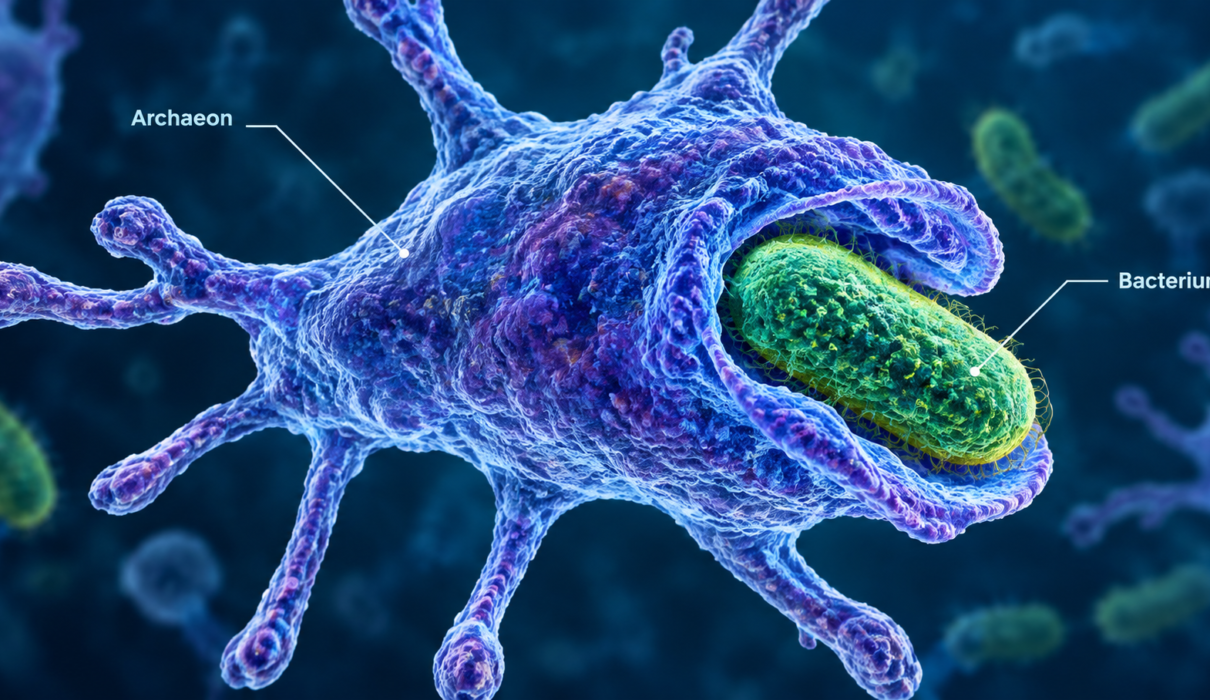
How did Earth’s first complex cells evolve? It’s one of the biggest puzzles in biology, and honestly, it’s a wild one. Every animal, plant and mushroom you’ve ever met is built from these cells. Yet for billions of years, life stayed tiny and simple. Then something changed, and it seems to have happened only once.
Here’s the good news: scientists finally have real clues, and several showed up in the last few years. I’ll walk you through them in plain words, show you where experts still argue, and tell you where each date comes from, so you can check me yourself.
Try this next time you eat a salad. Each leaf cell in that bowl carries the far off descendants of ancient bacteria. Sounds silly, right? It’s true, and you’ll see why soon. Curious how the very first cells got started at all? Read our deep dive on how the first cells formed on Earth.
Key Takeaways
- How did Earth’s first complex cells evolve? Through a partnership between an archaeon and a bacterium.
- A 2025 Nature study says the host cell grew complex first, between 3.0 and 2.25 billion years ago.
- The oldest widely accepted eukaryote fossils are about 1.78 billion years old.
- Every date here is an estimate, and scientists still debate the order of events.
Table of Contents
How Did Earth’s First Complex Cells Evolve? The Short Answer
Here’s the short version. One tiny microbe from a group called Asgard archaea joined forces with a bacterium, and over a very long time the pair became a single cell. That cell is the ancestor of every plant, animal and fungus alive today. A 2025 study in Nature describes it as a merger between an Asgard archaeal host and a partner related to today’s alphaproteobacteria.
Think of two roommates who got along so well they merged into one person. Weird, yes, but that’s roughly the idea. The archaeon was already fancy. The bacterium moved in later and became the mitochondrion, the cell’s power plant.
Now here’s the fun part: the host had already built most of its fancy parts before the bacterium even showed up. The same study suggests it already had a bendy inner skeleton, membrane pouches and the early beginnings of a nucleus.
What Makes a Cell “Complex” in the First Place?
As Nick Lane and William Martin wrote in Nature in 2010, all complex life is built from eukaryotic cells, the kind with a nucleus. Simple cells, called prokaryotes, don’t have one. Bacteria and archaea are the two big prokaryote groups, and they were the only kind of life on Earth for a very long time. If you want the bigger picture, we’ve also covered what the first life forms on Earth actually looked like.
Picture a studio apartment next to a mansion. A simple cell is one open room where everything happens at once. A eukaryotic cell has separate rooms: a nucleus for the DNA, mitochondria for power, and membrane hallways for moving supplies around. Plant cells add chloroplasts, which catch sunlight.
So how did Earth’s first complex cells evolve all those extra rooms? Let’s meet the microbe that started it.
Meet the Host: Asgard Archaea, Our Strange Cousins

Asgard archaea are the closest known relatives of eukaryotes. For years, scientists knew them only from DNA pulled out of deep sea mud. That changed in 2020, when a Japanese team grew one in the lab and named it Prometheoarchaeum syntrophicum. The cell is tiny, about 550 nanometres across, and it grows extremely slowly. It also sprouts long, branching arms.
Those arms matter, and I’ll explain why in a second. First, a warning: that lab microbe looks like an ordinary simple cell overall, so it’s a modern cousin and not our actual ancestor.
How Did Earth’s First Complex Cells Evolve Their Skeletons?
Cells need a skeleton to hold their shape and move things around. Eukaryotes build theirs from a protein called actin. In late 2022, a team in Vienna grew a second Asgard microbe, Lokiarchaeum ossiferum, and studied it with 3D imaging. It divides every 7 to 14 days, and about 5% of its protein coding genes belong to the eukaryote like family, including four actin genes.
Inside its long arms, the team found filaments that looked almost identical to the actin in our own cells. They proposed that a complex actin skeleton existed before the first eukaryotes. I find that wild. A skeleton, inside a microbe, before complex cells even existed?
The Bacterial Partner That Became Our Power Plant
How did Earth’s first complex cells evolve their power plants? Mitochondria came from bacteria. Nature’s Scitable library explains that mitochondria arose from alphaproteobacteria, while chloroplasts arose from cyanobacteria. The big idea is called endosymbiosis. Lynn Margulis laid out the case in a 1967 paper, as this PLOS Genetics interview recalls. Today it’s textbook science.
So why did the bacterium matter? Lane and Martin argued that mitochondria gave cells the power to run roughly 200,000 times more genes. That’s a huge claim, and not everyone buys it. Michael Lynch and Georgi Marinov replied in 2016 that mitochondria don’t boost a cell’s energy capacity that way.
The 2025 study adds a twist. In its analysis, about 85% of the early gene copies from the archaeal side had settled in before the bacterium joined. That number caught me off guard, honestly, and I’ve reread it more than once.
When Did It All Happen? A Timeline You Can Check
How did Earth’s first complex cells evolve, and when? Dates come from two tools. Fossils show what lived and when. Gene clocks use DNA changes to guess when family lines split. Both are useful, but they don’t always agree. A 2011 PNAS study noted that proposed dates for the origin of eukaryotes differ by up to 2 billion years, and it placed the last common ancestor of living eukaryotes between 1866 and 1679 million years ago.
What Do Fossils and Gene Clocks Say?

Here are the main milestones from the 2025 Nature study. Remember, they’re estimates, not certainties.
- 3.05 to 2.79 billion years ago: the archaeal branch leading to eukaryotes splits from its relatives.
- 2.43 to 2.22 billion years ago: the Great Oxidation Event, when oxygen first built up. (We’ve gone deep on what the Great Oxygenation Event actually was.)
- About 2.2 billion years ago: the archaeon and bacterium were probably already partners.
- 1.80 to 1.67 billion years ago: the last common ancestor of all living eukaryotes spreads into new groups.
- About 1.78 billion years ago: the oldest widely accepted eukaryote fossils, found in Australia.
- About 1.63 billion years ago: Qingshania, a multicelled fossil from China linked to the plant and algae branch.
Fossils from this era are rare, so the real dates could turn out to be older still.
How Did Earth’s First Complex Cells Evolve Without Much Oxygen?
Here’s a twist. The oceans stayed largely low in oxygen for more than a billion years, the 2025 study says, so those early steps likely happened in oxygen poor places. We’ve covered the full story of when oxygen first appeared in Earth’s atmosphere if you want the bigger picture. That fits an idea called syntrophy, where microbes trade favours and one eats the other’s waste. The lab grown Asgard fits this picture nicely, since it feeds on amino acids and relies on partner microbes for survival.
Where Scientists Still Disagree
Let me be straight with you: this story isn’t finished. Researchers split into camps on one big question. Did the bacterium arrive first and hand the host loads of energy, or did the archaeon get fancy first and pick up the bacterium later? The 2025 team says its dates fit the second camp, and argue against the first. Yet they also admit no single existing idea matches every result perfectly. Gene clocks lean on assumptions, too; earlier studies put the last common ancestor anywhere from about 2.39 to 0.95 billion years ago.
That’s why the question of how did Earth’s first complex cells evolve still has no final answer. My honest take? Treat every date here as a strong hint, not a fact carved in stone. If a newer study shifts them, that’s science doing its job.
Quick Questions
Which microbe is the closest relative of complex cells?
Asgard archaea. In 2022, researchers grew Lokiarchaeum ossiferum, which divides every 7 to 14 days and carries four actin genes. Its arms hold filaments nearly identical to actin in human cells, which is why scientists call it a top clue to our origins.
When did the first complex cells appear?
The best fossils are about 1.78 billion years old. The 2025 study places the last common ancestor of living eukaryotes between 1.80 and 1.67 billion years ago. Older studies gave dates as young as 0.95 billion years, so experts haven’t fully settled it.
Did mitochondria or the nucleus come first?
The 2025 study points to the nucleus side arriving first. It found that about 85% of early archaeal gene copies settled before mitochondria joined. Still, the authors say no single theory fits everything, so this remains an open, lively debate.
Final Thoughts: Life’s Biggest Leap Started With a Partnership
So, how did Earth’s first complex cells evolve? Step by step, over more than a billion years. A tough archaeon built a skeleton and inner rooms, a bacterium moved in, and together they became the cell that makes you possible.
Which part surprised you most: the microbe with a skeleton, the 85% number, or the salad bacteria? Tell me in the comments below, because I read every one. Then keep exploring with our piece on how life survived Earth’s harsh early conditions.

1 Comment