


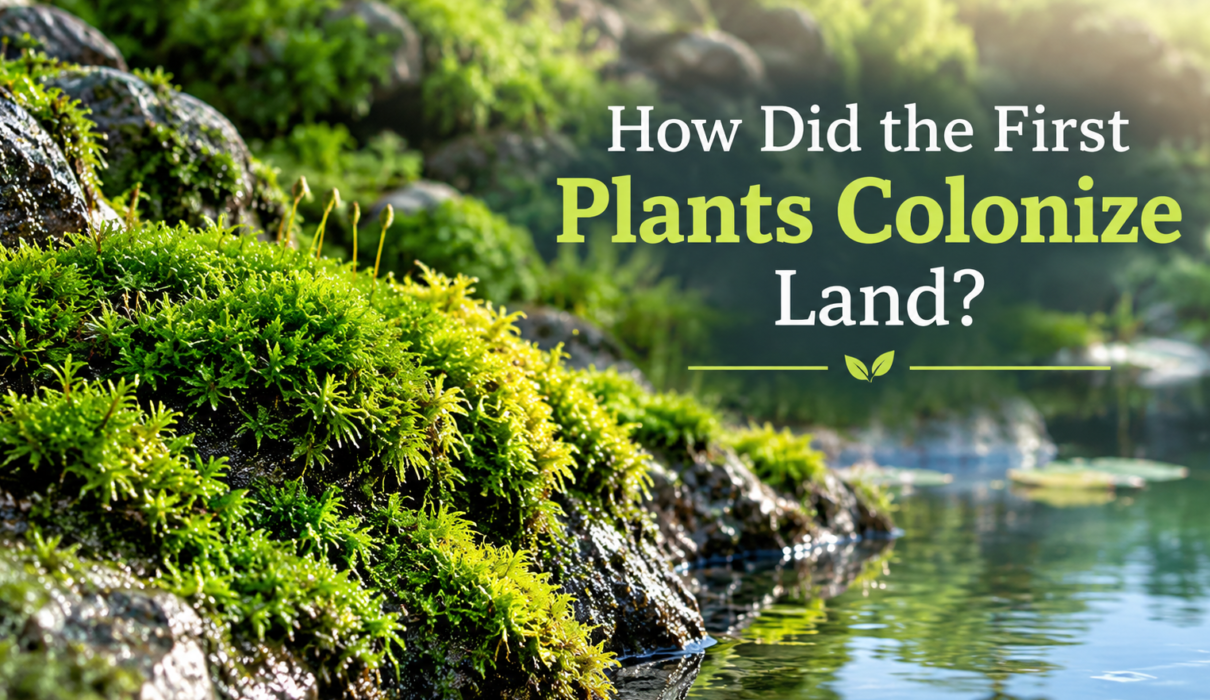
Picture Earth about 500 million years ago. The oceans are full of weird animals, but the land? It’s bare rock and dust. No grass, no trees, not even a patch of moss. So how did the first plants colonize land and turn that empty world green? That’s the question we’re tackling today.
Here’s the wild part. Nobody has a photo of it happening. Scientists have rebuilt the story from microscopic spores, rocks in Scotland, algae living in ponds right now, and the DNA of living plants. We’ll walk through all of it in plain words, and you won’t need a science degree.
Stick around, because the story includes pond scum, a secret partnership with fungi, and a tiny plant that may have helped cool the whole planet. It’s one of my favourite stories in biology, and honestly, I think it’s one of the most underrated.
Key Takeaways
- The first land plants grew out of freshwater green algae. Their closest living relatives are the Zygnematophyceae, a group of simple pond algae.
- Gene clock estimates in a 2018 PNAS study put the origin of living land plants between about 515 and 470 million years ago.
- Tough spore walls, waxy coats, tiny pores and fungus partners helped the first land plants survive out of water.
- A 2012 Nature Geoscience paper suggests early nonvascular plants may have cooled Earth by pulling carbon dioxide from the air.
Table of Contents
How Did the First Plants Colonize Land? The Short Answer
Land plants descended from freshwater green algae, and gene clocks put their start between roughly 515 and 470 million years ago, according to a 2018 study in PNAS. So, how did the first plants colonize land? Slowly, in tiny steps, starting at the damp edges of ponds and streams. It wasn’t one big leap.
Here’s the version I’d tell a ten year old. A pond plant got tougher. It learned to hold on to water, to protect its spores from drying out, and to make friends with fungi in the dirt. Those small upgrades piled up over millions of years. They became moss first, then ferns, then forests. That’s the whole story in a nutshell, and we’ll unpack every step.
Who Were the Ancestors of the First Land Plants?
So, how did the first plants colonize land if they started out as algae? The answer begins with the family tree. Every land plant you’ve ever seen, from a dandelion to a redwood, came from a green alga that lived in fresh water. That isn’t a guess. In a 2012 paper in PLOS ONE, researchers compared 160 genes from the cell nucleus across many algae and found that one group, the Zygnematales, sits closest to land plants on the family tree. Before that, many scientists had picked a different group, the stoneworts, so this was a real shake up. For the backstory on cells like these, read How Did Earth’s First Complex Cells Evolve?
Meet the Pond Scum Behind Every Forest

These algae are called Zygnematophyceae, and yes, people really do call them pond scum. A 2022 study in Current Biology notes there are more than 4,000 species, and they’re simple: single cells or tiny threads. Scientists were surprised, because other algae look far fancier. Honestly, I love that the closest cousins of every tree on Earth are the stuff floating in a murky pond.
So why do plants look so different from their algae cousins? The two lines split about 550 million years ago, according to the University of Göttingen’s summary of that study, and each went its own way. The algae stayed small. The first land plants went on to build the green world.
Some of these algae already live in damp places outside open water, much like mosses do. A 2019 genome study in Cell found genes in two of them that help land plants resist stress, especially drying out. Here’s the twist. Those genes seem to have come from soil bacteria, through a trick called horizontal gene transfer, which simply means borrowing genes from a different species.
When Did Plants Move Onto Land? Two Clocks, One Puzzle
How did the first plants colonize land, and when? Scientists read two very different clocks, and they don’t agree perfectly yet. One clock is made of fossils, and the other is made of DNA. Let’s look at both. Because gene clocks point to the Cambrian, you might also like the animal side of that era in What Caused the Cambrian Explosion?
The Fossil Clock: Tiny Spores and Slow Clues
The oldest clues are microscopic. Plants make spores wrapped in tough walls, and those walls can last for hundreds of millions of years, which is why they’re such handy clues. A 2021 report in Science describes spores from the Early Ordovician, about 480 million years ago, that mix features of older Cambrian spores and younger plant spores. That’s a rare link between algae and early land plants.
Fossils you can see without a microscope don’t show up until much later. The same paper notes that proper plant fossils first appear in the middle Silurian, almost 80 million years after the gene clocks suggest plants began. That’s a huge gap. A review titled Revisiting the Great Ordovician Diversification of land plants adds that no Cambrian record clearly proves land plants were there yet.
The first land plants behind those spores were small. A 2014 review in New Phytologist argues that the plants making early spores, called cryptospores, were simple land organisms only millimetres high. Imagine something no taller than a grain of rice, and you’ll have the right picture.
The Gene Clock: Counting DNA Changes

The second clock compares DNA from living plants. Scientists use a few well dated fossils to set the pace, then estimate when family branches split, a bit like using a few known birthdays in a big family to guess everyone else’s age. It’s a clever trick. The PNAS study placed the origin of living land plants between about 515 and 470 million years ago, and vascular plants a little later, in the Late Ordovician to Silurian.
It also found that all four major land plant lineages had split from each other by the late Silurian. Those are generally counted as the liverworts, mosses, hornworts and vascular plants. That’s fast work for something that started out so small.
Honestly, the gap between the two clocks still surprises me. Tens of millions of years of tiny plants, and so few fossils to show for it.
What Tools Did the First Land Plants Need?
How Did the First Plants Colonize Land? The Toughness Toolkit
So how did the first plants colonize land with no roots and no leaves? They needed a toolkit. A 2011 review in AoB Plants lists the key pieces: rooting structures, water carrying tissue, a waxy coat called the cuticle, tiny pores called stomata, protected sex organs, and tough spores. A textbook summary adds protected embryos and pigments that shield plants from harsh sunlight.
Think of it like packing for a trip to the desert. You’d bring a waterproof jacket, a tent, and sunscreen. The first land plants did the same. The cuticle was the jacket, the spore wall was the tent, and the pigments were the sunscreen. Researchers even suspect plants couldn’t have colonized land before the tough spore wall evolved, though that’s a hypothesis rather than a settled fact.
Stomata deserve a shout out. Scientists studying fossils from Scotland, which we’ll visit soon, found a tiny worm preserved inside the stomatal chambers of an early plant called Aglaophyton. So those pores weren’t just theory. They were real, and something was already living in them.
Standing tall came later. A 2000 paper in Philosophical Transactions of the Royal Society B explains that land plants stayed extremely small and simple until the Late Silurian, when tracheids appeared. Those are stiff, water carrying cells strengthened with a tough material called lignin. They’re like tiny drinking straws that double as scaffolding. If you’re curious how photosynthesis first changed Earth’s air, read When Did Oxygen First Appear in Earth’s Atmosphere?
The Fungus Friendship

Here’s the part that gets me every time. The first land plants didn’t do this alone. Plants without real roots struggle to find water and minerals, so many scientists think fungi helped. In a mycorrhizal partnership, the fungus brings water and nutrients, and the plant pays back with sugar from photosynthesis.
How Did the First Plants Colonize Land With Help From Fungi?
A 1995 study in Mycologia examined the 400 million year old Rhynie chert and showed arbuscules, the branching trading structures of arbuscular mycorrhizal fungi, from the Early Devonian. A commentary on the 2019 Cell genome paper says the new data back up the old mycorrhizal landing idea. That idea says fungus partnerships were central to the move onto land. CNRS, the French research centre, adds that many genes used for fungus partnerships are missing from the algae, so they likely appeared in the ancestor of land plants.
A Time Capsule in Scotland: The Rhynie Chert

Near the village of Rhynie in Aberdeenshire, Scotland, a rock holds one of the best answers to the question, how did the first plants colonize land? Around 400 million years ago, hot springs flooded the area with water rich in silica, a glassy mineral. Plants were sealed in stone before they could rot, and that’s why they survived. Palaeobotanists at the University of Hamburg’s online pages call it the oldest and most completely preserved land ecosystem. It’s a true time capsule.
A 2004 study in Proceedings of the Royal Society B describes the cherts as yielding exceptionally preserved early land plants, and it traced spores from all seven Rhynie chert plants. Names like Rhynia and Aglaophyton might sound like dinosaurs, but they’re humble upright stems.
Here’s a detail I like. The same study concluded that at least some of those plants weren’t specialists in hot spring life. They belonged to a wider flora, and they were simply the ones tough enough to live by the springs. So Rhynie isn’t a strange exception. It’s a window onto how the first land plants really lived.
How the First Land Plants Changed the Whole Planet
Once the first land plants spread out, Earth itself began to change. That’s the bigger payoff of asking how did the first plants colonize land, because the answer reaches all the way to the climate. The Late Ordovician, which ended 444 million years ago, saw ice sheets start to grow. A 2012 paper in Nature Geoscience argues that nonvascular plants sped up the chemical breakdown of rocks, called weathering, and may have pulled enough carbon dioxide out of the air to help trigger that cooling.
A 2021 review in Current Biology says the gene clock dates are compatible with that idea of plants as planet engineers. Imagine green fuzz on bare rock that’s quietly changing the climate. Wild, right? Don’t forget it’s still a hypothesis, not proof.
Try This at Home: Meet a Living Cousin

You don’t need a lab to feel this story. Mosses belong to the nonvascular plants, the group that stayed small and simple. Next time you’re outside after rain, go and look at some.
- Find a patch of moss on a wall, rock or shady ground, and grab a magnifying glass if you have one.
- Notice what’s missing. Moss has no true roots and no tall woody stem.
- Look for thin stalks with tiny capsules on top. Those capsules make spores.
- Sketch it, then compare it with a fern leaf nearby.
If you’re still asking how did the first plants colonize land, a patch of moss is a friendly place to begin. Want to know what lived before any plant? Read What Were the First Life Forms on Earth?
What Scientists Still Argue About
Here’s where I want to be upfront. Not every detail is settled, and good science says so out loud. The dates are one example. The PNAS gene clock study says 515 to 470 million years ago, the Science paper points to spores around 480 million years ago, and the older PLOS ONE paper gave 430 to 470. Different methods give different windows.
The spores are debated too. The 2014 New Phytologist review says the family ties of cryptospores are contentious, meaning scientists argue over exactly which plants made them. And the missing Cambrian fossils mean the earliest chapter may stay hidden for a while. The honest answer to how did the first plants colonize land has loose ends, and I’d rather show you those than pretend they’re tidy.
Frequently Asked Questions
When did the first land plants appear?
Gene clocks in a 2018 PNAS study estimate between 515 and 470 million years ago. The oldest definite spore evidence from different plant groups comes from the Middle Ordovician, according to a review of early land plants. Proper plant fossils you can see appear later, in the Silurian.
What were the first land plants like?
The first land plants were tiny and simple. A 2014 New Phytologist review says the plants behind early spores stood only millimetres high. The Rhynie chert plants, about 400 million years old, were humble upright stems that lived beside hot springs.
Did plants colonize land alone?
No. When people ask how did the first plants colonize land, fungi are a big part of the answer. A 1995 Mycologia study found fungus structures called arbuscules in the 400 million year old Rhynie chert, and many scientists think this partnership helped plants get water and minerals. It’s a leading idea, not a closed case.
Which algae are the closest relatives of land plants?
The Zygnematophyceae. A 2022 Current Biology study describes convincing evidence that this group, with more than 4,000 species, is the closest algal relative. That surprised scientists, because these algae are simpler than the other candidates.
Final Thoughts
So, how did the first plants colonize land? Step by step. Freshwater algae got tougher, learned to guard their spores, borrowed helpful genes, and teamed up with fungi. Then the first land plants changed the planet. We’ve covered a lot, and there’s still more to discover.
Got a favourite moss, or a question we missed? Drop it in the comments, and share this with the plant nerd in your life. Ready for the next chapter? Read What Were the First Animals on Earth?
How this was researched: every claim comes from scientific journals, university pages and research institutes, and dates were checked against more than one source. Last updated: October 18, 2026.
