


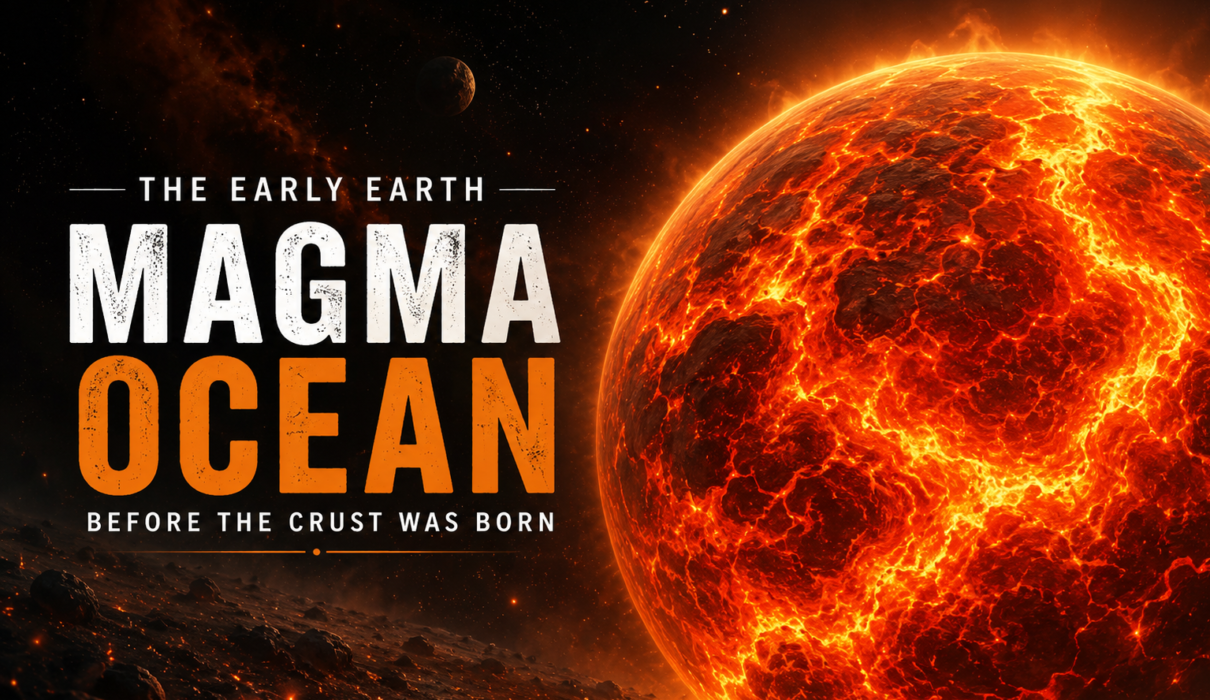
Picture this. You’re standing on solid ground right now, reading this on something firm, in a room that isn’t melting. That feels normal. But it wasn’t always this way. For the first several hundred million years of our planet’s life, there was no solid ground at all. Just an ocean of molten rock, glowing orange, hot enough to vaporize anything that touched it.
So how did Earth’s crust form out of that fiery mess? It’s one of the biggest questions in all of geology, and honestly, scientists are still piecing parts of it together. This article walks you through what we know, what’s still debated, and why the answer matters more than you’d think, even for the chair you’re sitting in right now.
Key Takeaways
- Earth’s crust began forming from a cooling magma ocean around 4.5 to 4.4 billion years ago, not long after the planet itself formed, per NASA Science.
- The oldest confirmed piece of Earth’s crust is a zircon crystal from Jack Hills, Australia, dated to about 4.4 billion years old, confirmed by UW-Madison News.
- There are two very different types of crust today: thin, dense oceanic crust and thick, lighter continental crust, and they formed through separate processes.
- Scientists still disagree on exactly when plate tectonics kicked in, with estimates ranging from roughly 4.4 billion to under 1 billion years ago.
Table of Contents
What Was Earth Like Before It Had a Crust?
Here’s the wild part. Earth didn’t start out as a planet with a hard shell. It started as a swirling protoplanetary disk of dust and gas around a very young sun, and it grew through a process called planetary accretion, where smaller rocky chunks kept smashing into each other and sticking together. That’s basically how Earth formed in the first place, one collision at a time, over millions of years. If you want the full picture of how our star and the rest of the solar system came together before Earth even existed, our piece on how the solar system formed covers that earlier chapter.
All that colliding generated enormous heat. So much heat, in fact, that the young Earth melted completely, top to bottom, according to Wikipedia’s overview of Earth’s crust. There wasn’t a crust yet, because there wasn’t anything solid to speak of, and there wasn’t much of a stable atmosphere either, a period we cover in more depth in our guide to the Hadean atmosphere. Just a churning ball of liquid rock and metal. It’s genuinely hard to imagine, even for someone who writes about this stuff regularly. A whole planet, and none of it was solid.
How Did Earth’s Crust Form From a Sea of Molten Rock?
As accretion slowed down, Earth finally got a chance to cool off, and this is where the story of how Earth’s crust formed really begins. The molten surface started to lose heat into space, and as it did, the outer layer began to crystallize, similar to how a candle forms a waxy skin as it cools. This first crust is called the primary or primordial crust.
That primordial crust didn’t last, though. It kept getting smashed apart by giant impacts, then melting again into fresh magma, then cooling into crust once more, over and over, a cycle also described in Wikipedia’s entry on Earth’s crust. Not a single piece of that original crust survives today. Every bit of it was destroyed by later impacts, erosion, and the churning of plate tectonics across billions of years. That alone tells you something about how violent early Earth truly was.
The Magma Ocean Theory
Most geologists point to the magma ocean model as the best explanation for how Earth’s crust formed. According to IntechOpen’s overview of Earth crust origins, the heat retained after Earth’s formation melted the entire upper mantle into a global sea of lava. As that ocean gradually cooled, it crystallized from the outside in, and a widespread crust formed across the whole planet.
This idea also explains something interesting about the crust we see today. A magma ocean that was roughly uniform in composition would naturally produce a crust with somewhat consistent chemistry, and that’s exactly what geologists find when they study very old rock samples. It’s a tidy explanation, and it fits the evidence better than the alternatives, including one older idea that asteroid impacts alone created the crust, which mostly fell apart once researchers realized there simply weren’t enough impact events early on to cover the whole planet, a point the same IntechOpen chapter makes as well.
What About the Moon Forming Impact?
Here’s a detail that surprises a lot of people. Earth’s crust story is tangled up with the birth of the Moon. Around 4.5 billion years ago, a Mars sized object that scientists call Theia is thought to have slammed into the young, still partly molten Earth. Debris from that collision, made up of vapor, molten rock, and dust, eventually clumped together in orbit and became the Moon, according to NASA’s overview of Moon formation.
That impact would have added even more heat to an already molten planet, likely deepening or refreshing the magma ocean that later cooled into crust. Some researchers, writing in Space.com’s coverage of the moon forming impact model, even argue that Earth’s magma ocean helps explain why the Moon’s rocks are chemically so similar to Earth’s own mantle, since so much of the debris cloud came from Earth’s own melted material rather than from Theia alone. It’s a strange thought that the Moon in our night sky is basically a leftover chunk of our planet’s molten childhood.
What Is the Oldest Evidence We Have for Earth’s Crust?

If you want actual physical proof of how Earth’s crust formed, you need to travel to a sheep ranch in Western Australia called Jack Hills. Buried in the rock there are microscopic zircon crystals, and in 2014, researchers led by geochemist John Valley confirmed one of them to be about 4.4 billion years old, making it the oldest known fragment of our planet, as reported by UW-Madison News.
That’s not a random number either. It means Earth’s crust had already started forming just 160 million years after the solar system itself came together, which honestly still catches me off guard every time I read it. That’s shockingly fast for a planet that supposedly spent its early life as molten rock. Zircons survive because they’re incredibly tough minerals, resistant to heat, pressure, and chemical change, so they act like tiny time capsules, as Sci-News explains.
The findings from Jack Hills also support what scientists call the “cool early Earth” theory. Instead of the Hadean eon being a nonstop hellscape of lava and asteroid strikes, evidence from these zircons suggests parts of Earth’s surface may have cooled enough for liquid water within a few hundred million years of the planet’s birth, National Geographic reports. That’s a pretty different picture from what most people imagine when they think about what Earth was like in the Hadean era.
How Did Earth’s Crust Form Into Two Different Types?
Once you get past the earliest chapter, the story of how Earth’s crust formed splits into two separate paths, because Earth doesn’t have just one kind of crust. It has two, and they’re built completely differently.
Oceanic Crust

Oceanic crust is the thinner, denser type, and it’s still being made right now, today, at this very moment, along underwater mountain ranges called mid ocean ridges. Molten rock rises up from the mantle, cools, and hardens into new basalt rock, constantly renewing the ocean floor, per National Geographic Education. This crust is thin, usually somewhere between five and ten kilometers thick, and because it’s so dense, it eventually sinks back into the mantle at subduction zones. That’s why the oldest oceanic crust anywhere on Earth is only about 200 million years old at most, according to EarthDate. It just doesn’t stick around long enough to get much older.
Continental Crust
Continental crust tells a completely different story. It’s thicker, sometimes reaching 70 kilometers under mountain ranges like the Himalayas, and it’s far less dense, which is why it floats higher and forms the land you and I actually stand on, as Britannica explains. It formed largely through volcanic activity at subduction zones, where slabs of oceanic crust melt as they dive beneath continental margins, feeding new magma up to the surface.
Because continental crust is so light, it almost never gets pulled back into the mantle the way oceanic crust does. It just keeps piling up and getting recycled at the surface instead, which explains why some continental rock in Canada and Australia is close to 4 billion years old, nearly as ancient as the planet itself.
Did Plate Tectonics Shape How Earth’s Crust Formed?

This is where things get genuinely uncertain, and I think it’s worth being upfront about that instead of pretending there’s a clean answer. Plate tectonics, the slow grinding movement of crustal plates across the mantle, clearly plays a huge role in how crust forms and recycles today. But when it actually started is one of the most debated questions in Earth science.Some researchers argue for plate motion beginning close to 4.4 billion years ago. Others say true, modern style plate tectonics didn’t take hold until sometime between 3.2 and 1 billion years ago, according to Scientific American.
A 2026 study using magnetic traces in ancient Australian rock, covered in that same Scientific American piece, found evidence that a chunk of crust was drifting measurably as early as 3.48 billion years ago, which pushed the known timeline back by hundreds of millions of years. Even so, the scientists behind that study were careful to say it’s still not clear whether that early motion looked anything like the plate tectonics we have now.
I’ll be honest, this is one area where I’d hold off on treating any single number as settled fact. Estimates in published research still range from roughly 700 million years ago to over 4 billion years ago, depending on which type of evidence a research team relies on. If a source ever tells you an exact, confident date for when plate tectonics began, that’s worth double checking against more recent studies.
What Is Earth’s Crust Actually Made Of?
After all that melting, cooling, and shifting, what did Earth actually end up with? The crust we walk on today is a mix of igneous, metamorphic, and sedimentary rock, and it’s dominated by a surprisingly small handful of elements. Oxygen and silicon alone make up the bulk of it, with aluminum and iron adding most of the rest, and together these elements form common minerals like quartz, feldspar, and mica that show up in granite, basalt, and countless other rock types you’d recognize on a hike, according to National Geographic Education.
Igneous rock, formed as magma cools, is actually the most abundant type in the crust, which makes sense once you remember that the whole crust started out as liquid rock in the first place.
Why Does It Matter How Earth’s Crust Formed?
You might be wondering why any of this matters beyond satisfying curiosity. It turns out the story of how Earth’s crust formed is directly connected to why our planet can support life at all.
- Continental crust gave life dry land to eventually crawl onto, something most other planets in our solar system never developed.
- The recycling of oceanic crust through plate tectonics helps regulate Earth’s climate over long timescales by cycling carbon between the crust, oceans, and atmosphere.
- The “cool early Earth” evidence from zircons suggests liquid water, and possibly the conditions for life, showed up far earlier than scientists once assumed.
- Studying ancient crust helps researchers understand other rocky planets too, including why Mars and Venus turned out so differently from Earth.
None of that happens on a planet that stayed a ball of molten rock forever. The crust had to form first.
Frequently Asked Questions
How did Earth’s crust form in the first place?
Earth’s crust formed as the planet cooled after its violent, molten beginning around 4.5 billion years ago. A global ocean of magma crystallized from the surface downward, eventually producing a solid, though frequently destroyed and reformed, primordial crust, per <u>NASA Science</u>.
How old is the oldest piece of Earth’s crust?
The oldest confirmed fragment of Earth’s crust is a zircon crystal from Jack Hills, Australia, dated to about 4.4 billion years old, or roughly 160 million years after the solar system itself formed, according to UW-Madison News.
What is the difference between oceanic and continental crust?
Oceanic crust is thin, dense, and constantly recycled at mid ocean ridges and subduction zones, rarely older than about 200 million years. Continental crust is thicker, lighter, and can survive for billions of years, with some patches nearing 4 billion years old, as Britannica notes.
Did an asteroid impact create Earth’s crust?
Probably not on its own. Early theories suggested asteroid impacts formed the crust, but there weren’t enough large impacts before oceanic crust already existed, and lunar evidence doesn’t support it either. Most geologists favor the magma ocean model instead, per IntechOpen.
