


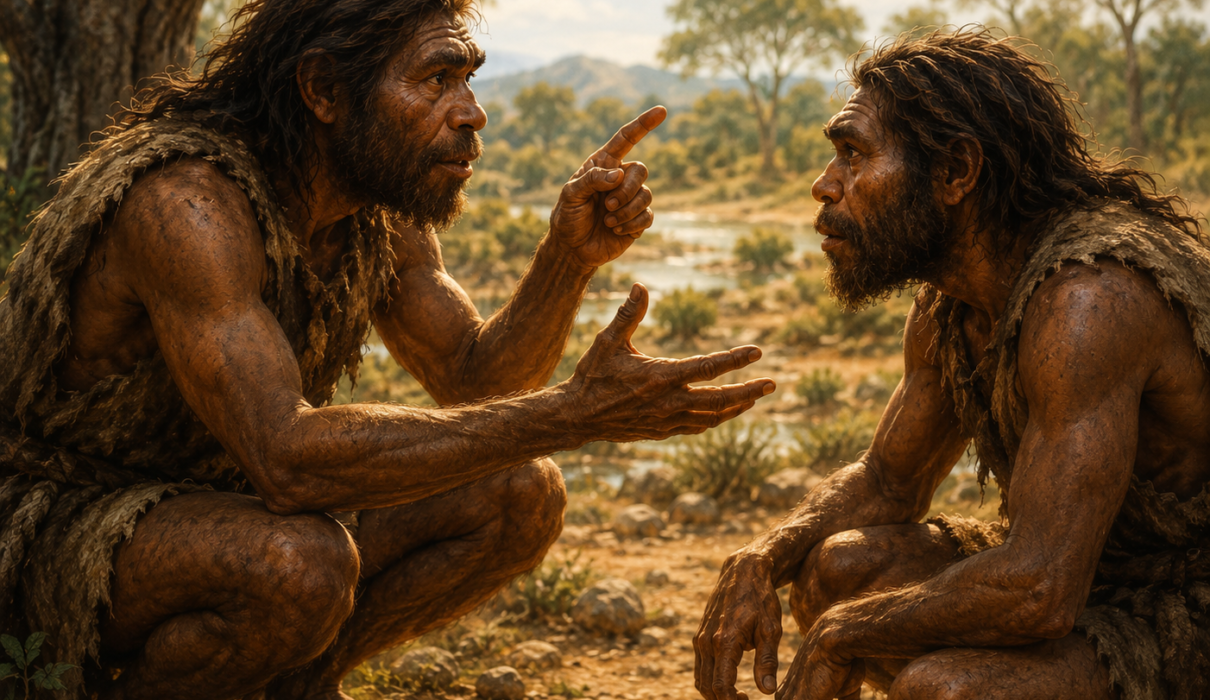
How did early humans communicate before language existed? It’s one of the most fascinating questions in all of science and the answer turns out to be far richer than anyone expected.
They didn’t just grunt. They gestured. They groomed each other. They drew on rocks. They sang. They used their faces, their hands, and a growing toolkit of sounds that slowly, over millions of years, became the words you’re reading right now.
Scientists can’t directly record prehistoric conversations. But they can read the evidence left behind in fossils, in ancient DNA, in cave art, and in the wiring of our own brains. And that evidence tells a remarkable story.
There are currently around 7,000 languages spoken on Earth today, according to a 2017 study published in BMC Biology (via PMC). Every single one of them can be traced, ultimately, to the communication methods early humans developed over six million years of evolution.
Source: What is human language, when did it evolve and why should we care?
Let’s trace that story from the very first grunt to the first painted cave wall to the genes that make speech possible.
Key Takeaways
- Early humans communicated through at least 5 distinct methods before full spoken language: gestures, vocalisations, grooming sounds, body posture, and symbolic art. (HistoryRise.com, 2025)
- The FOXP2 gene sometimes called the “language gene” underwent key mutations shared by both Homo sapiens and Neanderthals, suggesting both species had some speech capacity. (National Geographic)
- A Neanderthal hyoid bone found at Kebara Cave, Israel (dated ~60,000 years ago) has the same shape and internal mechanics as a modern human’s, suggesting Neanderthals could speak. (PLOS ONE, 2013)
- The oldest known symbolic engravings geometric patterns on ochre from Blombos Cave, South Africa date to 75,000–100,000 years ago. (Journal of Human Evolution; British Museum)
- Full spoken language with complex grammar likely emerged by at least 135,000 years ago, according to a 2025 study in Frontiers in Psychology. (Linguistic Discovery, 2025)
Table of Contents
7,000Languages on Earth today
100 ka Age of oldest symbolic art
135 kaEarliest possible language
400 ka Age of FOXP2 mutation
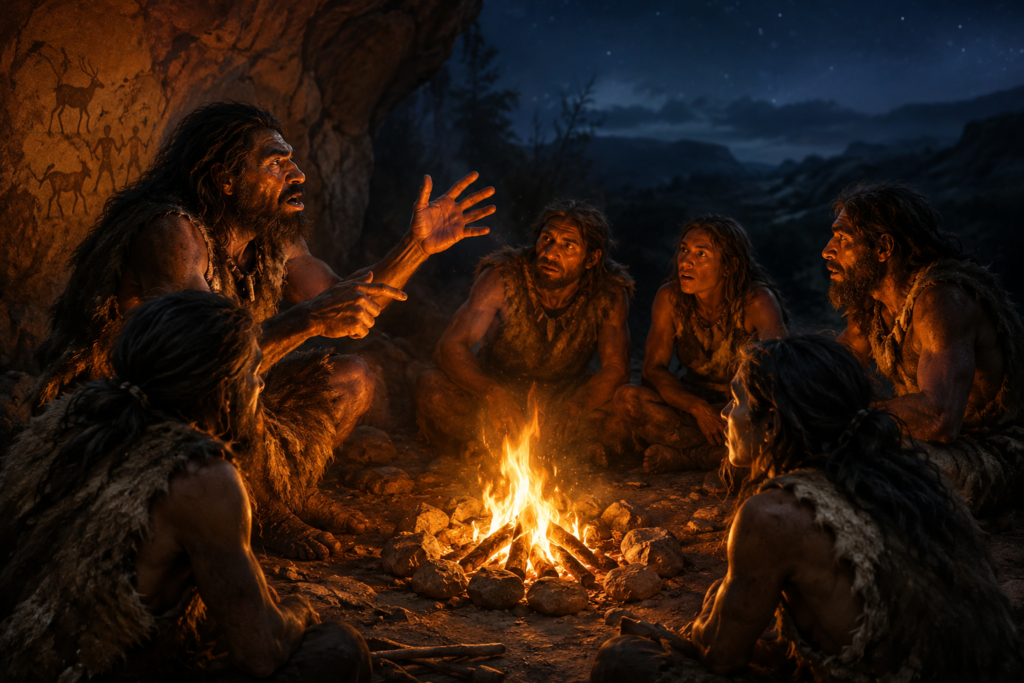
Before Words: What Did Early Human Communication Actually Look Like?
Six million years ago, our earliest hominin ancestors shared the world with great apes. Like chimpanzees today, they almost certainly communicated through a mix of calls, facial expressions, and body posture nothing like modern speech.
But here’s what’s fascinating. Even those basic signals were remarkably sophisticated. Modern research shows that great apes communicate more flexibly with gestures than scientists once thought. Their vocalisations also display far more complexity than was previously recognised.
As our ancestors’ brains grew larger and our social groups became bigger, the pressure to communicate more precisely increased. When you live in a group of 20, a simple grunt is enough. When you live in a group of 150 and need to coordinate hunting, plan tool-making, and pass knowledge to your children you need something much more powerful.
That pressure, most scientists believe, is what drove the step-by-step evolution of language.
Source: HistoryRise.com
Want to understand more about the ancient human species that developed these early communication tools? Explore our full guide: What Human Species Existed Before Us?
Method 1 — Gestures: The First Language Was in Your Hands
Was the very first human language spoken or signed? This debate has run for over a century, and the evidence is genuinely split.
The gesture-first theory argues that early humans began communicating with their hands and bodies before their vocal anatomy could support complex speech. Evidence comes from a landmark cross-cultural study published in Proceedings of the Royal Society B (PMC, 2022). Researchers tested 995 different word meanings using either gesture or non-linguistic vocal sounds across participants from Australia and Vanuatu.
The result was striking: gesture communication succeeded 61.17% of the time, versus only 29.04% for non-linguistic vocalisations. Gesture was roughly twice as effective for conveying meaning.
Source: Gesture is the primary modality for language creation
Why Gesture Makes Evolutionary Sense
Think about it. A pointing finger is universal. A cupped hand means “water” without any shared language. Mime of throwing a spear needs no translation. These are the kinds of signals that could work across groups, pass information about hunting, and even bridge different hominin species.
- Gestures work even when it’s noisy important when hunting near rushing water or amid thunderstorms
- They are easy to mimic and learn by watching others critical for passing skills to children
- They can be silent vital when stalking prey or avoiding predators
- They were likely used alongside sounds from the very beginning, not instead of them
Most modern researchers believe gesture and vocalisation evolved together rather than one replacing the other. Even today, people move their hands when they speak as if our bodies remember that the two were always intertwined.
Source: ScienceNewsToday.
Method 2 — Grunts, Calls, and Proto-Singing: The Vocal Roots of Language
While gesture may have been more effective early on, human infants show us something crucial we are born to make sounds.
A systematic 2021 study published in Frontiers in Psychology tracked 10 infants at 4, 7, and 11 months of age. At just 3 months old, infants produced more than 35 times more speech-like vocalisations than gestures. By 11 months, it was still 2.5 times more.
This suggests our drive to make sounds is deeply biological a foundation built into humans from birth.
From Animal Calls to Proto-Language
Early hominins probably started with warning calls alarm sounds when predators appeared, excitement calls during successful hunts. Over millions of years, those basic sounds became more nuanced.
- Warning calls: Different sounds for different threats “snake!” versus “eagle!” a system documented in modern vervet monkeys
- Contact calls: Sounds to maintain group cohesion when members were separated
- Emotional vocalisations: Sounds conveying fear, excitement, contentment, or pain universal across all human cultures today
- Proto-singing: Some researchers, including anthropologist Robin Dunbar, propose that a musical “proto-language” of rhythmic sounds preceded modern speech and helped bond large groups
The key transition happened as early hominins gained better voluntary control over their vocal output the ability to deliberately choose and modify sounds. That’s something no other primate can do to the same degree.
Source: Tracking the Evolution of Language and Speech
Method 3 — Social Grooming and Touch: Communication You Could Feel
Here’s a method most people never think about. For our ape-like ancestors, physical grooming was communication.
Among primates today, grooming picking through a companion’s fur isn’t just about hygiene. It’s the primary social bonding mechanism. It communicates trust, alliance, and affection. It calms aggression. It builds the social glue that holds groups together.
Evolutionary anthropologist Robin Dunbar proposes that as human social groups grew too large for everyone to groom everyone else physically, language evolved as “vocal grooming.” Talking about others, sharing gossip, telling stories these became the social substitute for one-on-one physical touch.
This is sometimes called the Social Brain Hypothesis. It explains why so much of human conversation even today is about people and relationships rather than facts and information.
“Language evolved as a form of grooming: a way of maintaining social bonds in large groups where physical grooming was no longer practical.” Concept attributed to Robin Dunbar (Oxford University), widely referenced in Paleoanthropology literature. Discussed in: HistoryRise.com — History of Human Language (2025)
This also explains why sharing stories and gossip feels so natural and important. It’s not a bad habit it’s an evolutionary communication mechanism tens of thousands of years old.
Curious how those early communicating humans also mastered fire another key social technology? Read: How Did Early Humans Start Fire?
The Body That Made Speech Possible — What Fossils Reveal
Language isn’t just about the brain. Speech requires a very specific set of physical anatomy and the fossil record shows us exactly when our ancestors got it.
The Descended Larynx
In humans, the larynx (voice box) sits unusually low in the throat compared to other mammals. This allows us to produce a far wider range of vowel sounds than any other species. It also means humans are the only mammals that can’t breathe and swallow simultaneously we can choke, which no chimp ever does. That trade-off only makes evolutionary sense if speech was worth it.
Research published in Penn Museum’s Expedition Magazine confirmed that fully modern vocal tract proportions capable of producing the complete range of modern speech sounds only appear in fossil humans dating to after 50,000 years ago. This date coincides precisely with the explosion of complex Upper Paleolithic culture, art, and tool-making.
Source: Tracking the Evolution of Language and Speech
The Hyoid Bone: A Smoking Gun for Early Speech
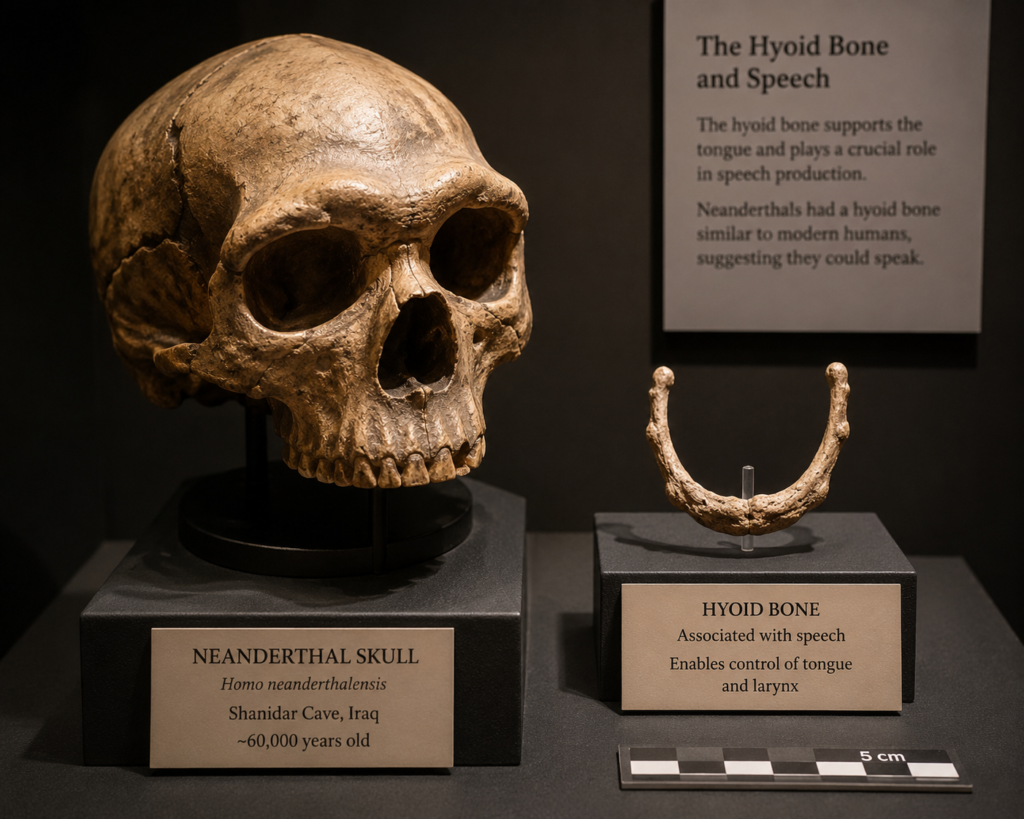
The hyoid is a U-shaped bone in the throat that anchors the tongue and larynx muscles. It’s essential for producing complex speech sounds. And it’s the only bone in the human body with no joint connections which means it preserves very rarely in the fossil record.
When a Neanderthal hyoid was found at Kebara Cave, Israel in 1989, it sparked decades of debate. A 2013 study in PLOS ONE went further: using micro-CT scanning and computational biomechanics, researchers showed that the Kebara 2 hyoid had not just the same shape as a modern human hyoid, but also the same internal bone architecture and mechanical loading patterns. Because bone remodels itself in response to actual physical use, this is compelling evidence that Neanderthals were using their hyoid in the same way we do for speech.
“Because internal architecture reflects the loadings to which a bone is routinely subjected, our findings are consistent with a capacity for speech in the Neanderthals”. Micro-Biomechanics of the Kebara 2 Hyoid and Its Implications for Speech in Neanderthals.
The Gene That Changed Everything: FOXP2 and the Biology of Language
If there’s one piece of molecular biology that transformed our understanding of how early humans communicated, it’s the FOXP2 gene.
FOXP2 is sometimes called the “language gene,” though scientists prefer to call it a key enabler of speech. Humans with mutations in FOXP2 have severe difficulties producing and comprehending speech they can understand language conceptually, but their mouths can’t form the precise, rapid sequences of movements that speech requires.
Here’s what makes FOXP2 remarkable for our story:
- The human version of FOXP2 differs from the chimpanzee version by just two critical amino acid changes tiny differences with enormous consequences.
- Genetic analysis suggests the human FOXP2 variant underwent a “selective sweep” spreading rapidly through the population possibly around 200,000 years ago, coinciding with the emergence of Homo sapiens.
- Most strikingly: Neanderthal DNA analysis confirmed they carried the same two amino acid changes as modern humans, suggesting the FOXP2 mutation predates our split from Neanderthals which occurred around 400,000 years ago.
Source: National Geographic
Important nuance: FOXP2 alone doesn’t create language. Research by 2024 suggests that Neanderthals may have had slightly different FOXP2 expression patterns (due to a transcription factor binding site) that could mean their language was advanced but perhaps not quite identical to ours.
Source: The FOXP2 Gene: Unveiling the Mysteries of Language (2024)
The FOXP2 story connects directly to the broader question of whether Neanderthals could truly speak which we explore in depth in: 5 Jaw-Dropping Truths: Did Homo Sapiens and Neanderthals Interbreed?
Cave Art and Symbols — The First Written Messages in Human History
Before writing. Before alphabets. Before clay tablets. There were the caves.
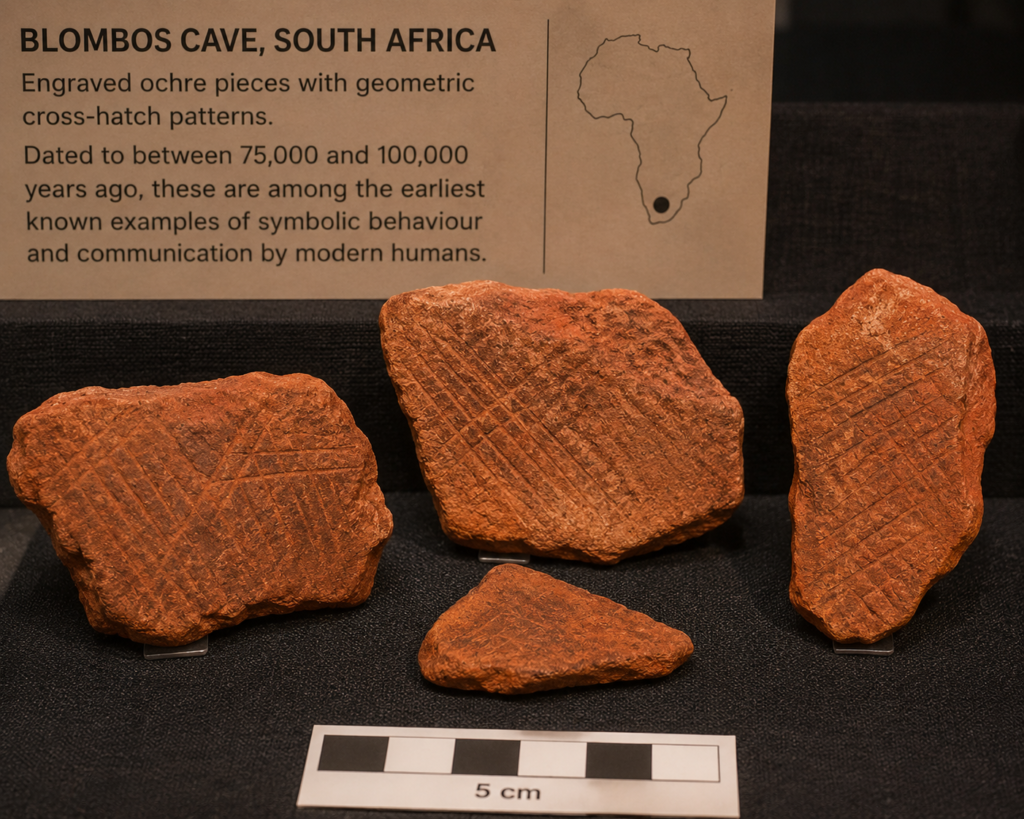
The oldest confirmed symbolic engravings ever found are geometric patterns scratched onto red ochre stones at Blombos Cave, South Africa. Multiple excavation campaigns confirmed these engravings date to between 75,000 and 100,000 years ago. VERIFIED DATA
Source: Journal of Human Evolution
A key debate: were these engravings symbolic communication, or just decorative? A 2020 study in PMC tested this directly, finding that the Blombos engravings evolved over 30,000 years to become more visually salient and easier to remember — suggesting they served as cultural tradition markers, shared identity signals between groups. DEBATED
Source: The evolution of early symbolic behavior in Homo sapiens
The Cave Paintings: Stories on Stone
Later and more famous are the cave paintings. The oldest known narrative cave art is from Maros-Pangkep karst, Sulawesi, Indonesia, dated to over 51,200 years ago. It depicts humans hunting pigs the oldest known figurative storytelling in the archaeological record.
In Europe, the Lascaux cave paintings in France date to around 17,000 years ago. Their horses, bulls, and deer represent not just art but shared cultural knowledge passed from generation to generation.
Source: The Dawn of Human Communication (2026)
The British Museum’s African Rock Art project argues that for these geometric motifs to convey meaning across groups, language was a prerequisite because the patterns are non-representational, culturally constructed, and arbitrary. To share what they mean, you need words.
Source: British Museum Origins of Rock Art in Africa
When Did Spoken Language Really Begin? The Latest Science
This is the hardest question in the whole field — because spoken language leaves no direct fossil. It’s invisible. It disappears the moment it’s made.
Scientists use four types of indirect evidence to estimate when language emerged:
- Fossil anatomy — the larynx, hyoid, and vocal tract in fossils
- Archaeological evidence — the appearance of complex tools, art, and symbolic behaviour
- Genetic data — FOXP2 and other language-related genes and their estimated timing
- Computational linguistics — modelling how much time language diversity requires to develop
A 2025 study published in Frontiers in Psychology used computational linguistic analysis to set an important upper boundary. The study concluded that linguistic capacity was present in the Homo sapiens population at least 135,000 years ago — meaning language couldn’t have appeared later than that.
Most researchers today believe full, grammatically complex language was in place by 50,000–100,000 years ago at the latest with earlier, simpler forms of proto-language stretching back much further.
The explosion of art, sophisticated tools, long-distance trade, and ritual burial that marks the Upper Paleolithic (beginning around 40,000–60,000 years ago) is almost universally cited as indirect evidence that complex language was already operating by then. You simply cannot coordinate that level of cultural complexity without it.
Understanding how this communication helped early humans survive connects directly to one of their most critical technologies learn more in our piece: 7 Surprising Ways Climate Change Affected Human Evolution
Could Neanderthals Communicate Too? The Evidence Is Surprising
When people ask how did early humans communicate, they usually mean Homo sapiens. But what about our closest relatives — the Neanderthals?
The evidence is genuinely compelling that Neanderthals had some form of complex communication:
- Matching FOXP2: Neanderthals shared the same two critical FOXP2 mutations as modern humans the same gene variant linked to speech capacity.
- Identical hyoid mechanics: The Kebara 2 Neanderthal hyoid bone (60,000 years old) had the same internal structure and load patterns as a modern human hyoid.
- Vocal tract length concern: Research from Penn Museum found Neanderthal necks were shorter and faces longer than modern humans, which may have limited their vocal tract proportions below the modern human threshold. This is a genuine uncertainty.
- Cultural complexity: Neanderthals made personal ornaments, pigments, and buried their dead behaviours that many researchers argue imply some form of symbolic communication.
The current scientific consensus leans toward Neanderthals having some speech capacity perhaps similar to an early form of language but likely not the full grammatical complexity of modern Homo sapiens. The question remains genuinely open.
The full story of Neanderthal and human interaction including how they interbred and what genetic legacy that left is explored in our article:Did Homo Sapiens and Neanderthals Interbreed?
Frequently Asked Questions: How Did Early Humans Communicate?
How did early humans communicate before spoken language?
Early humans communicated through a combination of gestures, vocalisations, facial expressions, social grooming touch, and eventually symbolic markings. Cross-cultural research (PMC, 2022) found that gesture successfully conveyed meaning 61% of the time twice the rate of non-linguistic vocal sounds. Gestures and sounds likely co-evolved rather than one replacing the other.
When did early humans first develop spoken language?
Language’s exact origin is unknown, but a 2025 computational study in Frontiers in Psychology established that language capacity existed in the Homo sapiens population at least 135,000 years ago. Most researchers believe fully complex spoken language was in place by 50,000–100,000 years ago. Archaeological evidence art, ritual, complex tools confirms complex communication by 40,000–60,000 years ago.
What is the FOXP2 gene and what does it tell us about early human communication?
FOXP2 is a gene essential for fine motor control of speech. Humans with FOXP2 mutations have severe speech and language difficulties. The human FOXP2 variant carries two unique amino acid changes absent in chimpanzees. Neanderthals shared these same mutations suggesting the capacity for speech predates our split from Neanderthals (~400,000 years ago).
What is the oldest evidence of symbolic communication by early humans?
The oldest confirmed symbolic engravings are geometric patterns on red ochre from Blombos Cave, South Africa, dated to 75,000–100,000 years ago. The oldest known narrative cave art — depicting humans hunting pigs — is from Maros-Pangkep, Sulawesi, Indonesia, dated to over 51,200 years ago.
Could Neanderthals speak?
Probably some form of speech, yes but the level of complexity is debated. Neanderthals shared the human FOXP2 gene variant and the Kebara 2 Neanderthal hyoid bone shows identical mechanics to a modern human’s. However, fossil evidence suggests their vocal tract proportions may have been less optimal for the full range of modern speech sounds. The question remains scientifically open.
The Complete Answer: How Did Early Humans Communicate?
They didn’t just grunt. They gestured, groomed, called, sang, drew, engraved, and eventually spoke in full sentences that carried the shared memory of the whole tribe.
The key takeaways from the science:
- Gestures were likely the first powerful communication tool — twice as effective as early vocalisations for conveying meaning
- Human infants produce 35× more vocalisations than gestures at 3 months — showing our biological drive to speak is built-in
- The FOXP2 gene mutation enabling speech capacity predates our split from Neanderthals (~400,000 years ago)
- The oldest symbolic engravings Blombos Cave ochre date to 75,000–100,000 years ago
- Full language capacity existed by at least 135,000 years ago according to 2025 research
- Every single one of the 7,000 languages spoken on Earth today traces back to these ancient roots
Every word you’ve read in this article is the direct descendant of a gesture made in the African savannah hundreds of thousands of years ago. That’s not a metaphor. That’s science.
