


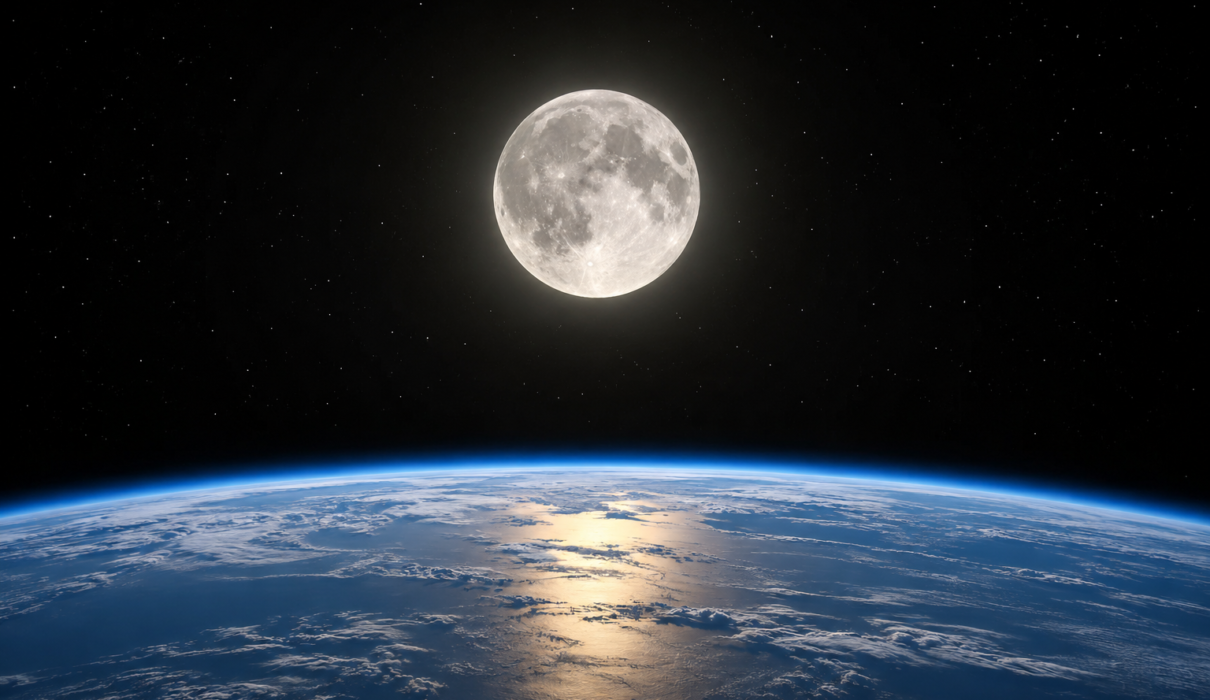
How did the Moon form? The short version sounds like something out of a disaster movie. About 4.5 billion years ago, a planet roughly the size of Mars slammed into a very young Earth, and the wreckage from that collision eventually clumped together into the Moon we see tonight. It’s a wild story, and honestly, it gets stranger the deeper you look into it.
If you’ve ever looked up at a full moon and wondered where it actually came from, you’re asking one of the oldest questions in astronomy. It’s tangled up with a bigger question too, namely how did the solar system form in the first place, since the Moon’s story starts in that same chaotic nursery of gas and rock. Scientists have been chasing the answer for over a century, and it took actual Moon rocks, brought home by real astronauts, to finally crack the case.
Key Takeaways
- Most scientists agree the Moon formed from a giant impact between early Earth and a Mars-sized body called Theia, roughly 4.5 billion years ago (NASA Science).
- Apollo rock samples show the Moon is at least 4.46 billion years old, and some zircon crystals push that age back to 4.51 billion years (Space.com).
- A November 2025 study suggests Theia formed close to Earth, in the inner solar system, not out in the asteroid belt as once thought (Science).
- The Moon is still drifting away from Earth today, about 3.8 centimeters a year, roughly the speed your fingernails grow.
In this guide, we’ll walk through exactly how the Moon formed, what evidence backs it up, which older theories got tossed out, and what scientists are still arguing about even now. Grab a coffee. This one’s a good one.
Table of Contents
So, How Did the Moon Form? The Short Answer First
Here’s the answer up front, since nobody likes scrolling forever for it. The leading explanation for how the Moon formed is called the Giant Impact Hypothesis. Early Earth, still hot and only partly formed, got hit by a Mars-sized protoplanet that scientists now call Theia. The collision was so violent it blew a massive cloud of vaporized rock, dust, and molten debris into orbit around Earth. Over time, gravity pulled that debris together into a single sphere, and that sphere became the Moon.
It sounds almost too simple for something this cataclysmic, doesn’t it? But the details behind it are genuinely fascinating, and they took decades of detective work to piece together.
The Giant Impact Hypothesis: How the Moon Formed From a Cosmic Collision
Before Apollo astronauts ever set foot on the Moon, scientists had three competing ideas about where it came from. To understand any of them, it helps to know the basics of what the nebular hypothesis says about planets forming from a spinning disk of gas and dust, because every early Moon theory borrowed from that same starting picture. One said the Moon was a wandering rock that Earth’s gravity simply captured as it drifted past. Another claimed Earth spun so fast in its youth that a chunk of it flew off and became the Moon. A third suggested Earth and the Moon just formed side by side, like siblings, from the same cloud of gas and dust.
None of them held up. The capture theory couldn’t explain why Moon rocks and Earth rocks share nearly identical chemical fingerprints. The spin off idea didn’t match the physics of how fast Earth would’ve needed to rotate. And the sibling theory couldn’t account for the Moon’s oddly small iron core.
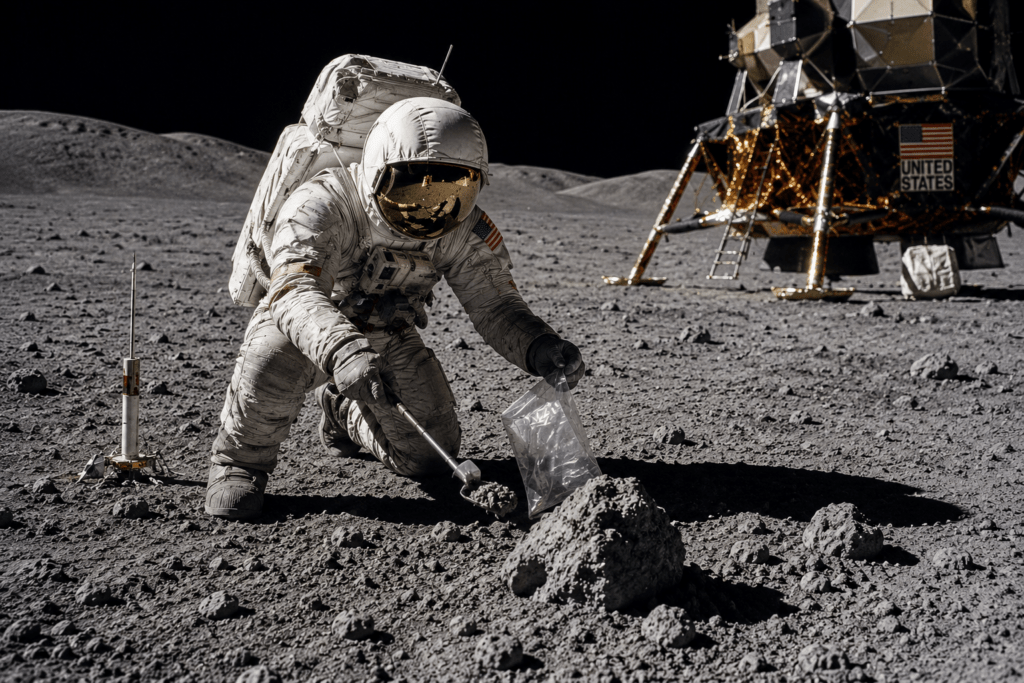
It was the Apollo missions, and the roughly 400 kilograms of lunar samples they hauled back, that finally settled things (NASA Science). Analysis of those rocks pointed toward one dominant explanation, and by the 1980s, the scientific community had largely rallied around it.
Meet Theia, the Planet That Made the Moon
Theia, named after the Greek Titan who mythologically gave birth to the Moon goddess Selene, is thought to have been roughly the size of Mars. That’s not a small object. We’re talking about a genuine planet, not an asteroid or a stray comet.
Around 4.5 billion years ago, Earth itself was still forming, and proto-Earth and Theia were orbiting in the same general neighborhood during what’s known as the Hadean eon, a violent, molten stretch of our planet’s early history. Eventually, their paths crossed, and the collision was catastrophic enough to partially vaporize both bodies (Natural History Museum). Some of that debris fell back to Earth. The rest stayed in orbit, swirling as a ring of hot rock and gas, before slowly gathering itself into the Moon.
Here’s a genuine oddity worth sitting with for a second: Theia itself basically vanished. We’ve never found a single confirmed piece of it. That’s part of what makes this whole story so hard to fully nail down, and it’s a detail I find genuinely wild every time I read about it.
What the Simulations Show
Modern supercomputers have let researchers model the impact in extraordinary detail, and one 2023 NASA study produced a jaw dropping result. Under certain impact angles and speeds, the Moon may have formed within just a matter of hours, not the millions of years earlier models assumed (NASA).
That fast formation model also helps explain something that puzzled scientists for years: why Moon rocks and Earth rocks look so chemically alike. If more of the Moon came from Earth’s own outer layers, rather than mostly from Theia, the similarity makes a lot more sense.
How Do We Know? The Evidence Locked Inside Moon Rocks
You might be wondering how anyone can be confident about something that happened 4.5 billion years ago. Fair question. The answer sits in a locked cabinet somewhere at NASA, in the form of actual Moon rocks.
Here’s what the evidence shows:
- Earth and Moon rocks share nearly identical oxygen isotope ratios, something that’s very hard to explain unless they formed from the same material.
- The Moon has a surprisingly small iron core, consistent with forming mostly from Earth’s outer mantle rather than a full planet’s worth of material.
- Earth’s spin axis and the Moon’s orbit line up in a way that fits a violent, angled collision rather than a calm co-formation.
- Lunar meteorites, which land all over the Moon’s surface and not just the Apollo landing sites, tell the same origin story (<u>NASA Science</u>).
- Zircon crystals recovered from Apollo samples carry uranium-lead ratios that let scientists date the Moon with real precision.
Every one of these clues, taken alone, wouldn’t prove much. Together, they build a case that’s hard to argue with, and it’s the same basic process, planetary accretion, that built the planets themselves out of smaller pieces of debris.
The Other Theories That Didn’t Survive Contact With Evidence
It’s worth spending a moment on the ideas that got left behind, because science rarely moves in a straight line, and these theories weren’t silly. They were reasonable guesses given what people knew at the time.
The capture theory imagined the Moon as a rogue body that wandered too close to Earth and got trapped by gravity, similar to how Mars captured its two tiny moons. It’s a tidy idea, but it falls apart once you compare the chemistry of Moon rocks to meteorites from elsewhere in the solar system. They just don’t match.
The fission theory, championed by Charles Darwin’s own son George Darwin back in the 1800s, proposed that a young, fast spinning Earth flung off a piece of itself that became the Moon. Elegant, but the math never quite worked, and it couldn’t explain the Moon’s chemical differences from Earth’s crust.
The co-accretion theory suggested Earth and the Moon simply formed together from the same protoplanetary disk of swirling material, like two pebbles rolling down the same hill. This one explains the chemical similarities reasonably well, but it completely fails to explain the Moon’s small core or the system’s unusually high angular momentum.
Each theory got knocked out by physical evidence, not by opinion. That’s honestly the part of this story I find most satisfying. It’s real science doing what it’s supposed to do.
How Old Is the Moon, Exactly?

This is where things get genuinely messy, and where I think a lot of blog posts oversimplify. Most Apollo lunar samples date to around 4.35 billion years old. But in 2023, researchers analyzing a zircon crystal from an Apollo 17 sample calculated the Moon to be at least 4.46 billion years old, about 40 million years older than earlier estimates (Space.com).
Other zircon studies push even further back, suggesting a minimum age of 4.51 billion years, meaning the Moon formed within roughly 60 million years of the solar system’s birth. So why the gap between 4.35 billion and 4.51 billion? A December 2024 study offered a compelling explanation: early gravitational tugging between Earth and the young Moon caused it to partially remelt, essentially resetting the geological clock in many surface rocks and making them read younger than the Moon actually is (Universe Today).
In plain English, the Moon is old, but its face got a “facelift” early on that confused the dating for decades. It’s a genuinely elegant fix to a problem that had researchers arguing for years, and it’s exactly the kind of detail that gets left out of most articles on this topic.
A Fresh Twist: Where Did Theia Actually Come From?
Here’s something you probably won’t find in older articles about how the Moon formed. In November 2025, a team led by geoscientist Timo Hopp published new research in the journal Science, using precise measurements of iron isotopes in lunar rocks, Earth rocks, and meteorites (Science).
Their conclusion? Theia most likely formed in the inner solar system, close to Earth, rather than drifting in from the outer reaches like the asteroid belt. As Hopp put it, Earth and Theia were probably neighbors before they collided. That single finding helps explain why Earth and Moon rocks are so chemically similar. If Theia formed from roughly the same raw ingredients as Earth, the near identical isotope signatures stop being such a mystery.
It’s a small update, sure, but it closes a gap that’s bothered planetary scientists for over twenty years.
Why the Moon’s Formation Still Matters Today
You might think a 4.5 billion year old collision is ancient history with zero relevance to your Tuesday. I get it. But the Moon’s violent birth still shapes life on Earth right now, in ways that are easy to overlook. It even set the stage for later chaos, like the Late Heavy Bombardment, when a fresh wave of impacts pummeled both worlds while Earth’s crust was still forming.
That giant impact likely knocked Earth’s axis into its current 23.5 degree tilt, which gives us seasons. The Moon’s gravity also stabilizes that tilt over long timescales, keeping our climate relatively steady instead of wobbling wildly the way Mars’s axis does. And the Moon is still slowly drifting away from us today, at about 3.8 centimeters per year, a rate that’s been measured with startling precision using laser reflectors the Apollo astronauts left behind decades ago.
That drift is lengthening Earth’s days too, just extremely slowly. None of this happens fast enough for you to notice in a lifetime, but it’s a direct, ongoing consequence of that one ancient collision.
Frequently Asked Questions About How the Moon Formed
How did the Moon form?
The Moon most likely formed when a Mars-sized planet called Theia collided with early Earth about 4.5 billion years ago. The impact threw debris into orbit, which gravity gradually pulled together into the Moon we see today (NASA Science).
How old is the Moon?
Apollo samples date the Moon to at least 4.46 billion years old, with some zircon evidence suggesting an age closer to 4.51 billion years, making it just slightly younger than Earth itself.
What happened to Theia after the impact?
Most of Theia is thought to have merged with early Earth, while a smaller portion formed the Moon. No confirmed intact fragment of Theia has ever been found, though its chemical fingerprint may be embedded in both Earth and Moon rocks.
Is the Giant Impact Hypothesis 100% proven?
It’s the leading, best supported theory, backed by decades of rock analysis and simulations, but it isn’t airtight. Scientists still debate exact impact angles, Theia’s precise origin, and why Earth and Moon rocks are so chemically similar.
Could the Moon have formed a different way?
Earlier theories, including capture, fission, and co-accretion, were seriously considered but were ruled out once Apollo rock data contradicted their predictions. The giant impact model remains the best fit for the evidence we have.
