


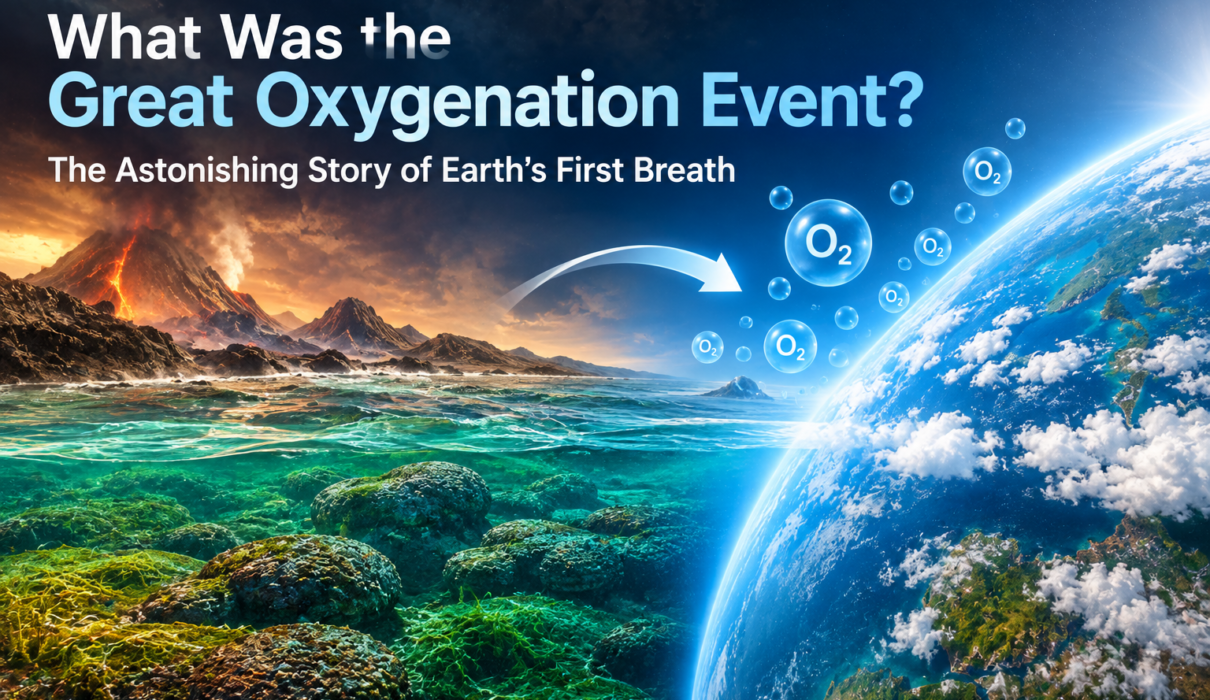
So, what was the Great Oxygenation Event? In short, it’s the moment, starting around 2.4 billion years ago, when Earth’s air went from having almost no oxygen to having enough that it changed the planet forever. It didn’t happen in a day. It didn’t even happen in a thousand years. It crept up on the planet over hundreds of millions of years, and when it finally tipped over, it killed off most of the life that existed at the time.
That’s not an exaggeration. Before this event, oxygen was basically poison to nearly every living thing on Earth. Honestly, that fact still catches me off guard every time I think about it, the very gas keeping you alive right now was once a planet-wide extinction weapon.
Key Takeaways
- The Great Oxygenation Event happened roughly 2.4 to 2.1 billion years ago, caused by cyanobacteria (ASM.org).
- It’s considered one of the first mass extinctions in Earth’s history, since oxygen was toxic to most life at the time.
- It likely triggered the Huronian glaciation, possibly the longest ice age Earth has ever seen (The Conversation).
- Without it, complex life (including us) probably wouldn’t exist.
Table of Contents
What Was the Great Oxygenation Event, Exactly?
Picture Earth about 2.5 billion years ago. No plants. No animals. Not even a single visible living thing anywhere, just the first life forms on Earth, simple microbes floating in ancient seas. Add to that water, rock, and an atmosphere thick with methane and carbon dioxide, not a trace of the oxygen we breathe today.
Then a group of tiny microbes called cyanobacteria figured out something no living thing had done before: they learned to turn sunlight, water, and carbon dioxide into food, and release oxygen as a waste product. We call this oxygenic photosynthesis, and it’s the same basic trick every plant on Earth still uses.
At first, this oxygen didn’t build up in the air. It got soaked up almost immediately by iron dissolved in the oceans, sort of like the planet was rusting from the inside out. But eventually the ocean’s iron ran low, and oxygen started leaking into the sky instead. That leak is what scientists call the Great Oxygenation Event, sometimes also written as the Great Oxidation Event, and it’s arguably the single biggest environmental shift this planet has ever gone through (ASM.org).
When Did the Great Oxygenation Event Happen?
Researchers generally date the Great Oxygenation Event to somewhere between 2.4 and 2.1 billion years ago. Some studies narrow it down even further, pointing to rocks between 2.5 and 2.3 billion years old as showing the clearest chemical fingerprints of the shift (The Conversation). If you want the fuller backstory on exactly when oxygen first appeared in Earth’s atmosphere, we’ve covered the earliest oxygen traces in more depth in a separate post.
Here’s the part that surprises most people, though: cyanobacteria didn’t just suddenly appear right before the event. Evidence suggests they’d already been photosynthesizing for hundreds of millions of years before oxygen ever showed up in the atmosphere in any meaningful amount (ScienceDaily). So why the delay? That’s actually one of the biggest open questions in this whole field.
A quick timeline, roughly speaking:
- ~3.5 billion years ago: Cyanobacteria begin producing oxygen in small, localized pockets of ocean.
- ~2.6 to 2.4 billion years ago: Oxygen starts sweeping through large stretches of seawater, well before it reaches the sky (ScienceNews).
- ~2.4 to 2.1 billion years ago: The Great Oxygenation Event proper, oxygen finally accumulates in the atmosphere.
- Today: Oxygen makes up close to 21% of the air we breathe.
Why Did It Take So Long to Get Going?
This is where things get genuinely interesting, and honestly a little strange. A 2025 study suggests high levels of nickel and urea in the early oceans may have kept cyanobacteria populations small and scattered for a very long time. Once those levels dropped, cyanobacteria could finally bloom on a much bigger scale, and that’s what may have kicked the whole event into gear (ScienceDaily).
What Caused the Great Oxygenation Event?
At its core, the cause is simple: living things made a gas that hadn’t existed in any real quantity before, and eventually there was nowhere left for it to go except up into the sky. But the full story involves a few moving parts working together.
First, cyanobacteria had to evolve the ability to split water molecules using sunlight, releasing oxygen as a byproduct, a huge leap from the simple chemistry that let the first cells form on Earth in the first place. Second, the ocean had to run out of “sinks,” things like dissolved iron, that were soaking up that oxygen before it could escape into the air. Once the iron ran low, that oxygen had nowhere else to go.
There’s also a newer and pretty wild theory floating around: some scientists think Earth’s slowing rotation, meaning longer days, gave cyanobacteria more sunlight hours per day to photosynthesize, which may have nudged oxygen production over the tipping point (Science/AAAS). It’s a genuinely clever idea, though it’s still debated, and I’ll admit I find it one of the more fun theories in all of Earth science.
The Great Oxygenation Event Triggered an Ice Age

Here’s something most people don’t expect: this burst of oxygen didn’t just change the air, it froze the planet. Before the event, Earth’s atmosphere was loaded with methane, a powerful greenhouse gas that kept the planet relatively warm. Oxygen reacted with that methane and broke it down, and as the methane disappeared, so did a big chunk of Earth’s natural insulation.
Temperatures dropped hard. This kicked off what’s known as the Huronian glaciation, a series of ice ages that may have been the longest and most severe in Earth’s entire history, possibly even a “snowball Earth” scenario where ice covered most or all of the planet (The Conversation).
Think about that for a second. The very organisms that eventually made animal life possible also nearly froze the entire planet solid as a side effect. Life, it turns out, has been rearranging Earth’s climate since long before humans showed up.
Banded Iron Formations: Earth’s Rusty Diary

You can actually see evidence of the Great Oxygenation Event today, in rock. As oxygen reacted with dissolved iron in ancient oceans, it formed layers of red and grey rock called banded iron formations. These stripes, found in places like Minnesota and Western Australia, are essentially a written record of the planet slowly rusting, one layer at a time, as oxygen levels rose and fell (ScienceNews).
What Were the Effects of the Great Oxygenation Event?
This is the part that tends to shock people most: oxygen, the gas we can’t live five minutes without, was once a mass killer.
Most life at the time was anaerobic, meaning it survived just fine without oxygen, and in fact oxygen was toxic to it. When oxygen suddenly started building up, it’s believed to have wiped out huge numbers of these anaerobic organisms in what scientists now consider one of Earth’s earliest mass extinctions. It’s one more chapter in the bigger story of how life survived Earth’s harsh early conditions, over and over, against some pretty brutal odds.
So what did the event actually leave behind? A massive die-off of anaerobic microbes that simply couldn’t tolerate oxygen, for one. The Huronian glaciation, that brutally long ice age caused by falling methane levels, for another. It also left behind the banded iron formations we walked through above, layer after layer deposited across the ocean floor as evidence of the change. And, maybe most importantly, it left behind the opening for aerobic life: organisms that didn’t just tolerate oxygen but learned to burn it for energy far more efficiently than anaerobic life ever could.
That last point turned out to be the real game changer. Some surviving microbes adapted by taking in oxygen-using bacteria as partners rather than food, a process called endosymbiosis. Those partner bacteria eventually became mitochondria, the tiny power plants inside your own cells right now. Without that adaptation, most scientists agree complex life, plants, animals, us, likely never would have evolved at all.
Why Does the Great Oxygenation Event Still Matter Today?

You might be wondering why any of this matters two and a half billion years later. Here’s the thing: every breath you take exists because of what happened during this event. It set the atmospheric stage for everything that came after it, fish, dinosaurs, forests, and eventually humans.
It also matters for a much bigger question scientists are asking right now: how do we find life on other planets? When astronomers study distant exoplanets, one of the biggest clues they look for is oxygen in the atmosphere, because on Earth, oxygen has almost always meant life. Understanding exactly how and why our own planet built up its oxygen helps researchers judge whether oxygen spotted on a faraway world might mean the same thing, or whether it could form some other way entirely. That connection between ancient microbes and modern space telescopes is one of my favorite things about this topic. It’s not just ancient history, it’s actively shaping how we search the universe.
Frequently Asked Questions
What was the Great Oxygenation Event in simple terms? It was the point in Earth’s history, around 2.4 billion years ago, when tiny microbes called cyanobacteria filled the atmosphere with oxygen for the first time, changing the climate and killing off most of the life that existed back then (ASM.org).
Is the Great Oxygenation Event the same as the Great Oxidation Event? Yes. Both names describe the same event. You’ll also sometimes see it called the Oxygen Catastrophe or the Oxygen Crisis in older papers and textbooks.
What caused the Great Oxygenation Event? Cyanobacteria evolved the ability to photosynthesize and release oxygen. Once the ocean’s iron stopped absorbing that oxygen, it began building up in the atmosphere instead (ScienceDaily).
Did the Great Oxygenation Event cause an ice age? Most researchers think so. Oxygen broke down atmospheric methane, a major greenhouse gas, which cooled the planet enough to trigger the long Huronian glaciation (The Conversation).
