


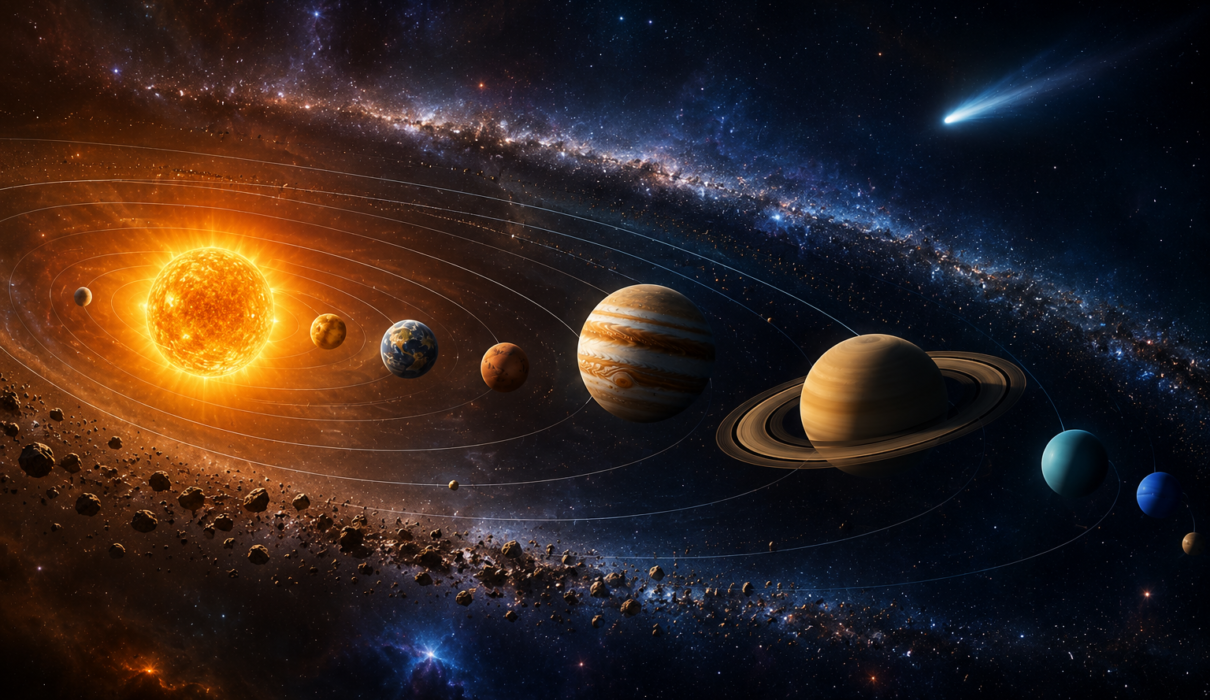
How did the solar system form? It started as a cold, quiet cloud of gas and dust, just floating out there in space. Somehow that shapeless cloud turned into the Sun, eight planets, hundreds of moons, and billions of icy rocks. That leap sounds almost impossible. But scientists have actually pieced the whole story together, using meteorites, moon rocks, telescopes, and even other stars that are forming planets right now, as we speak.
By the end of this post, you’ll know exactly how did the solar system form, step by step, in language a ten year old could follow. No jargon walls, no guessing. Just the real science, with a source named for every major claim so you can go check it yourself if you want.
Key Takeaways
- Our solar system started forming about 4.6 billion years ago from a collapsing cloud of gas and dust called the solar nebula (NASA Science).
- The Sun formed first, right at the center, and it grabbed more than 99 percent of all the material.
- Leftover dust and gas flattened into a spinning disk, and planets, moons, asteroids, and comets slowly built up from there through collisions.
- Rocky planets formed close to the Sun where it was scorching hot, while gas giants formed farther out where it was cold enough for ice to stick around.
Table of Contents
How Did the Solar System Form From a Cloud of Dust and Gas?
The story of how did the solar system form begins with something astronomers call a molecular cloud. Picture a giant, cold patch of gas and dust drifting through the galaxy, minding its own business for millions of years. According to NASA Science, our solar system formed about 4.6 billion years ago from a dense cloud of interstellar gas and dust that likely collapsed after a nearby star exploded as a supernova and sent a shockwave rippling through it.
Once the cloud started collapsing, gravity did the rest. Every speck of dust pulled on every other speck, and the whole cloud began shrinking and spinning faster, kind of like a figure skater who speeds up the second she pulls her arms in. That spin isn’t just a neat detail either. It’s the reason every planet in our solar system orbits the Sun in the same direction, on roughly the same flat plane. Nothing about that is an accident.
Here’s what happened during this early stage, based on NASA’s Astrobiology page:
- A giant molecular cloud, made mostly of hydrogen and helium left over from the Big Bang, collapsed under its own gravity.
- The collapse made the cloud spin faster and flatten into a disk shape.
- The center grew hotter and denser until it became the Sun.
- The outer material stayed cooler and spread out, becoming the raw material for planets.
How Did the Solar System Form the Sun First?
Here’s the part people often miss when they picture this: the Sun showed up before any planet existed. As the cloud collapsed, most of its mass sank toward the center. NASA Space Place puts it simply, the cloud fell in on itself and formed a surrounding disk, while the center kept squeezing tighter and tighter until the pressure got so extreme that hydrogen atoms started fusing into helium. That fusion released a tremendous burst of energy. That was the moment our Sun was born.
This next fact still catches people off guard, honestly. The Sun ended up holding more than 99 percent of all the mass in the entire solar system, according to NASA Science. Everything else, all eight planets, every moon, every asteroid, every comet, adds up to less than one percent of the leftover material. Less than one percent. That’s how completely the Sun dominated everything around it once it lit up.
It’s worth sitting with that for a second, because it explains so much of what came next. With the Sun anchored at the center, the rest of the dust and gas were free to spread into a thin, spinning disk. And that disk is where every planet, moon, and asteroid you’ve ever heard of eventually got built.
How Did the Solar System Form Planets From a Spinning Disk?
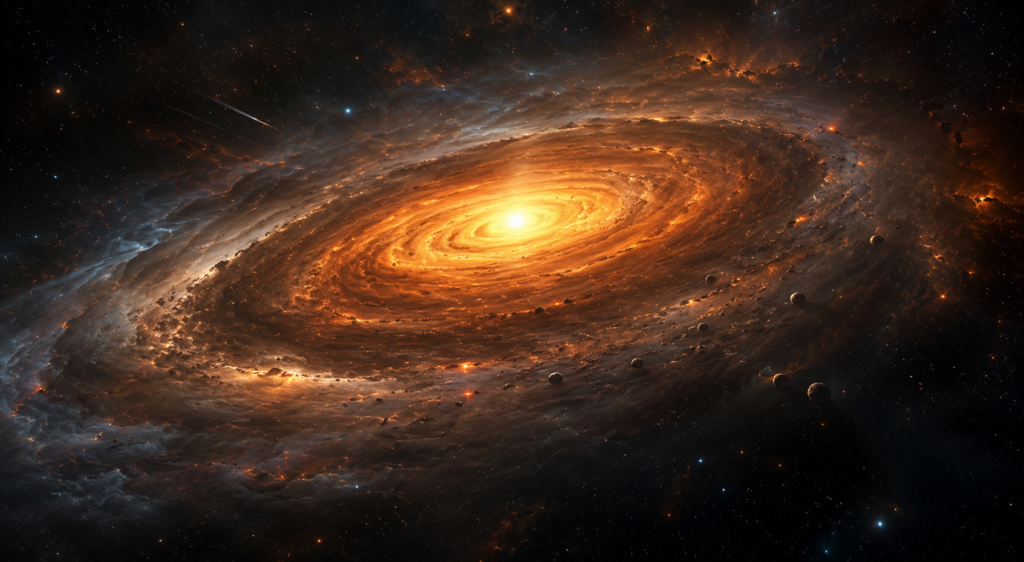
Once the Sun switched on, the leftover material formed what scientists call a protoplanetary disk, and this is really the answer to how did the solar system form its planets. According to NASA Science, solid particles of rock and ice inside this disk collided and merged, slowly building larger and larger objects. The disk itself stretched more than 100 times farther out than Earth is from the Sun today.
Tiny grains of dust, smaller than a speck of pepper, started sticking together through static electricity, not unlike how lint clumps together inside a dryer. Once those clumps grew big enough, gravity took over and started pulling in even more material. Scientists call these growing rocky bodies planetesimals, and some of them eventually grew to be miles across.
None of this happened fast. It likely took a few tens of millions of years for planetesimals to keep smashing into each other and slowly build up into the planets we know today. Some collisions were gentle enough to stick together. Others were violent enough to shatter whole planetesimals back into rubble, and that violence is actually part of why the asteroid belt looks the messy way it does today.
Why Are Some Planets Rocky and Others Are Gas Giants?
This is one of the more satisfying pieces of the puzzle, and it really comes down to temperature. Close to the young Sun it was far too hot for ice or gas to survive, so only metal and rock could condense into solid form there. Farther out, temperatures dropped low enough that ice, methane, and ammonia could freeze solid and stay that way.
According to Geosciences LibreTexts, this exact temperature split is why the inner four planets, Mercury, Venus, Earth, and Mars, ended up small and rocky, while the outer four, Jupiter, Saturn, Uranus, and Neptune, ended up as giant balls of gas and ice.
The Snow Line Explains Everything
Astronomers actually have a name for the boundary between these two zones: the snow line. Inside it, only rock and metal could form solid grains. Outside it, ice grains piled on enormous amounts of extra material, which is a big part of why the gas giants grew so much larger than Earth or Mars ever could. Jupiter alone ended up more massive than every other planet in the solar system combined. Every other planet. Combined.
How Did the Solar System Form Its Moons, Asteroids, and Comets?
Not every leftover chunk of material became a planet. Some smashed together into moons. Some stayed behind as rubble in belts. Some got flung all the way out to the icy edges of the solar system. This is where the story of how did the solar system form gets genuinely dramatic, especially for our own planet.
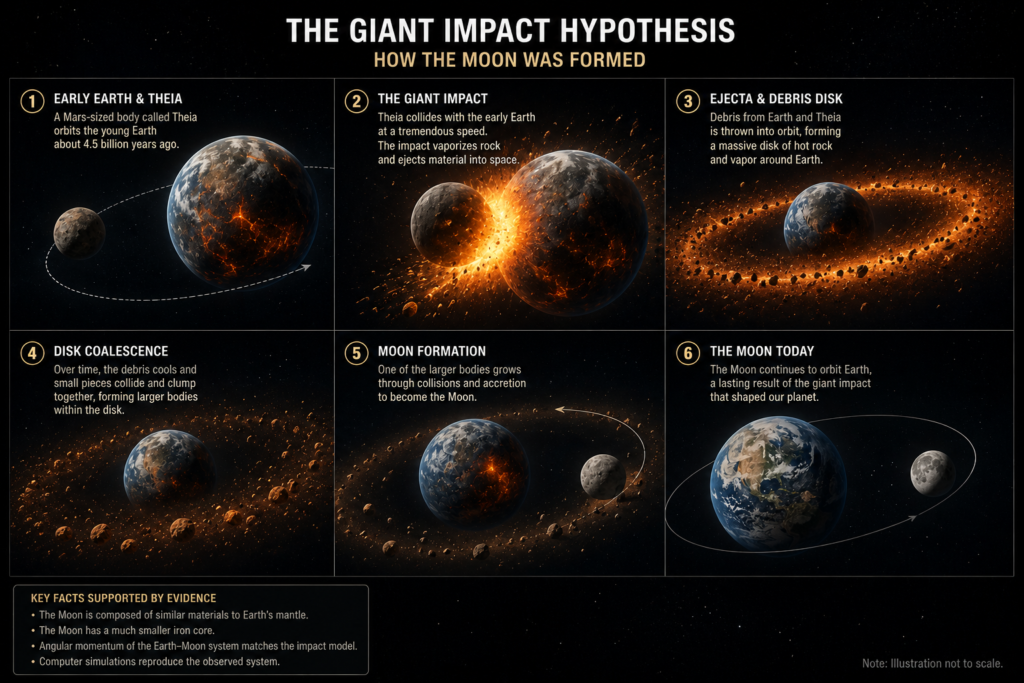
Earth’s Moon is thought to have formed through a massive collision, and it’s a wilder story than most people realize. The giant impact hypothesis proposes that a Mars sized object, sometimes nicknamed Theia, slammed into the young Earth roughly 4.5 billion years ago, only 20 to 100 million years after the solar system itself began forming.
Debris from that collision is believed to have circled Earth and eventually clumped together into what we now call the Moon. If you want a sense of just how young and violent Earth was during this window, it’s worth reading about what was the Earth like in the Hadean era, since this impact happened right at the start of that fiery chapter, formally known as the Hadean eon, in our planet’s history.
Meanwhile, in the neighborhood between Mars and Jupiter, Jupiter’s massive gravity stirred up the nearby planetesimals so violently they could never merge into a full planet. Instead they became the asteroid belt. Most objects there, according to NASA, are simply rocky leftovers from the earliest days of the solar system, still drifting around unfinished.
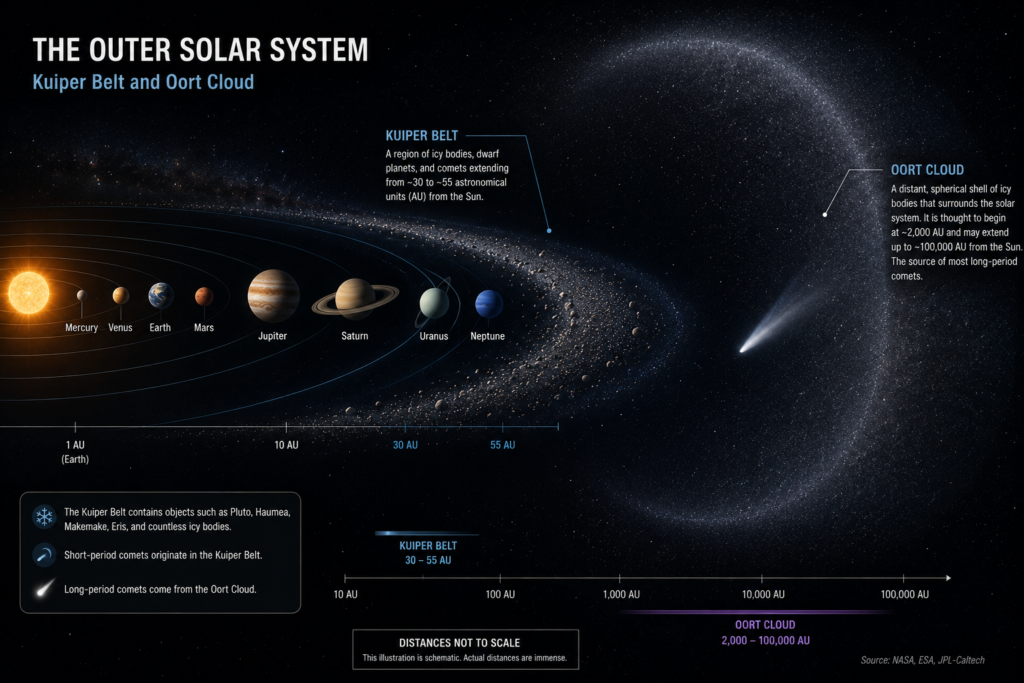
Farther out past Neptune, icy leftovers formed the Kuiper Belt. NASA’s Kuiper Belt facts page explains that shifting orbits among the giant planets scattered much of this icy material, flinging some of it into extremely distant orbits that eventually formed the Oort Cloud, a vast spherical shell of comets that may stretch halfway to the next star over.
What Was the Late Heavy Bombardment?
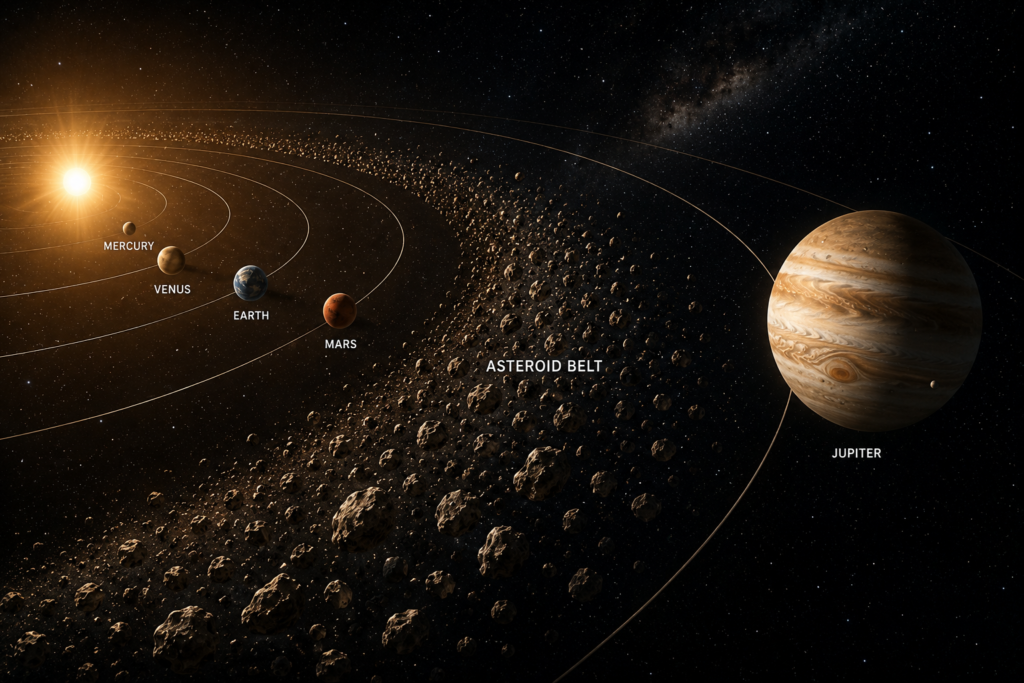
About 4 billion years ago, roughly 600 to 800 million years after the solar system formed, things got violent again. According to NASA Science, a sudden shift in the orbits of Jupiter, Saturn, Uranus, and Neptune threw the asteroid belt into chaos, sending huge numbers of asteroids crashing into the Moon, Mercury, Venus, and Earth. Scientists call this event the Late Heavy Bombardment, and it’s one of the more unsettling chapters in our solar system’s early life.
Evidence for this period comes from the ages of impact craters on the Moon, which cluster tightly around 3.8 to 4.0 billion years old, based on rock samples the Apollo missions brought back. This bombardment happened during Earth’s earliest geological chapter, and it ties directly into questions about what the planet looked like back then and whether <u>life could have possibly existed during the Hadean eon despite such rough conditions.
How Do Scientists Know Any of This Is True?
Fair question. You might be wondering how anyone can be confident about events from over four billion years ago. Honestly, no single piece of evidence proves the whole story on its own. It’s more that scientists have stacked up several independent clues that all happen to point in the same direction.
Meteorites give researchers a direct sample of material left over from the early solar system, since they’re basically unchanged chunks of the original planetesimals, frozen in time. Moon rocks brought back by the Apollo missions let scientists date impact craters and confirm the timing of major events like the Late Heavy Bombardment.
Telescopes like Hubble and the ALMA array have photographed actual protoplanetary disks around young stars elsewhere in the galaxy, which is essentially showing us a live preview of what our own solar system looked like billions of years ago. And computer simulations of gravity and orbital motion let researchers test whether a specific sequence of events, like the giant impact or the migration of Jupiter and Saturn, could really produce the solar system we see today.
Because these independent lines of evidence keep agreeing with each other, the nebular hypothesis has stayed the leading explanation for how did the solar system form for decades now, even as the finer details keep getting refined.
Frequently Asked Questions
How did the solar system form in simple terms?
A cloud of gas and dust collapsed under its own gravity about 4.6 billion years ago, flattened into a spinning disk, and formed the Sun at its center. Leftover material in the disk clumped together into planets, moons, asteroids, and comets over millions of years (NASA Science).
How old is the solar system?
The solar system is about 4.6 billion years old, based on radioactive dating of meteorites and the oldest rocks found on Earth and the Moon, according to NASA Science.
Why did the Sun get most of the mass?
Gravity pulled the bulk of the collapsing cloud toward its densest point, which became the Sun. NASA reports the Sun ended up with more than 99 percent of all the mass in the solar system, leaving less than one percent for every planet, moon, and asteroid combined.
What caused the Late Heavy Bombardment?
NASA Science explains that a shift in the orbits of Jupiter, Saturn, Uranus, and Neptune disturbed the asteroid belt, sending large numbers of asteroids crashing into the inner planets and the Moon around 4 billion years ago.
Did the Moon form at the same time as Earth?
Not quite. Earth formed first, and the Moon followed shortly after through a massive collision with a Mars sized object, roughly 4.5 billion years ago, according to the giant impact hypothesis documented on Wikipedia and supported by NASA research on lunar meteorites.

1 Comment