


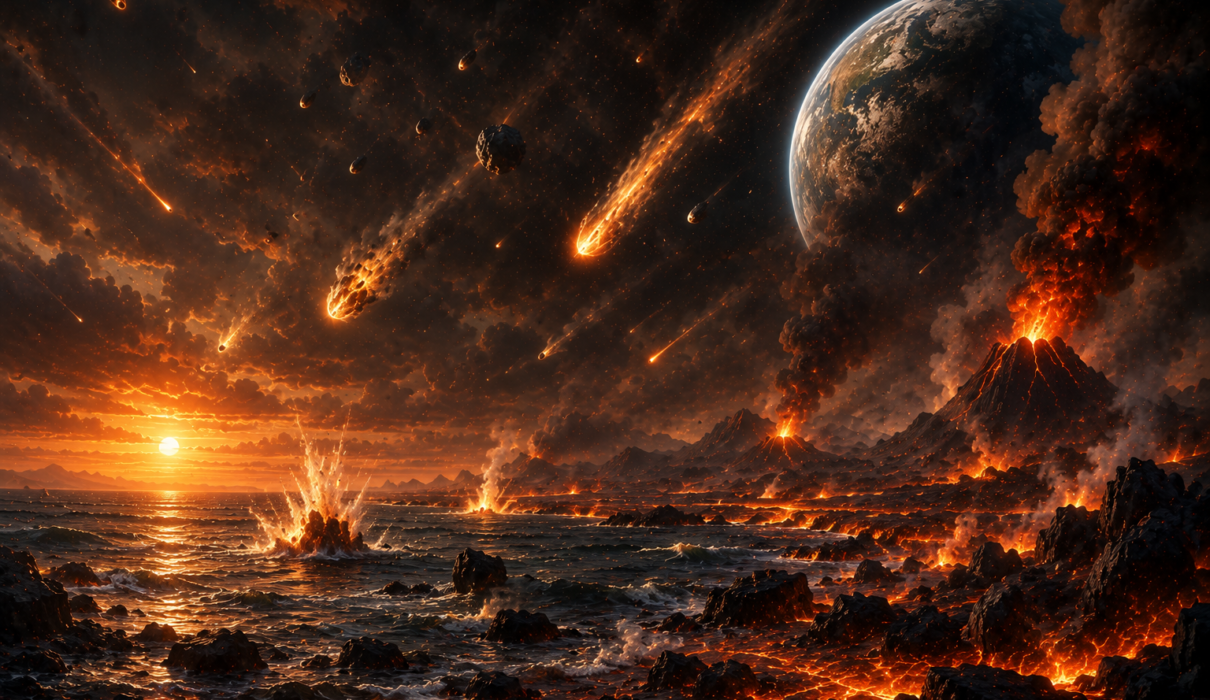
If you stepped outside on Earth 4.5 billion years ago, you would not survive one single breath. The atmosphere during the Hadean eon was not blue, not breathable, and not friendly. It was a thick, scorching, orange haze made of steam, carbon dioxide, and volcanic fumes, sitting on top of an ocean of melted rock. There was no sky as we know it. There was no oxygen. There was, in fact, almost nothing that resembled the planet you are reading this on right now.
That is what makes this story so strange to think about. This is our planet, yet it looked like something from a nightmare. Scientists have spent decades piecing together clues from tiny crystals, ancient rocks, and computer models just to answer one simple sounding question: what did the atmosphere during the Hadean eon actually look like? In this guide, you will get a clear, honest, source backed answer, written so anyone can follow it, even if you have never taken a geology class in your life.
Key Takeaways
- The atmosphere during the Hadean eon was rich in water vapor, carbon dioxide, and nitrogen, with almost no free oxygen (Britannica; Geology Science).
- Tiny zircon crystals from Jack Hills, Australia, dated to about 4.4 billion years old, suggest liquid water existed far earlier than scientists once believed.
- A Mars sized object, nicknamed Theia, likely smashed into Earth and helped strip away or reshape the planet’s earliest air (Wikipedia: Giant Impact Hypothesis).
- The so called Late Heavy Bombardment, a spike in asteroid strikes, is still debated among scientists and may not have been one single dramatic event.
- A dim young Sun should have left Earth frozen, so greenhouse warming from carbon dioxide and water vapor likely kept the surface warm enough for liquid water (Britannica; Reviews of Geophysics, 2012).
Table of Contents
What Was the Atmosphere During the Hadean Eon Made Of?
The atmosphere during the Hadean eon was mostly water vapor and carbon dioxide, with a healthy dose of nitrogen mixed in. There was almost no oxygen at all. That single fact changes everything about how you should picture this world. No blue sky. No white clouds drifting lazily overhead. Instead, picture a dense, hot, grey orange blanket of gas pressing down on a landscape of lava lakes and cooling rock.
Researchers describe this early air as a mix that Geology Science says likely consisted of water vapor, carbon dioxide, nitrogen, and other volatile compounds released as the young planet cooled. This is not guesswork built on nothing. It is based on comparing early Earth to volcanic gases we can measure today, then adjusting for a planet that was far hotter and far more chaotic.
Water Vapor and Carbon Dioxide Dominated the Sky
Water vapor and carbon dioxide were the heavyweights of this ancient sky. Volcanoes across the planet spewed these gases nonstop, since Earth’s interior was still radiating leftover heat from its violent formation. Carbon dioxide levels were far higher than today, similar in some models to the thick atmospheres we now see on Venus and Mars.
Here is a simple way to picture it:
- Water vapor built up because the surface was too hot for liquid oceans to survive at first.
- Carbon dioxide came pouring out of volcanic vents in enormous quantities.
- As the planet slowly cooled, water vapor condensed into rain, and that rain began forming the very first oceans.
- Some of that carbon dioxide later dissolved into those oceans and combined with calcium, locking it away as limestone rock.
Nitrogen, Methane, and Other Trace Gases
Nitrogen was also a major ingredient, and it has stuck around ever since, since nitrogen gas does not react easily with much else. Smaller amounts of methane, ammonia, sulfur dioxide, and hydrogen rounded out the mix. Britannica notes that the atmosphere likely began as escaping hydrogen and helium before ammonia, methane, and neon appeared once the crust cooled, with volcanic outgassing later adding water vapor, nitrogen, and more hydrogen.
Scientists genuinely disagree on the exact ratio of these gases. Some models point to a more oxidized mix dominated by carbon dioxide and water. Other models, based on heating meteorite like material in laboratories, suggest a more chemically reduced mix loaded with methane and ammonia. The honest answer is that nobody has a perfect recipe, because nobody was there with a notebook.
How Did Earth Get Its First Atmosphere During the Hadean Eon?
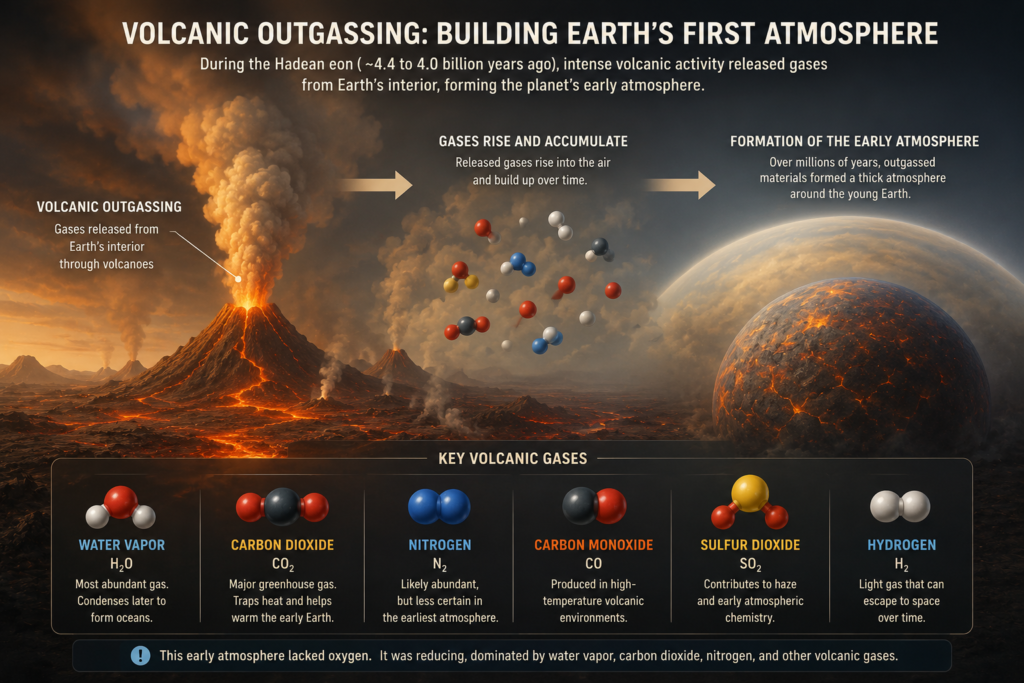
Earth actually built its atmosphere during the Hadean eon at least twice, not once. The first attempt was almost immediately wiped out. The second version is the one scientists usually mean when they describe this ancient sky.
Earth’s very first atmosphere may have been a thin layer of hydrogen and helium pulled in directly from the cloud of gas and dust that formed the solar system. That fragile shell did not last. A giant impact, involving a Mars sized body many researchers call Theia, is thought to have struck the young Earth. According to Wikipedia’s summary of the giant impact hypothesis, this collision likely happened around 4.5 billion years ago, early in the Hadean eon, and the debris thrown into orbit eventually formed the Moon.
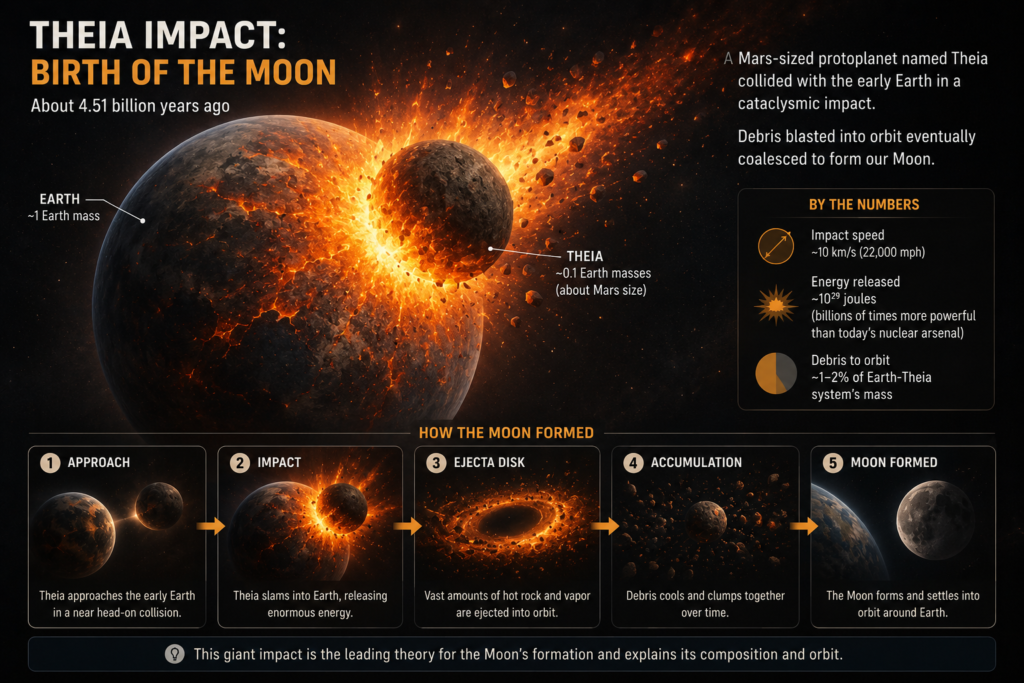
That kind of collision would have boiled away any thin early atmosphere and melted much of Earth’s surface into a rolling ocean of magma. Everything had to start over from there.
The second atmosphere during the Hadean eon grew back slowly through volcanic outgassing. As the magma ocean cooled and a crust began to form, volcanoes released trapped gases from deep inside the planet, along with vapor from incoming space debris. This rebuilt the water vapor, carbon dioxide, and nitrogen rich sky that most scientists now picture when they talk about the Hadean.
If you want a deeper dive into how this entire era unfolded, our guide on what was the Hadean eon, walks through the full timeline from Earth’s formation to the first solid crust, and it pairs nicely with this atmosphere focused breakdown.
Was There Oxygen in the Atmosphere During the Hadean Eon?
No, there was essentially no free oxygen in the atmosphere during the Hadean eon. This is one of the clearest points scientists agree on. The air back then is often called a reducing atmosphere, meaning it lacked the oxygen that today’s plants and photosynthetic microbes constantly pump out.
Why does this matter so much? Oxygen only builds up in large amounts once living things start producing it faster than it gets consumed by rocks, oceans, and chemical reactions. During the Hadean, there were no forests, no algae blooms, no cyanobacteria doing their slow quiet work yet, so there was nothing generating oxygen at any meaningful scale.
Without oxygen, there was also no ozone layer. That means the surface of early Earth was blasted with intense ultraviolet radiation from the sun, unfiltered and constant. Some researchers actually think this harsh UV environment helped drive early chemical reactions that eventually contributed to the building blocks of life, since energy has to come from somewhere when you are trying to stitch molecules together.
How Did Greenhouse Warming Shape the Atmosphere During the Hadean Eon?
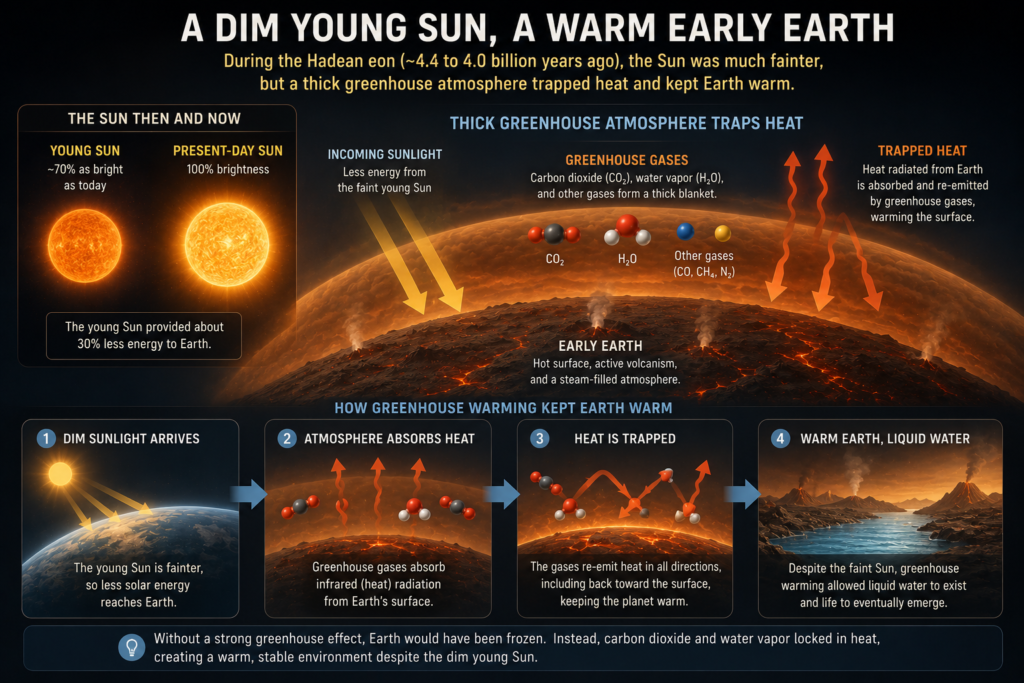
Greenhouse warming is the piece that quietly holds this whole story together. Here is the puzzle. The young Sun was noticeably dimmer than it is today, roughly 25 percent fainter according to standard models of stellar evolution, cited in a detailed 2012 review in Reviews of Geophysics. With that little sunlight, Earth should have been a frozen ball of ice for its first two billion years. Yet the zircon evidence already discussed above points to liquid water instead. Scientists call this mismatch the faint young Sun paradox.
The leading explanation is that the atmosphere during the Hadean eon was so thick with greenhouse gases that it trapped enough heat to make up the difference. Britannica explains that greenhouse gases, especially carbon dioxide and methane, let sunlight pass through freely but then trap the heat that bounces back off the surface, warming the planet from below like a blanket. With carbon dioxide levels potentially far above today’s, and water vapor adding even more heat trapping power, this thick early sky may have offset a dim Sun almost perfectly.
Researchers are still refining exactly how much carbon dioxide was needed. Some early estimates required unrealistically high amounts, while newer models mix in methane, ammonia, and even leftover heat from tidal interactions with a much closer Moon, described in the same Reviews of Geophysics review. The bottom line has not changed though. Without a strong greenhouse effect baked into the atmosphere during the Hadean eon, Earth’s oceans should never have existed this early at all.
The Late Heavy Bombardment and Its Effect on the Hadean Sky
You cannot fully understand the atmosphere during the Hadean eon without mentioning the Late Heavy Bombardment, even though scientists are still arguing about how real it actually was. The idea, first built from lunar rock samples brought back by Apollo astronauts, suggests there was a spike in asteroid and comet impacts on the Moon and Earth roughly 3.9 billion years ago.
If this bombardment happened as originally described, it would have periodically superheated the atmosphere, vaporized surface water, and possibly reset the chemistry of the young ocean and sky over and over again. However, a widely cited 2016 study published in PNAS argues that the evidence for one dramatic spike may be an illusion created by how scientists interpreted the ages of lunar rock samples, and that impacts may have simply declined steadily over time instead.
A 2017 review in Annual Reviews of Earth and Planetary Sciences adds more nuance, describing evidence for a discrete episode of higher impact activity between roughly 3.5 and 4.2 billion years ago, with a quieter stretch before that. In plain terms, the impacts were real, but whether they arrived in one violent cluster or a long messy trickle is still an open scientific question.
Either way, these impacts mattered for the atmosphere during the Hadean eon because large collisions can:
- Vaporize huge volumes of surface water back into the sky.
- Deliver additional volatile compounds and metals from space.
- Temporarily thicken or reshape the mixture of gases surrounding the planet.
- Melt and rework patches of the young crust, releasing trapped gases in the process.
Did the Atmosphere During the Hadean Eon Allow Liquid Water and Life?
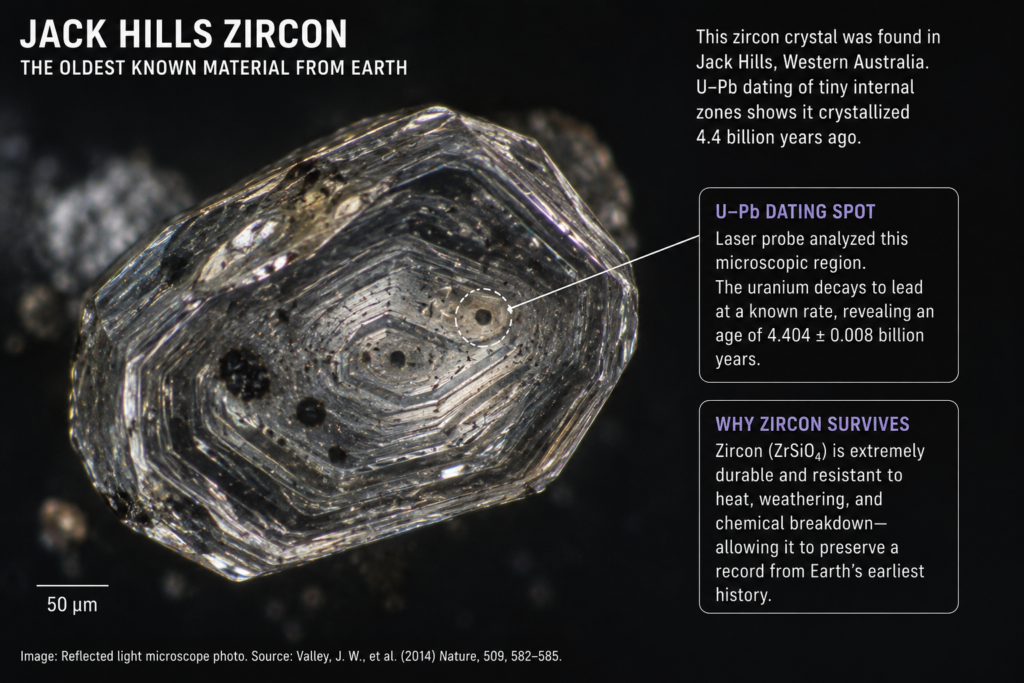
Yes, and this is genuinely one of the most surprising discoveries in modern geology. For a long time, textbooks described the Hadean as a completely molten hellscape from start to finish, which is honestly where the eon gets its name, since Hadean comes from Hades. But tiny mineral grains called zircons have quietly rewritten that story.
Zircon crystals discovered in the Jack Hills region of Western Australia have been dated to around 4.4 billion years old, making them the oldest known fragments of Earth ever found. According to University of Wisconsin Madison’s research announcement, geochemist John Valley and his team confirmed this age using atom by atom analysis of trapped lead atoms, and the findings support what researchers now call a cool early Earth model.
That is a big deal. It means temperatures were low enough, in at least some regions, for liquid water and a stable crust to exist just a few hundred million years after the planet formed, rather than hundreds of millions of years later than that. A 2024 report covered by CNN even points to evidence of fresh water and dry land on Earth roughly 4 billion years ago, based on further zircon analysis, suggesting parts of the planet were not entirely ocean covered either.
So the atmosphere during the Hadean eon was hostile by our standards, thick with carbon dioxide and completely lacking oxygen, yet it sat above a surface that may have already been cool enough for oceans, rain, and possibly the very earliest chemical steps toward life.
How Do Scientists Actually Know What the Atmosphere During the Hadean Eon Looked Like?
Nobody has a time machine, so how can anyone claim to know what gases filled the sky over four billion years ago? The answer comes from clever detective work across several scientific fields, and it is worth walking through briefly, because it builds trust in the whole picture.
Researchers rely on:
- Zircon crystals, which trap chemical signatures at the moment they form and survive essentially unchanged for billions of years.
- Isotope ratios, tiny variations in atoms like oxygen and sulfur that shift depending on the temperature and chemistry of the environment they formed in.
- Lunar and meteorite samples, since the Moon and asteroids preserve impact records that Earth’s own shifting crust has long since erased.
- Modern volcanic gas measurements, used as a starting template that scientists then adjust for a hotter, more chaotic young planet.
- Computer models, which combine all of the above to test which gas mixtures are physically possible and consistent with the evidence.
A 2015 study in PNAS even used sulfur isotope measurements from some of the oldest sediments ever found, in the Nuvvuagittuq Greenstone Belt in Canada, to show that this unusual atmospheric fingerprint traces all the way back to the end of the Hadean eon. As the American Chemical Society’s Tiny Matters podcast team explains, there simply is not much full rock record left from this period, which is exactly why these small, tough zircon grains have become so valuable to researchers piecing this puzzle together.
Frequently Asked Questions
What gases made up the atmosphere during the Hadean eon?
The atmosphere during the Hadean eon was mostly water vapor, carbon dioxide, and nitrogen, with smaller amounts of methane, ammonia, sulfur dioxide, and hydrogen. There was no meaningful free oxygen (Britannica; Geology Science).
Could a human have survived in the Hadean atmosphere?
No. There was no breathable oxygen, carbon dioxide levels were extremely high, and much of the surface was either molten rock or scorching hot rain and steam. It would have been lethal within moments.
When did oxygen first appear in Earth’s atmosphere?
Free oxygen did not build up in large amounts until much later, during the Great Oxidation Event roughly 2.4 billion years ago, once photosynthetic microbes had been releasing it for a long stretch of time. That is well after the Hadean eon ended.
Did the Late Heavy Bombardment really happen?
It is debated. Lunar samples first suggested a sharp spike in impacts around 3.9 billion years ago, but a 2016 PNAS study argues this pattern could be an illusion from how ages were measured, and impacts may have simply declined steadily instead.
How do scientists study something that happened billions of years ago?
Mainly through zircon crystals, isotope chemistry, lunar and meteorite samples, and computer modeling, cross checked against each other to build the most consistent picture possible of the atmosphere during the Hadean eon.
The Bottom Line
The atmosphere during the Hadean eon was a thick, oxygen free blend of water vapor, carbon dioxide, and nitrogen, shaped by nonstop volcanic activity, a planet reshaping impact that likely formed the Moon, and a long, messy bombardment from space debris that scientists are still working to fully understand. It was hostile, strange, and utterly unlike the sky above you right now.
Yet somewhere inside that chaos, cool patches of crust and possibly liquid water were already forming, setting the stage for oceans, and eventually, for life itself. If you want to keep exploring this period, our companion piece on what the Earth was like in the Hadean era covers the surface conditions, the crust, and the earliest oceans in more detail.
