


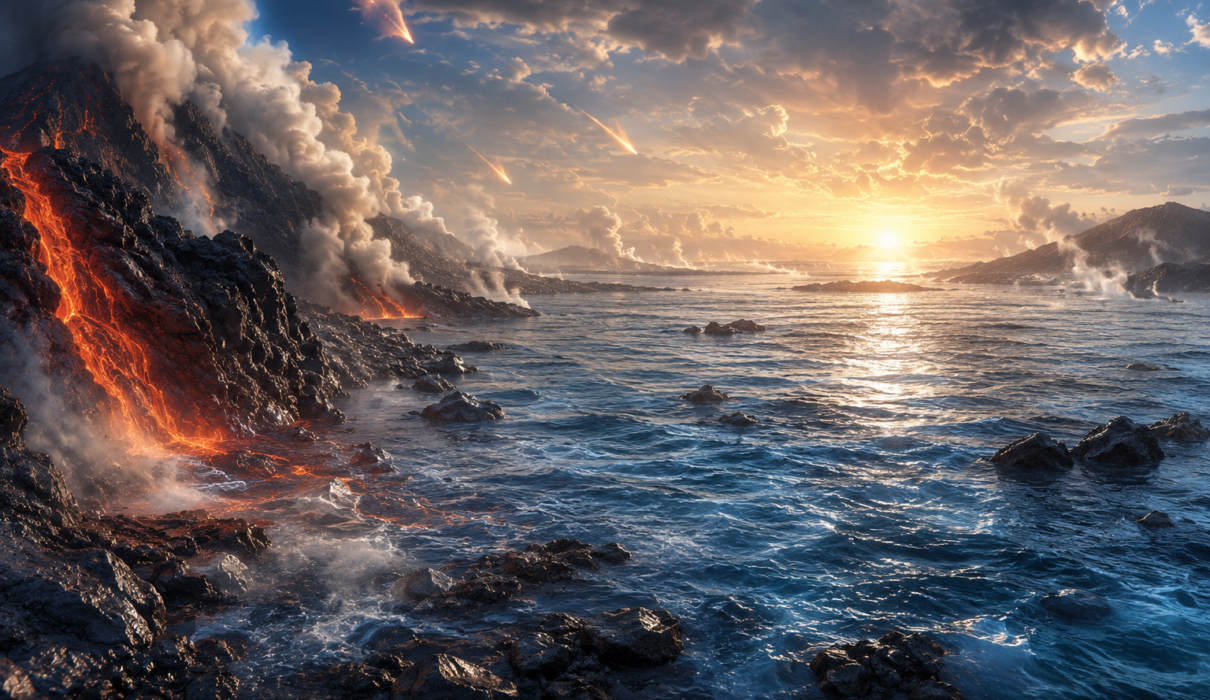
Earth’s first oceans formed at a time when our planet looked nothing like the blue marble we know today. Picture a world covered in glowing magma, battered by space rocks, and too hot for a single drop of liquid water to survive on its surface. Then, somehow, that changed. Water pooled into basins, and life eventually crawled out of it.
How did that happen? Scientists have spent decades piecing this puzzle together using zircon crystals, comet dust, and ancient rock layers in Greenland and Australia. Stick with me, because the answer involves volcanoes, asteroids, and a cosmic delivery system that sounds almost too strange to be true.
Key Takeaways
- Earth’s first oceans formed roughly 4.4 billion years ago, according to zircon evidence studied by NASA and the University of Wisconsin-Madison.
- Water likely came from two sources: outgassing from Earth’s interior and impacts from water rich asteroids.
- Isotope studies of comet 67P show comets probably supplied only a small share of Earth’s ocean water.
- The oldest confirmed proof of surface water on Earth comes from 3.8 billion year old rock in Isua, Greenland.
- The Late Heavy Bombardment period, around 4.1 to 3.8 billion years ago, may have added even more water to the young planet.
Table of Contents
What Was Earth Like Before Its First Oceans Formed?
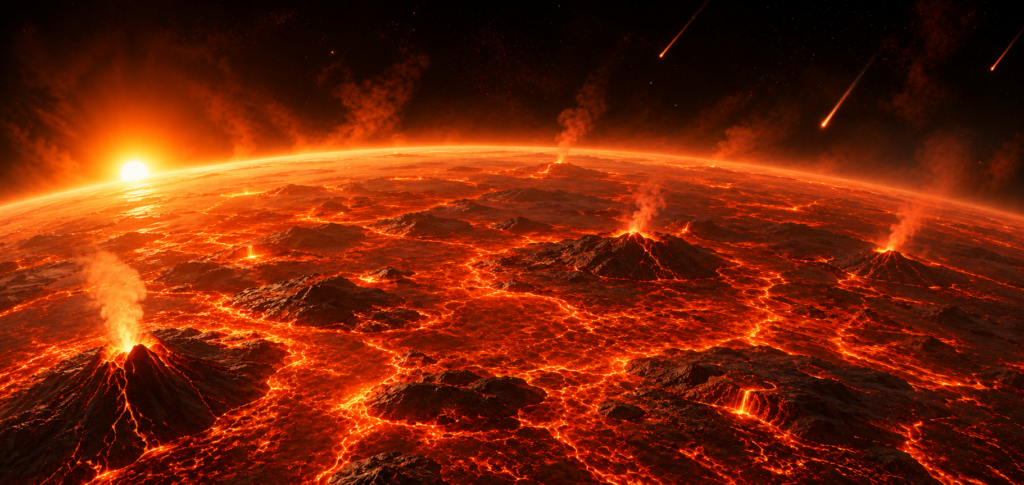
Earth formed about 4.54 billion years ago from dust and rock swirling around the young sun. For its first several hundred million years, the planet was a molten world. Surface temperatures were far above the boiling point of water, so nothing could stay liquid for long.
This scorching early period falls inside what geologists call the Hadean eon, named after the Greek underworld because conditions were so hostile. If you want the full picture of just how extreme this era really was, our guide on what was the Earth like in Hadean era breaks down the timeline in detail.
Before Earth’s first oceans could exist, the planet had to cool. A massive collision with a Mars sized object is thought to have melted and reshaped Earth around 4.5 billion years ago, the same event believed to have formed the moon, according to Sci-News. Only after that chaos settled could a crust form and water begin to gather.
Where Did the Water in Earth’s First Oceans Actually Come From?
This is the question that keeps planetary scientists up at night. There are two leading explanations, and most researchers now think both played a role in filling Earth’s first oceans.
The Volcanic Outgassing Theory
Earth was built from material that already contained water locked inside minerals and metallic compounds. As the planet heated up from radioactive decay and impacts, this trapped water was released through volcanic eruptions in a process called outgassing.
According to Introduction to Oceanography, gases stay dissolved in magma under high pressure deep inside Earth. When that magma rises and pressure drops, water vapor and other gases escape into the atmosphere. Over time, as the planet cooled, this vapor condensed into rain that filled low lying basins, giving Earth’s early oceans their start.
Water Delivered by Asteroids and Comets
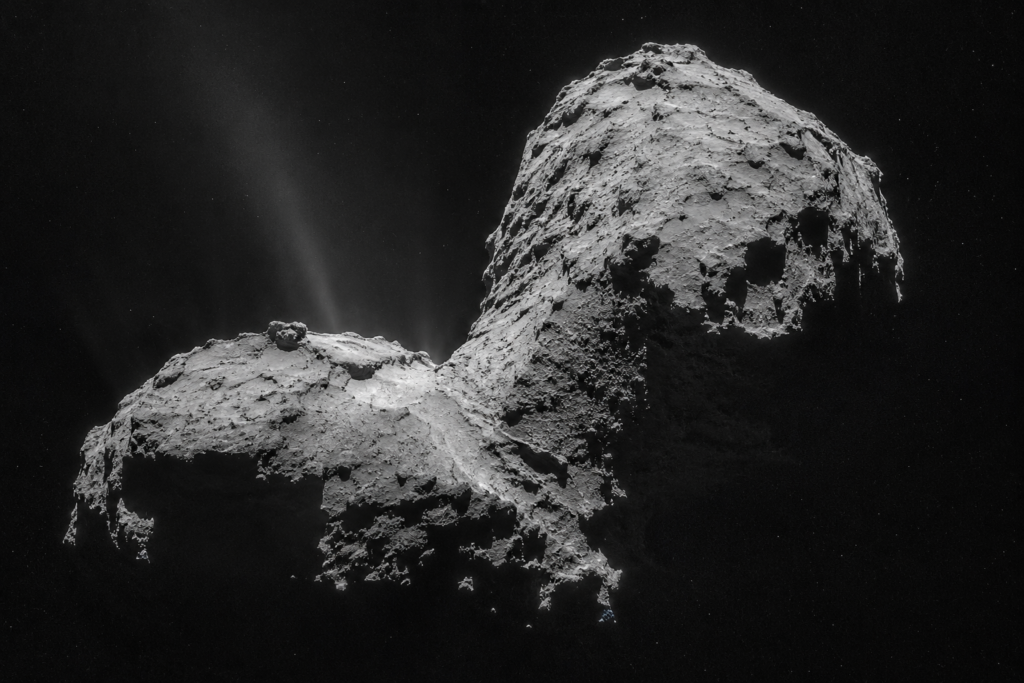
The second piece of the puzzle came from space. Icy asteroids and comets slammed into the young Earth for hundreds of millions of years, and many scientists believe these impacts delivered a huge share of our planet’s water.
Here is where it gets interesting. Researchers can trace water’s origin by measuring its deuterium to hydrogen ratio, sometimes called the D/H ratio. When the European Space Agency’s Rosetta mission studied comet 67P/Churyumov Gerasimenko, it found a D/H ratio nearly three times higher than what is found in Earth’s oceans, according to Physics World. That mismatch strongly suggests comets like 67P were not the main water source.
Asteroids tell a different story. Their chemical fingerprint lines up much more closely with Earth’s ocean water, which is why NASA notes that asteroid impacts are considered the strongest candidate for delivering most of the water that ended up in Earth’s first oceans. Some Jupiter family comets show a closer match too, so the full picture likely involves a mix of both.
- Volcanic outgassing released water already trapped inside Earth
- Asteroid impacts delivered additional water from beyond the solar system’s snow line
- Comets contributed a smaller, still debated, share
- The D/H isotope ratio is the main tool scientists use to trace where the water came from
When Did Earth’s First Oceans Actually Form?
This is where the story gets genuinely surprising. For a long time, textbooks placed the first oceans around 3.8 billion years ago. Newer evidence pushes that date back much further.
Evidence From the Jack Hills Zircons
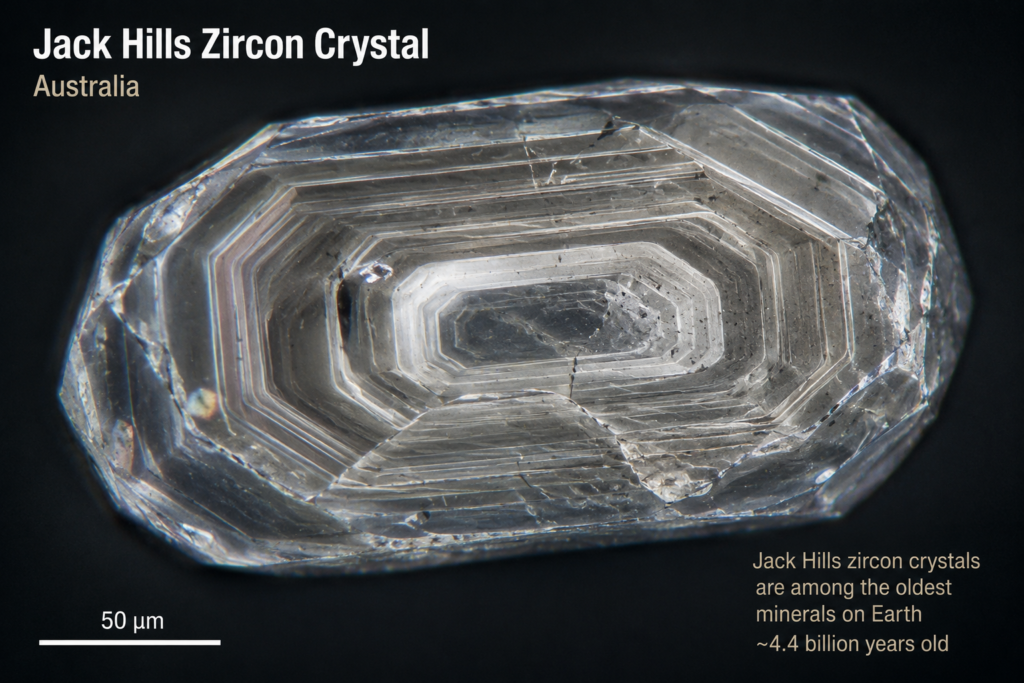
In the Jack Hills region of Western Australia, scientists have found zircon crystals dated to 4.4 billion years old, making them the oldest known material ever found on Earth. A 2014 study led by geochemist John Valley confirmed one crystal at 4,404 million years, plus or minus 8 million years, according to University of Wisconsin-Madison News.
What makes these tiny crystals so important is their oxygen isotope signature. That chemistry only forms when magma interacts with liquid water at low temperatures. In other words, these zircons are physical proof that Earth’s first oceans, or at least significant bodies of surface water, existed as early as 4.3 to 4.4 billion years ago. NASA describes this as strong support for the “cool early Earth” theory, meaning our planet became hospitable far sooner than scientists once assumed, as explained on the NASA Science website.
Evidence From Ancient Rocks in Greenland
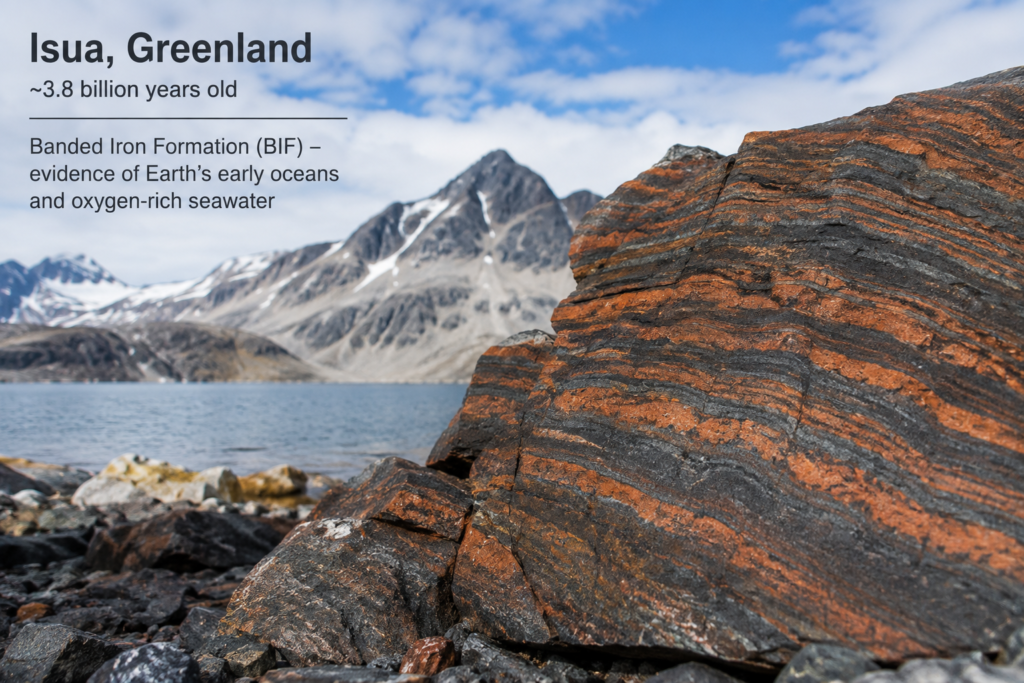
Not every scientist agrees the zircon evidence proves full oceans existed that early. A more conservative and firmly confirmed timeline comes from the Isua region of Greenland, where a rock formation called a banded iron formation provides what researchers call definitive ground truth for stable surface water around 3.8 billion years ago, according to research summarized by Carleton College’s SERC program.
So there are really two competing hypotheses among geologists:
- Earlier hypothesis: oceans, or at least large water bodies, existed by 4.2 to 4.4 billion years ago based on zircon chemistry
- Later hypothesis: confirmed, undeniable oceans existed by at least 3.8 billion years ago based on the Isua rock record
Both are backed by real data. The debate is really about how much water existed and how widespread it was, not whether water existed at all.
How Did Earth Cool Enough for Liquid Water to Exist?
Water cannot stay liquid above 212 degrees Fahrenheit, which is the boiling point at sea level pressure. Early Earth had to drop below that threshold before any ocean could form.
According to the Public Broadcasting Service, citing data from the National Oceanic and Atmospheric Administration, the planet cooled enough for water vapor to condense and rain down into basins around 3.8 billion years ago, based on the confirmed geological record described by PBS News. As steam filled the early atmosphere, it eventually condensed into what may have been a global, planet spanning rainstorm that lasted for an extraordinarily long stretch of time.
This cooling process was not instant or simple. Earth’s crust had to solidify enough to hold water in place, and volcanic activity had to slow down enough for the atmosphere to stabilize. Once those conditions lined up, Earth’s early oceans could finally take hold and stay put.
What Role Did the Late Heavy Bombardment Play?
Around 4.1 to 3.8 billion years ago, the inner solar system went through an intense spike in asteroid and comet impacts known as the Late Heavy Bombardment. This period is best documented on the moon, where scarred craters still preserve the record of that violent chapter, according to NASA Science.
Earth almost certainly endured similar bombardment, though plate tectonics and weathering erased most of the physical evidence here. Some researchers believe this period delivered a fresh wave of water rich material to Earth, adding to whatever oceans already existed from earlier outgassing and impacts. Others argue the bombardment may have partially boiled away existing surface water before it settled again.
Either way, the timing lines up closely with the Isua Greenland evidence, which is one reason many scientists connect the Late Heavy Bombardment to the final chemical composition of Earth’s first oceans.
For a full breakdown of this violent period, see our guide on what is the Late Heavy Bombardment.
Why Do Earth’s First Oceans Matter So Much Today?
Every drop of water in the ocean around you today traces back to this ancient process. Earth’s first oceans did more than just fill low points in the crust. They regulated temperature, dissolved minerals from rock, and eventually created the chemical soup where the earliest life is believed to have emerged.
Modern oceans now cover about 71 percent of Earth’s surface and hold roughly 97 percent of the planet’s total water. None of that would exist without the exact sequence of cooling, outgassing, and cosmic bombardment that unfolded billions of years ago. Understanding how Earth’s first oceans formed also helps scientists searching for habitable planets elsewhere, since the same outgassing and impact delivery model could apply to rocky exoplanets around other stars.
Frequently Asked Questions About Earth’s First Oceans
How long ago did Earth’s first oceans form?
Evidence from Jack Hills zircons suggests significant surface water existed by 4.3 to 4.4 billion years ago, while confirmed, stable oceans are documented by at least 3.8 billion years ago through Greenland’s Isua rock formation, according to NASA and Carleton College research.
Did all of Earth’s water come from comets?
No. Isotope data from the Rosetta mission shows most comets, including 67P, have a deuterium to hydrogen ratio too high to match Earth’s oceans. Asteroids are now considered the more likely dominant water source, according to NASA and Physics World.
What is the Hadean eon and why does it matter?
The Hadean eon covers Earth’s first several hundred million years, a molten and hostile period before the first oceans formed. For a deeper breakdown of this timeframe, see our guide on what was the Earth like in Hadean era.
Could life have started before Earth’s first oceans fully formed?
Some zircon studies have found possible traces of biogenic carbon in rocks dated to 4.1 billion years ago, hinting life may have started not long after liquid water first appeared, though this remains an active area of research among geologists.
Final Thoughts
Earth’s first oceans did not appear overnight. They formed through a slow, violent, and genuinely astonishing combination of volcanic outgassing, asteroid bombardment, and a planet gradually cooling from a ball of molten rock into something capable of holding liquid water.
Quick recap of what the evidence shows:
- Earth cooled from a molten state starting around 4.5 billion years ago
- Water came from both internal outgassing and external asteroid impacts
- Zircon evidence points to surface water as early as 4.3 to 4.4 billion years ago
- Greenland’s Isua rocks confirm stable oceans by 3.8 billion years ago
- The Late Heavy Bombardment may have added even more water during this window
The next time you look at the ocean, remember you are looking at the end result of one of the longest and strangest chemistry experiments in the history of the solar system. If you want to go even further back in the timeline, our article on what was the Earth like in Hadean era is the natural next stop.
