


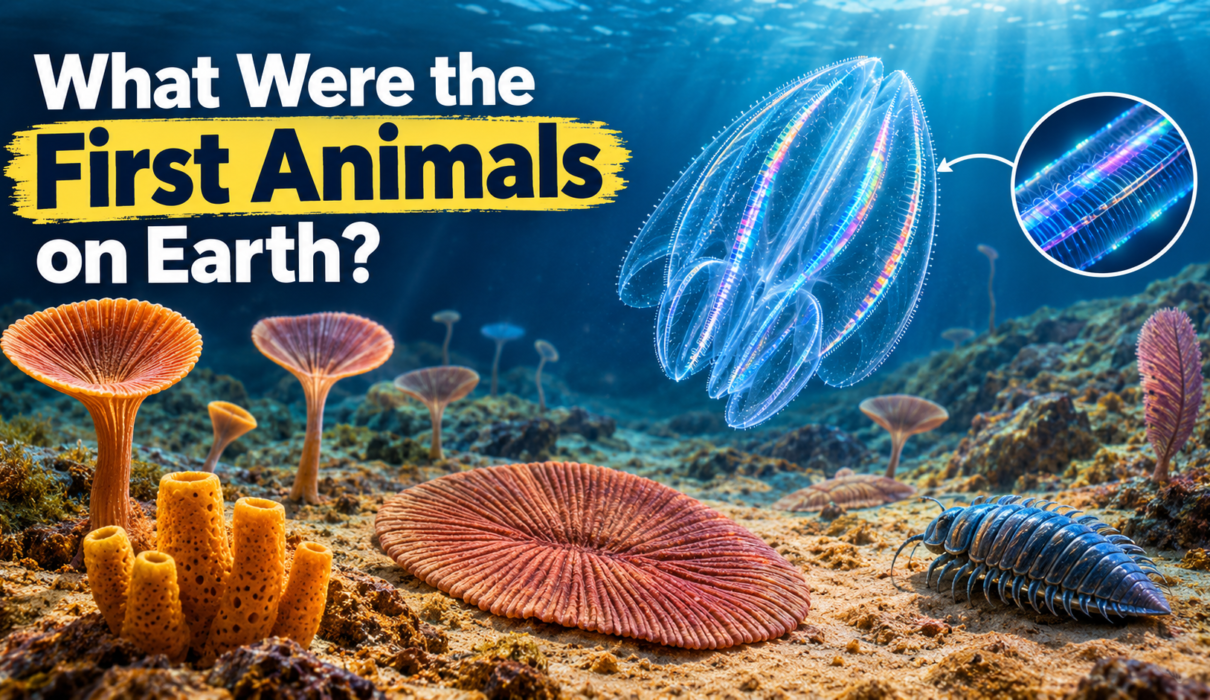
What were the first animals on Earth? Scientists still can’t hand you one neat answer, and honestly, that’s what makes this question so much fun. Here’s the twist. The story shifted in 2021, shifted again in 2023, and got another jolt in 2026. Stay with me, because by the end you’ll know which clues scientists trust, which ones they’re still fighting over, and why a soft bath sponge belongs in this tale. Oh, and one of the best clues is hiding in fossil fat.
I’ll keep this simple, so you won’t need a science degree. Every big claim below links to a real scientific paper or a university research page. When something is only a good guess, I’ll say so.

Key Takeaways
- Scientists haven’t proven a single “first animal.” Three different questions hide inside this one.
- The oldest fossil scientists are sure about is Dickinsonia, from the Ediacara period (571 to 541 million years ago).
- Possible sponge fossils from about 890 million years ago exist, but experts don’t agree on them yet.
- DNA studies disagree on whether sponges or comb jellies branched off first.
Table of Contents
What Were the First Animals on Earth? The Short Answer
Here’s the short version. There isn’t one answer, because people mean three different things when they ask. Some want the oldest fossil that might be an animal. Others want the oldest fossil that’s definitely an animal. And a few are really asking which animal family branched off first on the tree of life.
- Oldest possible animal fossil: sponge shaped tubes from about 890 million years ago. Still debated.
- Oldest confirmed animal fossil: Dickinsonia, proven by chemical clues. Widely accepted.
- First branch of the family tree: sponges or comb jellies. Still debated.
One more thing before we dig in. Researchers think the earliest animals probably didn’t have shells or bones. That’s a big problem, since squishy bodies almost never turn into fossils.
Could the First Animals Have Been Sponges? The 890 Million Year Old Clue
Possibly. In 2021, geologist Elizabeth Turner reported odd tube shapes inside rocks from ancient reefs in northwestern Canada. The rocks date to about 890 million years ago. The tubes look like the bendy, protein based skeleton of some modern sponges, the kind you’ve probably seen as a bath sponge. If she’s right, these are the oldest animal body fossils ever found (Nature, 2021).
Turner collected her samples over many years, between 1992 and 2018, then studied thin rock slices under a microscope. The tubes branch and rejoin in a pattern that matches horny sponges. If they’re sponges, they’d be about 350 million years older than the next oldest sponge fossils that nobody argues about. That’s a huge gap.
Why Scientists Still Say “Maybe”
I love how careful the paper’s own title is. It says “possible” sponge fossils, not definite ones, and that’s no accident. Other researchers have good reasons for caution. A 2023 review in the journal Sedimentology concluded that nobody has verified fossil horny sponges in ancient limestone, and that every claimed example can be explained another way.
Turner also notes that some sponges handle low oxygen well (our guide on the Great Oxygenation Event explains how oxygen built up), which would fit the thin oxygen of that ancient ocean. So, what were the first animals on Earth? Sponges are strong candidates if you want a safe bet, but the fossil proof isn’t settled yet.
Dickinsonia: The Oldest Animal Scientists Are Sure About
This one’s solid. When people ask what were the first animals on Earth, Dickinsonia is the safest name to say out loud. It was a flat, ribbed oval that looked more like a leaf or a bath mat than an animal. For years, scientists couldn’t agree on what it was. Some said animal. Others said giant single cell, or even a lichen (Science, 2018).

What Were the First Animals on Earth? How Fossil Fat Gave Us a Clue
In 2018, a team led by Ilya Bobrovskiy stopped staring at the fossil’s shape. Instead, they hunted for chemicals still trapped inside. They found fatty molecules called lipid biomarkers, a bit like a leftover fingerprint. Dickinsonia and its relatives made only cholesteroids, and that’s a hallmark of animals.
That’s why the authors call them the oldest confirmed animals big enough to see. Notice the careful wording, though: “confirmed.” It leaves room for older animals, tiny or soft ones, that haven’t left us a fingerprint we’ve found yet.
Quick Explainer: What Is a Biomarker?
A biomarker is a chemical clue left behind by a living thing. Cholesterol is one. When scientists find the right chemicals in a fossil, it’s like finding a name tag inside a very old coat.
The Family Tree Fight: Sponges or Comb Jellies?
Fossils are only half the story, and they’re often the harder half. Scientists also compare DNA from living animals to work out who split off first. Picture a family tree with five big branches: sponges, comb jellies, placozoans (tiny flat animals), cnidarians (think jellyfish and sea anemones) and bilaterians. That last group includes us, plus worms, insects and many more.

What “First Branch” Really Means
The first branch is the group that split away before all the others, which scientists call the sister group to all other animals. It doesn’t mean that living animal looks like the very first animal. The 2023 authors warn that today’s sponges and comb jellies may be poor stand ins for the earliest members of their lines.
What Were the First Animals on Earth, According to DNA?
Many studies pointed to sponges. Then, in 2023, a team including Darrin Schultz and Daniel Rokhsar shook things up. They compared how genes are arranged on whole chromosomes in comb jellies, sponges and single cell relatives of animals. Here’s what they found: comb jellies branched off first (Nature, 2023).
Their evidence is a set of rare chromosome mix ups that are very hard to undo. Sponges share them with other animals, but comb jellies don’t. The authors call the support strong. Still, the case isn’t closed. A December 2025 paper in Molecular Biology and Evolution raises concerns about the statistics behind those chromosome results, and it calls the sponge versus comb jelly argument an ongoing dispute (Molecular Biology and Evolution, 2025).

Why the Nervous System Makes This So Exciting
Sponges don’t have nerve cells or muscle cells. Comb jellies do. If sponges branched first, nerves evolved once, later on. If comb jellies branched first, nerves either evolved twice or sponges lost them along the way. Either answer changes how we think about the brain itself, and that’s wild. Honestly, that thought gets me every single time.
How Do Scientists Even Know Any of This?
You can’t exactly photograph the sea from 890 million years ago, so scientists work like detectives with three kinds of clues. Fossils show shapes, but early animals were soft, so few survive. Chemistry, like the fat in Dickinsonia, gives fingerprints when shapes are too weird to read. DNA comparisons and molecular clocks estimate when groups split, though those dates are only estimates, and Turner’s paper says the physical evidence hasn’t caught up. When all three clues line up, scientists feel confident. When they don’t, you get debates like these. That’s why what were the first animals on Earth is a question with several honest answers, not one.
The Plot Twist: Complex Animals Showed Up Earlier Than Expected
Now for the part that surprised me. Many people think animals appeared in the Cambrian explosion, around 530 million years ago, when marine animals evolved most of their basic body shapes in perhaps as few as 10 million years. But UC Berkeley’s Understanding Evolution project points out that “explosion” is a bit of a misnomer. Many animal groups actually split apart earlier, in the Precambrian. I’ll admit the word always made me picture a light switch flipping.
Then came 2024. Researchers described Helicolocellus, a goblet shaped sponge from South China dated to roughly 551 to 539 million years ago. It wasn’t small. It stood more than 40 centimeters tall, taller than a standard school ruler. Its body had a grid pattern made of organic material, not minerals, and the team places it as a relative of modern glass sponges (Nature, 2024).
In 2026, a Science paper reported more than 700 fossils from the Jiangchuan site in Yunnan, China, aged between 554 and 539 million years. Among them were relatives of starfish, worm shaped animals and rare fossils interpreted as early comb jellies. The team says many complex animals existed before the Cambrian began (University of Oxford research release). It’s brand new, so expect other scientists to keep checking it. So when you ask what were the first animals on Earth, picture them with surprisingly fancy neighbors by 554 million years ago.

A Quick Timeline of the Big Clues
Here’s the whole “what were the first animals on Earth” story on one page. Remember, some dates are firm, and others aren’t settled.
- About 890 million years ago: possible sponge fossils in Canada (debated).
- More than 800 million years ago: animals and their closest single cell relatives had already split apart.
- 571 to 541 million years ago: the Ediacara biota, including Dickinsonia, confirmed as an animal.
- 554 to 539 million years ago: the Jiangchuan fossils in China, with surprisingly complex animals.
- 551 to 539 million years ago: Helicolocellus, a large sponge relative.
- Around 530 million years ago: the Cambrian explosion.

Frequently Asked Questions
What Were the First Animals on Earth in Simple Words?
The best guess is simple, soft bodied animals, probably like sponges. The oldest animal fossil scientists are sure about is Dickinsonia, a flat ribbed oval that’s older than the Cambrian explosion. Older sponge fossils may exist, but experts still argue.
Were the First Animals Sponges or Comb Jellies?
Scientists don’t agree. A 2023 Nature study says comb jellies branched off first. Other work, including a 2024 Nature paper, treats sponges as the most basic animals. A 2025 paper questions the statistics in the 2023 result.
Did the Cambrian Explosion Create the First Animals?
No. The Cambrian animals didn’t appear out of thin air, and UC Berkeley’s Understanding Evolution says many animal groups split during the Precambrian, and fossils from before the Cambrian have been found.
Is Dickinsonia Really an Animal?
Yes, according to the 2018 Science study. Its fossils held only cholesteroids, which are a hallmark of animals, so it isn’t a lichen or a giant single cell.
So, What Were the First Animals on Earth? My Honest Take
Back to the big question: what were the first animals on Earth? If you made me bet, I’d say the first animals were small, soft and simple, living in the sea long before the Cambrian, with sponges or comb jellies on that first branch. But I wouldn’t bet the house. The evidence changes every few years, and that’s exactly what good science looks like.
Want more? Try our guides on what caused the Cambrian explosion, the first life forms on Earth, the Great Oxygenation Event and how Earth’s first complex cells evolved.
Now it’s your turn. Which team are you on, sponge or comb jelly? Tell me in the comments, and share which clue surprised you most.
