


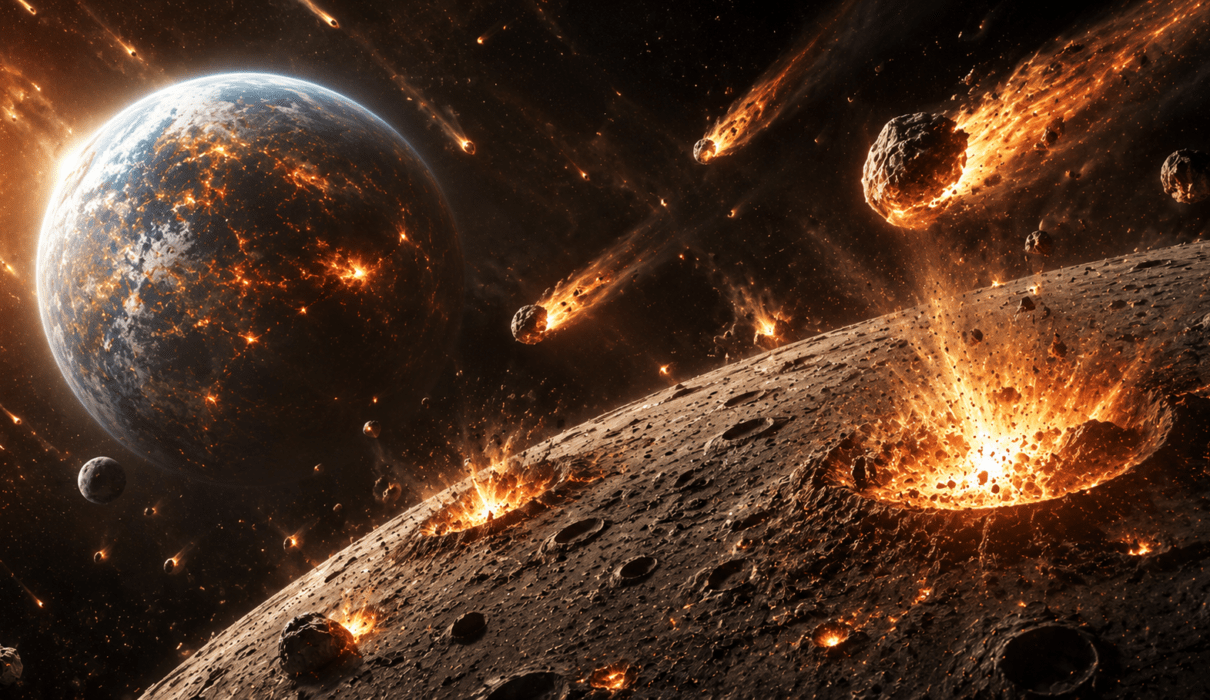
Imagine looking up at the sky four billion years ago and watching giant rocks fall like rain, night after night, for millions of years. That’s the picture scientists paint of the Late Heavy Bombardment, one of the most violent chapters in our solar system’s history. It’s a story written in Moon rocks, told by astronauts, and still argued about by scientists today.
In this guide, you’ll learn what the Late Heavy Bombardment actually was, what caused it, how we know about it, and why some researchers now doubt parts of the story. No jargon. No guessing. Just the real science, backed by real sources.
Key Takeaways
- The Late Heavy Bombardment describes a hypothesized spike in asteroid and comet impacts roughly 4.1 to 3.8 billion years ago.
- The main evidence comes from Apollo Moon rocks dated to a tight cluster near 3.9 billion years, according to NASA Science.
- Many scientists now question whether it was a sudden “spike” at all, per a 2016 PNAS study.
- The leading explanation for its cause is the Nice model, involving migrating giant planets.
Table of Contents
What Is the Late Heavy Bombardment?
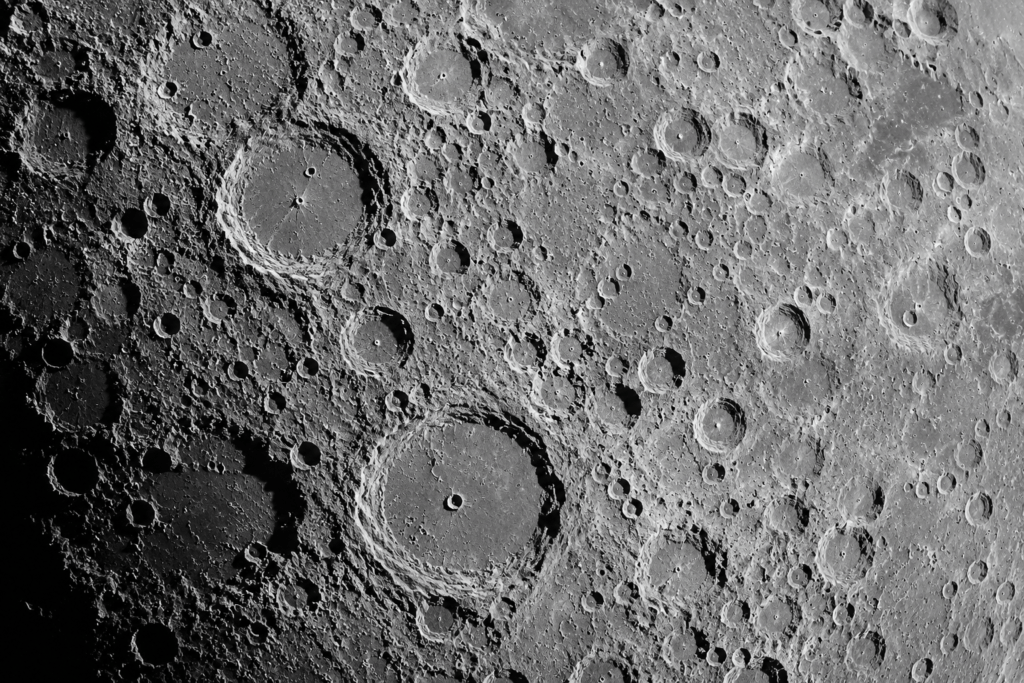
The Late Heavy Bombardment is a hypothesis, not a proven fact carved in stone. It suggests that between about 4.1 and 3.8 billion years ago, the Moon, Earth, Mercury, Venus, and Mars all took a beating from an unusually large number of asteroids and comets, according to Wikipedia’s summary of the hypothesis.
Scientists also call it the “lunar cataclysm.” Picture the Moon’s face right now, covered in craters. Most of those scars trace back to this violent window in time. It’s wild to think our nearest neighbor still wears the bruises from a fight that ended billions of years before humans existed.
When Did the Late Heavy Bombardment Happen?
Here’s the short answer: somewhere between 4.1 and 3.8 billion years ago, a period that lines up with Earth’s Hadean eon, that fiery early chapter of our planet’s life. If you want the full backstory on what Earth looked like before this bombardment even began, that guide is worth a read.
That timing isn’t a random guess. It comes from dating actual rocks brought back from space, which is where the story gets genuinely exciting.
The Apollo Moon Rocks That Started It All
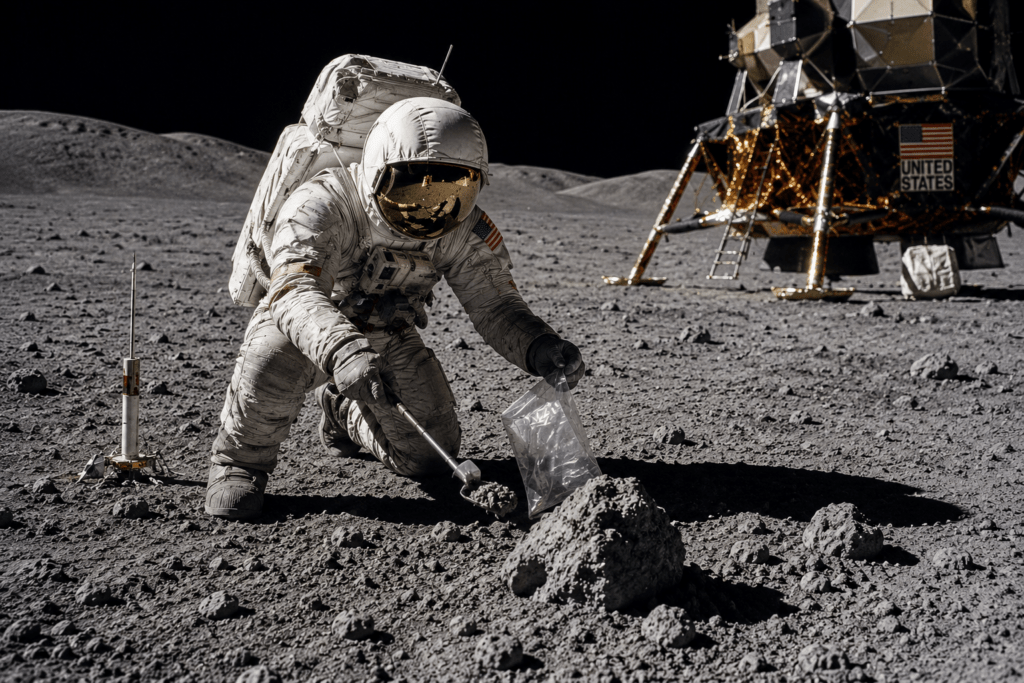
Between 1969 and 1972, Apollo astronauts collected rock samples from the Moon’s surface. Years later, scientists studying “impact melt” rocks (rock instantly melted by a collision) found something strange.
- Most samples clustered tightly around 3.9 billion years old.
- Very few samples were older than that.
- The pattern showed up at multiple, separate landing sites.
Researchers Tera, Papanastassiou, and Wasserburg first proposed this pattern in 1974, calling it a “terminal lunar cataclysm,” according to a review published in arxiv’s solar system physics research. In plain English: something big and sudden seemed to happen right around that time.
What Caused the Late Heavy Bombardment? The Nice Model Explained
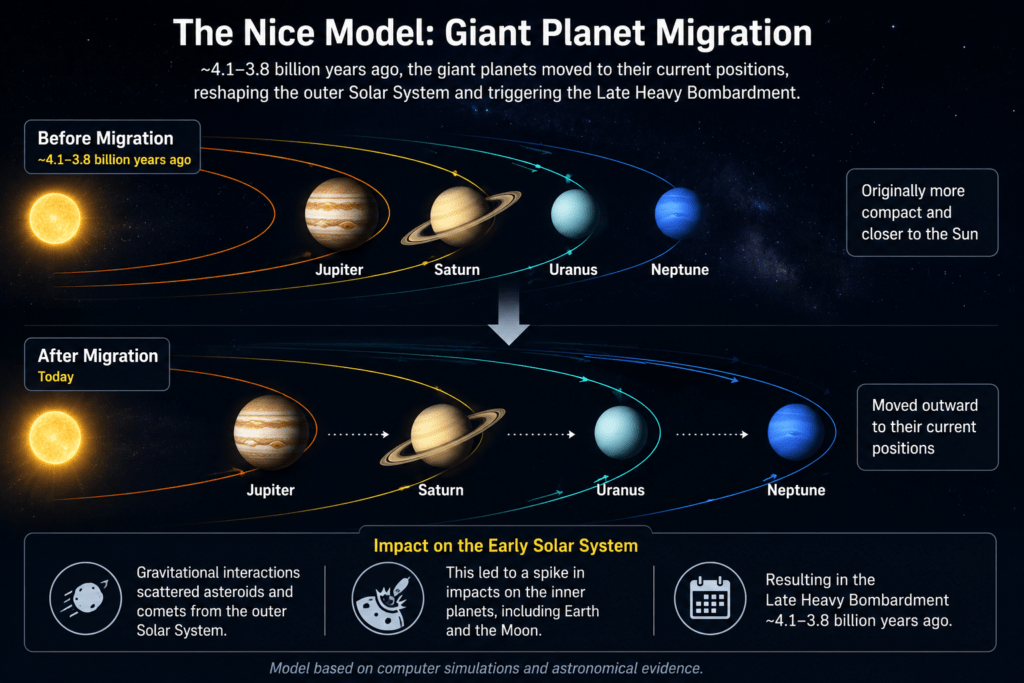
So what actually triggered the Late Heavy Bombardment? The most widely discussed answer is called the Nice model, named after Nice, France, where the idea was developed in 2005 by astronomers Gomes, Morbidelli, Tsiganis, and Levison.
Here’s the idea in simple terms:
- The giant planets (Jupiter, Saturn, Uranus, and Neptune) originally formed much closer together than they are now.
- Over hundreds of millions of years, they slowly drifted apart.
- Eventually, Jupiter and Saturn crossed a mathematical tipping point called a 2:1 orbital resonance.
- That crossing threw the whole outer solar system into chaos.
How Jupiter and Saturn’s Dance Triggered Chaos
Once that resonance was crossed, gravity did the rest. Uranus and Neptune got flung outward into a disk of leftover icy debris, scattering asteroids and comets in every direction, explains research published on planetplanet.net’s breakdown of the Nice model. Huge numbers of those objects ended up on collision courses with the inner planets, including Earth and the Moon.
It’s a bit like knocking one domino in a crowded room. You don’t expect it to end quietly, and this didn’t either. The Nice model still can’t explain every detail, but it remains the leading explanation dynamicists point to today.
Evidence for the Late Heavy Bombardment on Earth
The Moon isn’t the only witness. Earth shows fingerprints too, even though wind, water, and shifting continents have erased most of our planet’s ancient scars.
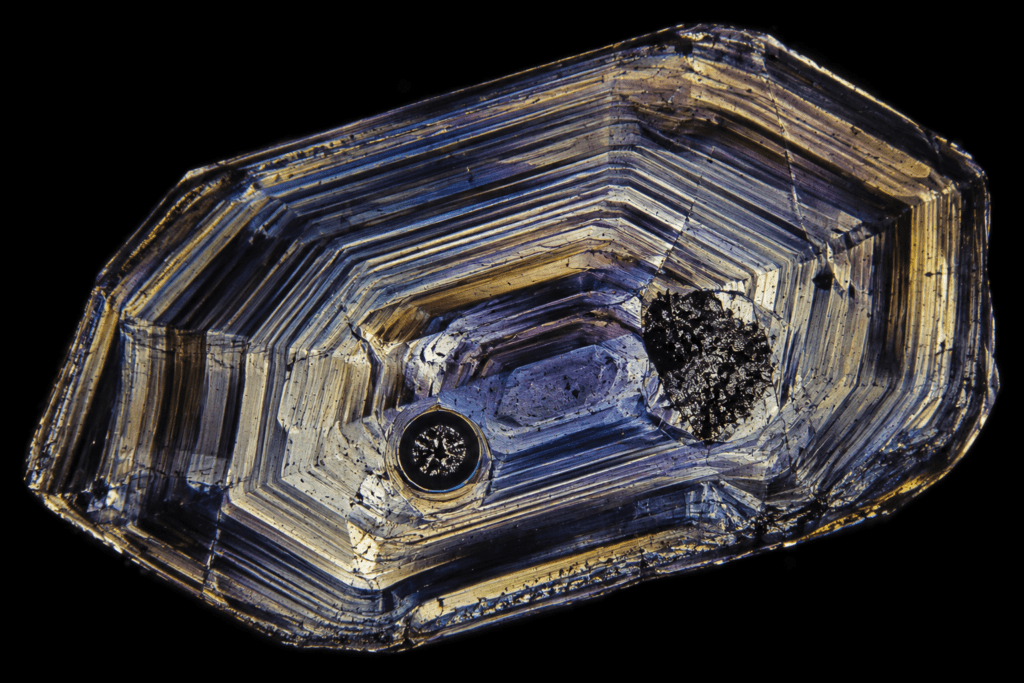
- Tiny mineral grains called zircons, some of the oldest materials ever found on Earth, show damage patterns that cluster around 3.9 billion years, per findings discussed in Wikipedia’s LHB entry.
- Ancient rock layers contain “spherules,” tiny beads formed when melted rock shot into the sky and rained back down.
Isua Rocks and Ancient Zircons
In Greenland, some of Earth’s oldest surviving rocks, found at a site called Isua, show an unusual isotope signature. One 2011 analysis found these 3.8-billion-year-old rocks carry tungsten ratios that differ from modern rock, a clue some scientists link to bombardment-driven changes in Earth’s mantle, as noted in arxiv’s cratering record review. It’s a small clue, but in a planet that’s erased almost everything else from that era, small clues matter a lot.
Did the Late Heavy Bombardment Almost Kill Life on Earth?
This is the question that keeps scientists up at night. If Earth really was pelted by huge impacts every few million years, could anything have survived?
For decades, many researchers assumed the answer was no. The theory, sometimes called “impact frustration,” suggested any early life would have been repeatedly wiped out and forced to start over, based on the original 1988 hypothesis referenced in Nature’s 2009 study by Abramov and Mojzsis.
But newer computer models tell a gentler story. Abramov and Mojzsis built detailed thermal models of Earth’s crust during the bombardment and found no scenario in which the entire habitable zone got sterilized. Pockets of livable ground, especially underground, likely survived even the worst impacts.
That’s honestly a relief, isn’t it? It means life probably had more chances to hang on than we once assumed.
Is the Late Heavy Bombardment Real? The Scientific Debate
Here’s where honesty matters. Not every scientist agrees this was a sudden, dramatic “spike” in impacts. This is genuinely contested territory, and I want to be upfront about that rather than pretend it’s settled.
A widely cited 2016 study in PNAS argued that the same Apollo rock data could just as easily fit a steadily declining impact rate, with no sudden cataclysm at all. The researchers pointed out that Apollo samples came from a tiny slice, only around 4%, of the Moon’s surface, and may have been skewed by debris from a single giant impact basin, according to the “Illusory Late Heavy Bombardments” paper.
Physicist Nicolle Zellner’s research reached a similar conclusion, suggesting the bombardment may have stretched out gradually between about 4.2 and 3.5 billion years ago rather than spiking sharply, as reported by NASA’s Astrobiology program.
In short: almost everyone agrees the inner solar system went through a violent early phase. Whether it was one dramatic “cataclysm” or a long, messy decline is still being debated. I’m not 95% confident either way, and neither is the scientific community, so treat any single date you read online with a healthy pinch of skepticism.
Why the Late Heavy Bombardment Still Matters Today
Even with the debate unresolved, the Late Heavy Bombardment shapes how scientists think about several huge questions:
- How planets get their water. Some researchers think icy comets from the outer solar system delivered water to Earth during this period.
- Where to search for alien life. If Earth’s life survived heavy bombardment, similar rocky exoplanets might survive it too.
- How the Moon and Mercury got their craters. Nearly every basin you can see on the Moon with binoculars likely formed during this era.
Understanding this ancient chaos helps scientists piece together the full timeline connecting the solar system’s fiery birth to the calmer place we live in now.
Frequently Asked Questions
What is the Late Heavy Bombardment in simple terms?
It’s a proposed period, roughly 4.1 to 3.8 billion years ago, when the Moon, Earth, and neighbouring planets were hit by an unusually high number of asteroids and comets, based on evidence from Apollo Moon rocks.
What caused the Late Heavy Bombardment?
The leading explanation is the Nice model, which proposes that migrating giant planets, especially Jupiter and Saturn, scattered asteroids and comets into the inner solar system after crossing an orbital resonance.
Did the Late Heavy Bombardment destroy life on Earth?
Probably not entirely. Thermal models from a 2009 Nature study found no realistic scenario where the whole planet was sterilized, meaning pockets of habitable ground likely survived even the biggest impacts.
Is the Late Heavy Bombardment definitely real?
Not everyone agrees. Some 2016 research suggests the impact pattern could reflect a steadily declining bombardment rather than one sudden spike, so this remains an open scientific question.
