


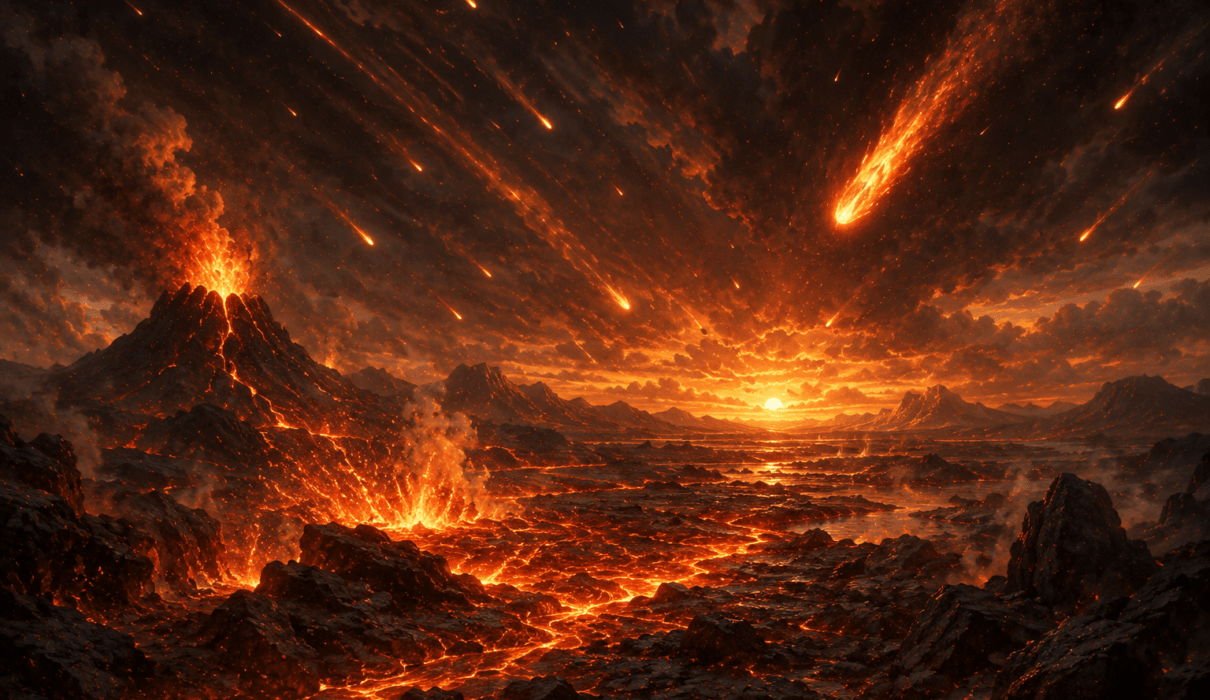
Close your eyes for a second. Imagine standing on Earth but 4.5 billion years ago. There’s no ground beneath your feet. Just glowing, churning lava. The sky above you is thick with volcanic smoke, toxic gas, and meteors raining down like hailstones. There are no birds. No trees. No oceans at least not yet. Just fire, pressure, and chaos.
That is what Earth looked like during the Hadean era. And once you understand just how extreme it was, you’ll never look at our calm, green planet the same way again.
This blog answers one big question in full: what was Earth like in the Hadean era? We’ve dug through peer-reviewed research, NASA data, and university geology textbooks to give you the most accurate picture possible. Every fact here is sourced. Everything you’re about to read is real.
Ready? Let’s go back to the beginning.
Key Takeaways
- What was Earth like in the Hadean era? Largely molten, gas-choked, and bombarded by space rocks from 4.6 to 4.0 billion years ago .
- Earth’s mantle temperature was around 1,600°C nearly 300°C hotter than today.
- The Moon formed during this era from a Mars-sized impact.
- Liquid water may have appeared as early as 4.4 billion years ago, far earlier than most people think.
- A second surge of asteroid impacts the Late Heavy Bombardment struck about 4.1 to 3.8 billion years ago.
Table of Contents
What Was Earth Like in the Hadean Era? A Quick Overview
Most people assume Earth always looked like Earth. Mountains, oceans, blue skies. But understanding what Earth was like in the Hadean era forces you to throw out everything you think you know.
The Hadean era more formally called the Hadean eon ran from approximately 4.6 billion years ago to 4.0 billion years ago (Britannica). That’s about 600 million years of unrecognizable, alien Earth. The name itself comes from Hades, the Greek god of the underworld, and was coined by American geologist Preston Cloud in 1972 (Earth.com).
The key word here is unofficial. The Hadean era has no formal geological subdivisions recognized by the International Commission on Stratigraphy because almost no rocks survive from it. Think about how extreme a period must be to erase nearly its entire rock record. That alone tells you everything.
What Did Earth’s Surface Actually Look Like During the Hadean Era?
Molten rock. Everywhere. That’s the shortest honest answer to what Earth was like in the Hadean era, at least during its earliest phase.
The earliest Earth was essentially a ball of liquid rock floating in space, rounded by gravity. Three powerful heat sources kept the surface from ever fully solidifying early on:
- Gravitational compression — as material piled onto the forming planet, the pressure generated enormous heat.
- Radioactive decay — unstable elements inside the rock decayed and released energy as heat.
- Asteroid impacts — each incoming rock delivered a burst of kinetic energy that converted directly into heat.
The mantle temperature during this magma ocean phase was around 1,600°C roughly 300°C hotter than Earth’s modern mantle (ScienceDirect). To put that in perspective, molten steel forms at around 1,370°C. The ground itself was hotter than liquid metal.
As Earth cooled, high-melting-point minerals started to crystallize and settle. Lighter minerals floated up to form a thin, fragile crust. But those early slabs were probably reabsorbed back into the magma ocean over and over again before the planet cooled enough to hold them (LibreTexts Geosciences).
“The earliest Earth was chiefly molten material and would have been rounded by gravitational forces so it resembled a ball of lava floating in space.” Source: LibreTexts Geosciences
So what was Earth like in the Hadean era on the surface? Imagine Iceland’s volcanic fields but covering every single inch of the planet, and 10 times hotter.
What Was Earth’s Atmosphere Like During the Hadean Era?
The sky was just as hostile as the ground.
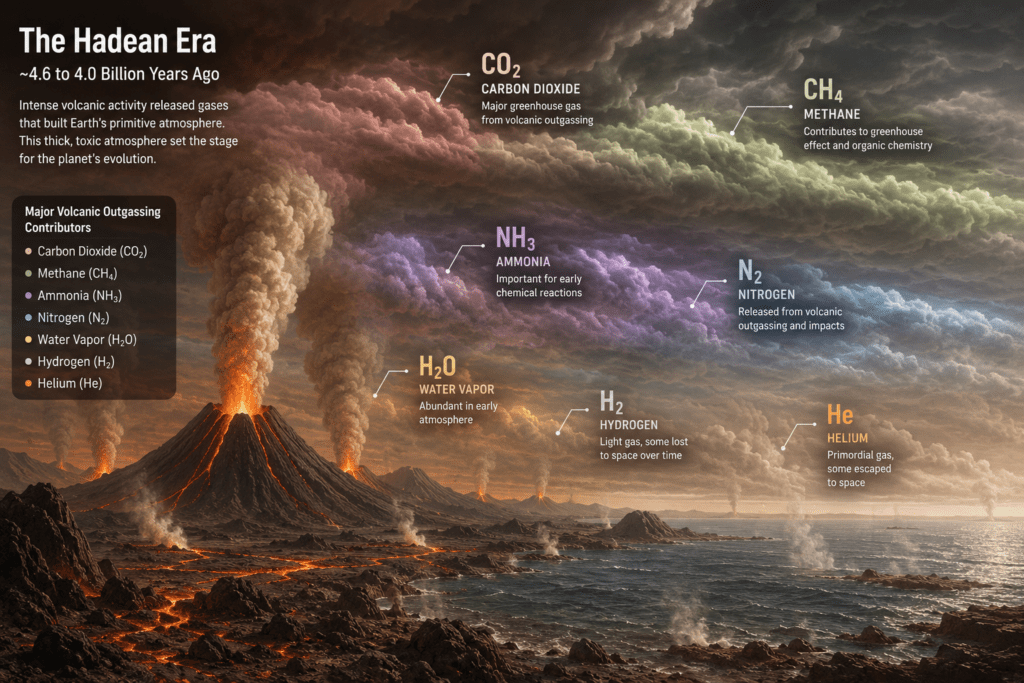
Earth’s first atmosphere was extremely thick and hydrogen-rich, resembling the composition of the gas giants mostly water vapor, methane, and ammonia. There was no oxygen. None at all. Breathing the air in the early Hadean era would have been instantly fatal to any modern life form.
Here’s how the atmosphere evolved across the eon:
- Very early Hadean: Hydrogen and helium dominated, similar to the solar nebula. Light gases constantly escaped into space due to low gravity and intense solar radiation.
- Mid Hadean: Volcanic outgassing added water vapor, carbon dioxide, nitrogen, and additional hydrogen to the mix (Britannica).
- Late Hadean: A heavy CO₂-rich atmosphere formed, trapping heat and keeping surface temperatures high. Early ocean surface temperatures may have reached around 230°C (446°F) due to this extreme greenhouse pressure (Earth.com).
The atmosphere was also under assault from outside. Incoming meteors vaporized on impact, releasing gases that further changed its chemistry.
Could anyone have breathed this air? Absolutely not. Understanding what Earth was like in the Hadean era means accepting that the sky was as inhospitable as the surface.
Was There Water on Earth During the Hadean Era?
Here’s the part that surprises almost everyone.
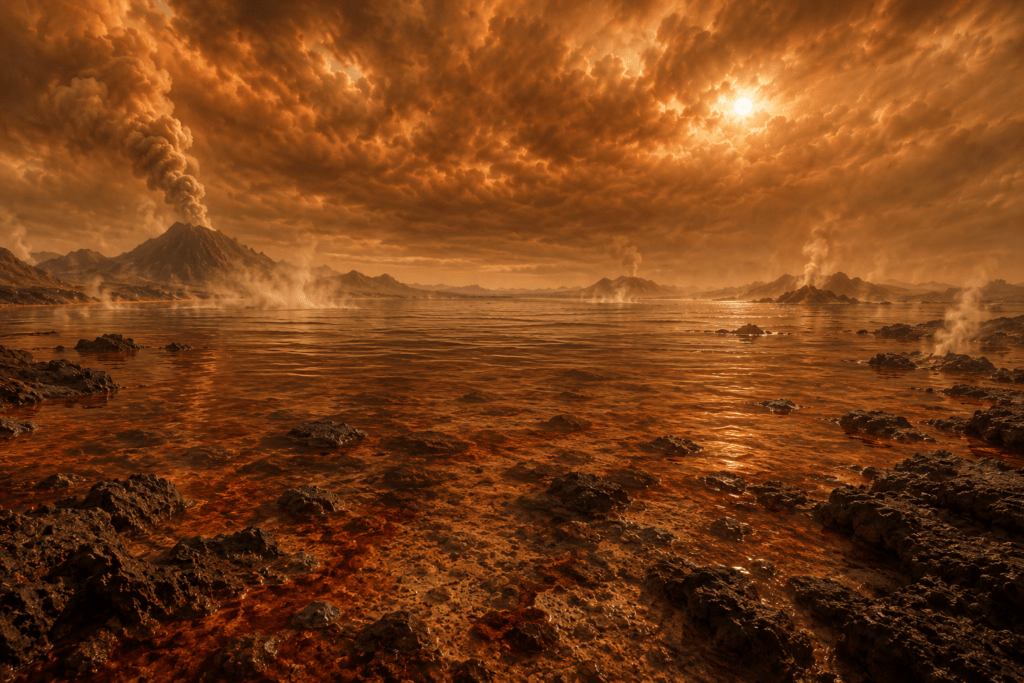
Yes there was likely liquid water during parts of the Hadean era. Scientists discovered this using some of the oldest material on Earth: zircon crystals from the Jack Hills region of Western Australia.
The oldest confirmed piece of Earth material, a tiny zircon grain, is about 4.4 billion years old. More specifically, a 2014 study confirmed one crystal’s age at 4.375 billion years, plus or minus 6 million years. Its oxygen isotope chemistry indicates it crystallized from magma that had interacted with liquid water at the surface (ScienceInsights).
The discovery of zircon grains in Australia provides compelling evidence that the atmosphere and oceans formed before 4.4 billion years ago.
Those early oceans were probably shallow less than a kilometer deep and sat beneath a thick, CO₂-rich atmosphere somewhat resembling modern Venus. As Earth’s surface cooled further, water vapor rained down from the atmosphere, pooling across the surface until eventually a superocean covered nearly the entire planet (Wikipedia: Hadean).
Sources of all that water remain debated, but scientists point to three likely candidates:
- Volcanic outgassing from inside Earth (since every volcanic eruption releases water vapor, sometimes more than 1% by volume).
- Comet ice melting on impact.
- Meteorites carrying water locked inside their minerals.
Earth’s water isotopically matches meteorites more closely than comets, though scientists acknowledge Earth’s own processes may have altered that signature over 4 billion years. All three sources may have contributed.
To understand more about how this same watery, changing Earth eventually shaped all life, check out our full breakdown of what was the Hadean eon for the complete geological timeline.
How Did the Moon Form During the Hadean Era?
One of the most violent events in Earth’s history happened inside the Hadean era and without it, our planet might be completely different today.
Around 4.5 billion years ago, a Mars-sized body now called Theia slammed into the young Earth. The collision likely happened between 20 and 100 million years after the solar system formed. The impact was so powerful it blasted molten rock and vapor into orbit around Earth. Over time, that debris clumped together and formed the Moon.
This is called the Giant Impact Hypothesis, and it’s currently the leading scientific explanation for why Earth has a Moon at all.
Why does this matter for understanding what Earth was like in the Hadean era? Because:
- The impact melted Earth’s entire crust several kilometers deep, resetting the surface clock completely.
- It added vast amounts of energy and heat that prolonged the magma ocean phase.
- The resulting Moon helped stabilize Earth’s axial tilt, which eventually made stable seasons and climate possible.
No Theia impact no Moon. No Moon very possibly, no stable life conditions on Earth ever. When you ask what Earth was like in the Hadean era, the Moon’s violent birth is right at the heart of the answer.
What Was the Late Heavy Bombardment During the Hadean Era?
Just when Earth started to cool down and stabilize, it got hit again. Hard.
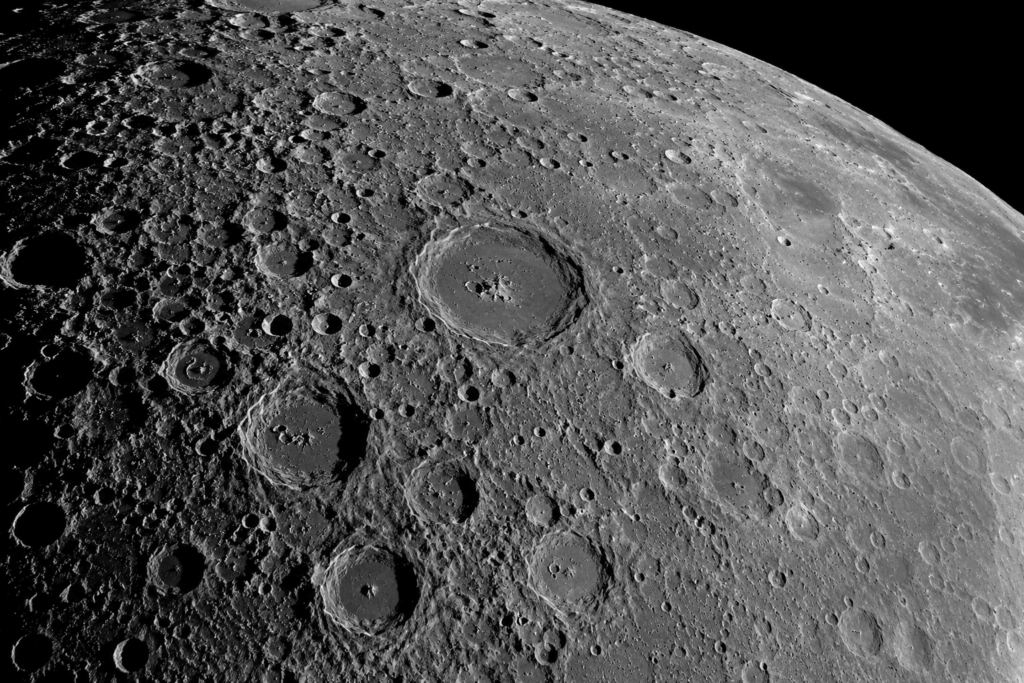
About 4.1 to 3.8 billion years ago right at the tail end of the Hadean era and into the early Archean a second massive surge of asteroids and comets struck Earth and the Moon. Scientists call this the Late Heavy Bombardment, and it’s why the Moon looks so pockmarked today most of its visible craters come from this event.
The Late Heavy Bombardment is estimated to have lasted between 20 and 200 million years.
Here’s the counterintuitive twist: this bombardment may not have killed all life. A University of Colorado Boulder study found that the impacts likely melted only a fraction of Earth’s crust, and microbes could have survived in subsurface habitats insulated from the surface chaos (CU Boulder). The researchers estimated underground microbes living at 175–230°F would actually have flourished during the bombardment.
So what was Earth like in the Hadean era by this point? Battered, yes but perhaps not as completely sterilized as we once thought.
“These findings are significant because they indicate life could have begun well before the Late Heavy Bombardment, during the so-called Hadean Eon.” — NASA Astrobiology Discipline Scientist Michael H. New, quoted in CU Boulder press release (May 2009). Source: CU Boulder
Was There Any Life During the Hadean Era?
This is the million-dollar question. And the honest answer is: maybe, toward the end.
Carbon found inside a 4.1-billion-year-old zircon grain has a chemical signature suggesting an organic origin meaning it may have come from living organisms. Scientists treat this as a hypothesis rather than proof, since the chemistry is possible to produce through non-biological processes too.
The most reliable fossil record actual preserved microbial mats called stromatolites begins at around 3.5 billion years ago, well into the Archean eon. But the chemical hints push the window of potential life further back possibly all the way into the Hadean era.
NASA’s Astrobiology website notes that the Earth’s crust cooled from its initial molten state and water appeared within a few million years and that life may have made its first appearance in the newly formed oceans, or in clay or rocks within the crust (NASA Astrobiology).
If any life existed during the Hadean era, it would likely have been:
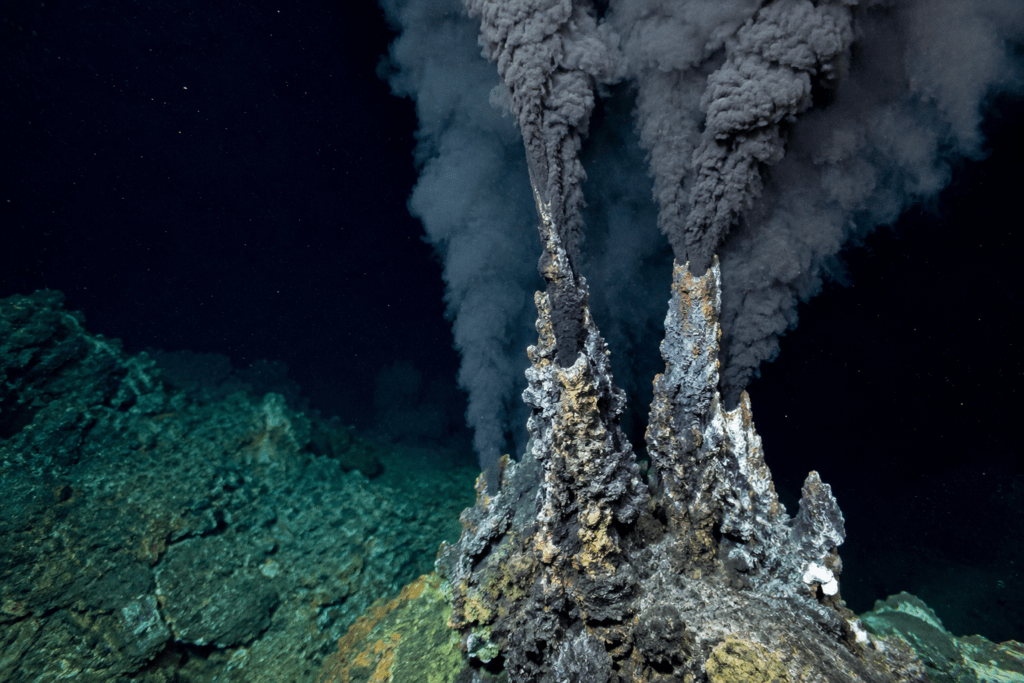
- Single-celled microbes living deep underground or in hydrothermal ocean vents
- Thermophiles — heat-loving organisms — that could survive extreme temperatures
- Constantly under threat of extinction from large asteroid impacts, with survivors rebuilding each time
The honest answer to “was there life in the Hadean era” is: we don’t know for certain, but scientists haven’t ruled it out and the evidence keeps pushing in that direction.
Was the Hadean Era Always a Fiery Hellscape?
Here’s something that surprises almost every geology student when they first hear it: the Hadean era was probably not always a raging inferno. It may have gone through cold phases too.
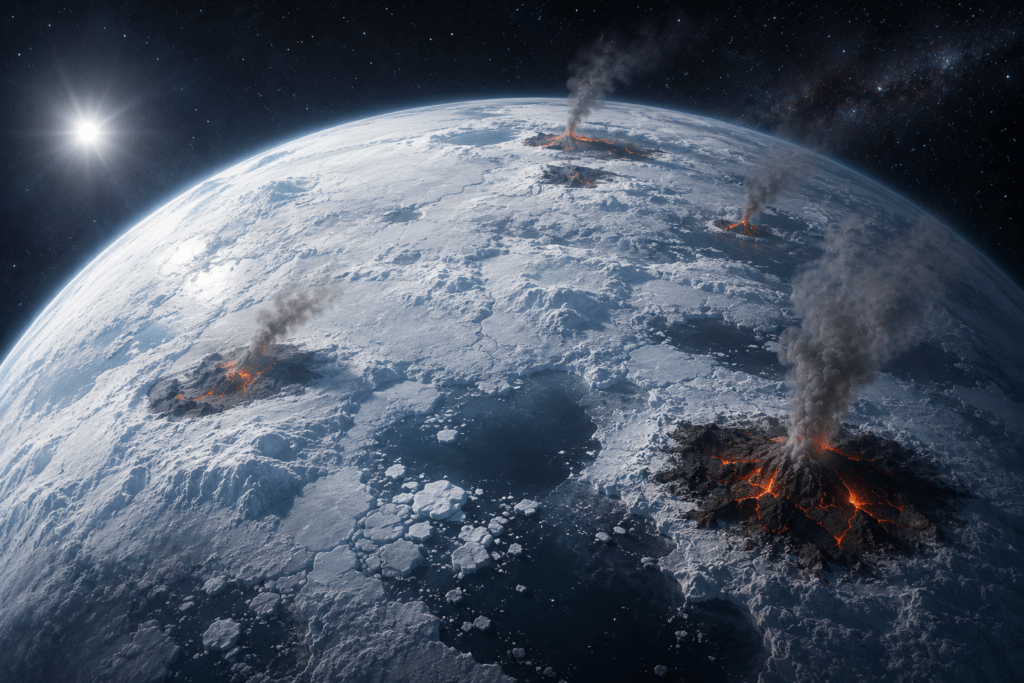
Scientists studying the carbon cycle during this time period have modeled a scenario where low CO₂ levels in the atmosphere, combined with a sun that was about 30% dimmer than today (NASA Astrobiology), could have actually produced very cold surface conditions. One peer-reviewed model calculated a roughly 70% probability that surface temperatures fell below 0°C around 4.3 billion years ago cold enough, potentially, for widespread ice.
Some scientists even call this a “Hadean Snowball Earth” scenario where much of the planet may have been covered in ice between major impact events.
So what was Earth like in the Hadean era, really? Think of it less like a permanent volcano movie and more like a wild, billion-year rollercoaster: magma ocean → cooling and water → ice phases → asteroid impacts → heating again → repeat. The Hadean era was chaotic in every direction.
What Proof Do We Have About What Earth Was Like in the Hadean Era?
Almost nothing from the Hadean era physically survives. Plate tectonics, erosion, and the Late Heavy Bombardment destroyed nearly all the original rocks.
What scientists do have:
- Jack Hills zircon crystals — The oldest dated zircon is 4.404 billion years old from Western Australia. Over 100,000 microscopic zircons from the site have been studied, ranging from 3 billion to nearly 4.4 billion years old (Live Science).
- Acasta Gneiss — The oldest intact rock formation on Earth, at 4.031 billion years old, found in Canada’s Slave Craton.
- Nuvvuagittuq greenstone belt — Volcanic deposits in Quebec, Canada, estimated at 4.28 billion years old (Britannica).
- Lunar samples — Apollo astronauts brought back moon rocks that carry records of the same bombardment events Earth experienced, since the Moon can’t recycle its crust the way Earth does.
- Meteorites — Fragments of the original solar system material that formed Earth, preserved as they fell to Earth.
Each piece of evidence is like a tiny puzzle piece from a 4.4-billion-year-old jigsaw and scientists are still fitting them together. What emerges is the best picture we have of what Earth was like in the Hadean era.
What Happened When the Hadean Era Ended?
The Hadean era didn’t end with a dramatic event you could point to on a calendar. It transitioned, slowly, into the Archean eon around 4.0 billion years ago. That transition was marked by:
- Decreasing asteroid impacts, making the surface more stable
- The formation of Earth’s first long-lasting solid crust
- The beginning of a recognizable rock record
- Conditions becoming gradually more suitable for life
The first well-preserved fossil evidence stromatolites appears about 3.5 billion years ago, in the Archean (LibreTexts Geosciences). Life, if it existed in the Hadean era, finally had a stable enough world to leave its mark.
Frequently Asked Questions: What Was Earth Like in the Hadean Era?
What was Earth like in the Hadean era overall?
Earth in the Hadean era was largely unrecognizable its surface was partly molten, its sky was toxic and oxygen-free, it was bombarded constantly by space rocks, and its mantle ran about 300°C hotter than today (ScienceDirect). It lasted from roughly 4.6 to 4.0 billion years ago (Britannica).
Was there water on Earth during the Hadean era?
Yes, likely. Zircon crystals from Australia suggest liquid water existed as early as 4.4 billion years ago, meaning oceans may have appeared within about 150 million years of Earth forming . Those early oceans may have been shallow, hot, and under enormous atmospheric pressure.
Could life have survived the Hadean era?
Possibly. A CU Boulder study found that even during the violent Late Heavy Bombardment at 3.9 billion years ago, subterranean microbes at 175–230°F could have survived and may have been boosted by the heat (CU Boulder). Whether life actually existed then remains unconfirmed.
Why is the Hadean era called “Hadean”?
The name comes from Hades, the Greek god of the underworld, coined in 1972 by geologist Preston Cloud to reflect the hellish surface conditions of early Earth. Some scientists argue the name is misleading, since the era may have included cold, icy phases too.
How long did the Hadean era last?
The Hadean era lasted roughly 600 million years from Earth’s formation at about 4.6 billion years ago to approximately 4.0 billion years ago, when the Archean eon began and the first lasting rocks appeared.
Final Thoughts: Why the Hadean Era Still Matters Today
Understanding what Earth was like in the Hadean era isn’t just a science trivia exercise. It’s a window into how planets become livable and what conditions life actually needs to survive.
The Hadean era shows us that even extreme, brutal beginnings can lead to something extraordinary. Out of the magma, the toxic air, and the relentless meteor rain, Earth built its core, grew its oceans, formed its Moon, and may have quietly started the first sparks of life. All before any dinosaur, any fish, any cell you’d recognize ever existed.
That’s a pretty remarkable origin story. And it’s yours.
